
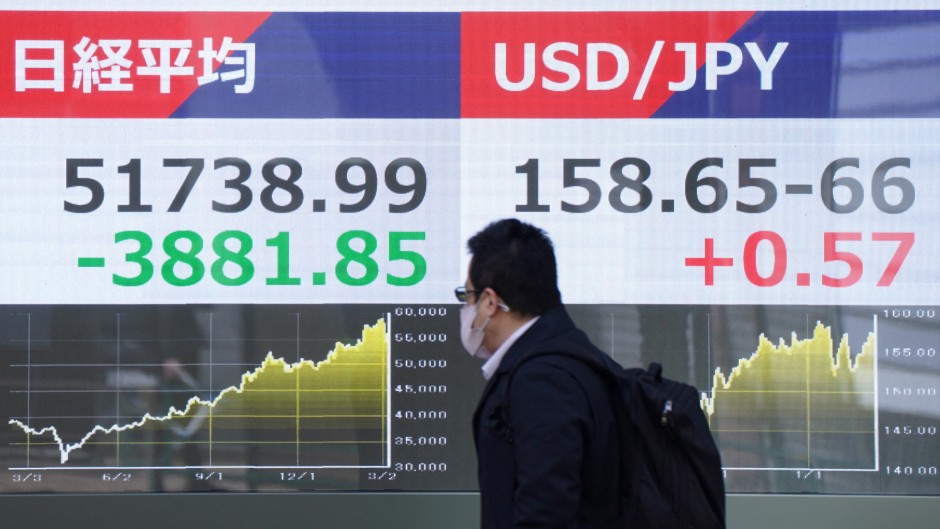
HONG KONG - Asian stock markets plunged on Monday as oil prices soared 30 percent on fears about supplies from the Middle East as the US-Israeli war against Iran continued into a second week with no sign of letting up.
Investors, already spooked by concerns over extended tech valuations and the huge spending on AI, ran for the hills as crude rocketed to its highest level since the Russian invasion of Ukraine in 2022.
Fears grew that the Middle East conflict could last for some time after US President Donald Trump said only the "unconditional surrender" of Iran would end the war.
He added at the weekend that the spike in prices was a "small price to pay" to eliminate Iran's nuclear threat, reiterating the White House's insistence that the rise is temporary.
Both main contracts, which had surged more than a quarter last week, spiked as Iran carried out retaliatory strikes against crude-producing Gulf nations.
West Texas Intermediate, the main US oil benchmark, jumped as much as 30 percent to hit a high of $118.88 per barrel, while Brent spiked 28 percent to as much as $118.73.
Since the beginning of the war, WTI is up more than 75 percent and Brent more than 60 percent.
Attacks on oilfields were reported in southern Iraq and in the northern autonomous Kurdistan region, which forced a US-run oilfield to cease production, while the United Arab Emirates and Kuwait have started reducing output.
That came with maritime traffic in the Strait of Hormuz -- through which a fifth of global crude and gas passes -- halted since the war began on February 28.
The prospect of high energy prices for a sustained period has fanned fears of a fresh spike in inflation that could hit the global economy while preventing central banks from cutting interest rates to support growth.
With the prospect of the global economy taking a blow from the crisis, equity markets extended last week's losses.
Seoul, which had been the best performer this year thanks to a tech rally, tumbled more than eight percent at one point, while Tokyo shed seven percent and Taipei fell more than five percent.
Hong Kong, Shanghai, Sydney, Singapore, Manila and Wellington were also sharply lower.