
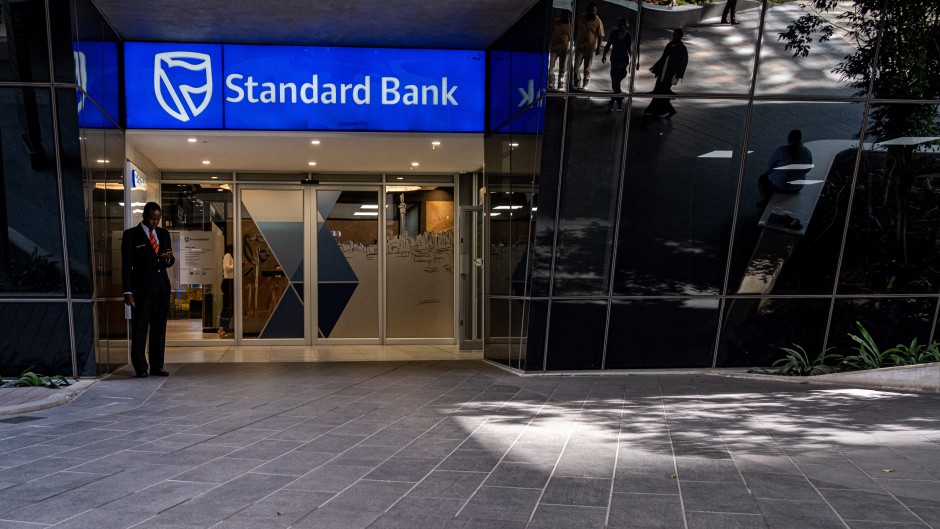
A general view of a Standard Bank branch in Sandton. AFP/Emmanuel Croset
JOHANNESBURG - Standard Bank Group CEO Sim Tshabalala, who heads up the B20 SA Finance and Infrastructure Task Force, has called for a critical review of global banking regulations that restrict lending into African economies.
Speaking recently on the topic of risk-weighted assets, Tshabalala argued that current frameworks, particularly those informed by Basel III standards, do not reflect the real risk environment in Africa and are unnecessarily limiting investment on the continent.
Overestimating risk, undermining growth
At the core of Tshabalala’s proposal is the idea that African projects are often treated as riskier than they are.
Under existing rules, banks are required to hold more capital against higher-risk assets.
However, the calculation of these risks is largely standardised and fails to consider the true, often lower, risk associated with many African investments.
“We are proposing that the rules which relate to risk-weighted assets need to be changed and made more aligned to the actual risk that you face in projects in Africa,” Tshabalala said.
By recalibrating these risk weights, banks could reduce the amount of capital they are required to set aside, thereby freeing up liquidity to fund more infrastructure, green energy, and development projects across the continent.
Development finance institutions deserve lower risk weights
Tshabalala also pointed to the treatment of multilateral and development finance institutions (DFIs) as another area ripe for reform.
DFIs, such as the African Development Bank or the World Bank, provide guarantees that significantly reduce the risk of default in the projects they support.
Yet, banks are still forced to assign relatively high-risk weights to these exposures.
“Reduce their risk weights because they are not that risky, and therefore we can hold less capital when we hold their guarantees,” he stated.
Adjusting these rules could make it more attractive for commercial banks to co-invest with DFIs, amplifying the impact of development finance and facilitating more blended finance structures.
Basel Rules: A poor fit for Africa
Tshabalala challenged the relevance of Basel III regulations in the African context.
Designed in response to the 2008 global financial crisis, the Basel framework was aimed at curbing excess leverage and poor risk management, issues that were prevalent in Western financial systems but largely absent in Africa.
“We did not suffer from any of those maladies in South Africa,” he noted, highlighting that South Africa had already tightened its own capital and liquidity regulations following earlier domestic crises.
As a result, Tshabalala argues, African banks are being penalised for problems they did not create. These rules constrain their ability to lend and, in turn, stifle economic development across the region.
Unlocking Africa’s potential
Reforming these risk-weighting rules, Tshabalala argues, “could unlock more lending and more banking activity in Africa, there's no question about it”.
Far from a call for deregulation, Tshabalala’s message is one of smarter regulation and tailored, context-aware frameworks that enable financial institutions to play a more active role in the continent’s development.
- by Melissa Tighy, eNCA Business Desk
South Africa is the current chair of the G20 and in November, will host leaders of the Group in Johannesburg. In the run-up to the meeting, this series aims to keep you informed and updated.