
Countries on Saturday elected Chile's COP climate summit chief negotiator to revive stalled talks on striking a landmark global treaty tackling the scourge of plastic pollution.
"Plastic pollution is a planetary problem that affects everyone: every country, every community and every individual," career diplomat Julio Cordano warned after being elected.
"If we don't take concerted action, it will get much worse in the coming decades. A treaty is urgently needed."
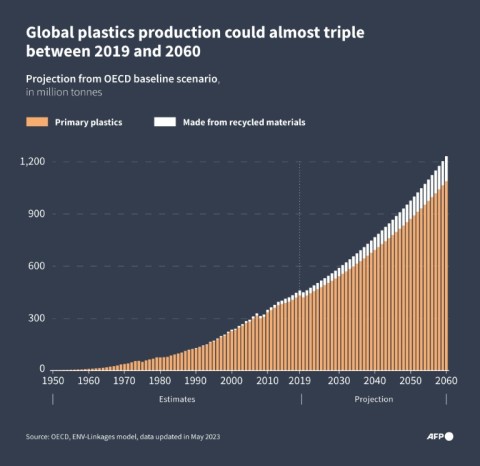
More than 400 million tonnes of plastic are produced globally each year, with half for single-use items.
The plastic pollution problem is so ubiquitous that microplastics have been found on the highest mountain peaks and in the oceans' deepest trench.
Talks in South Korea in 2024 ended without a deal and a resumed effort in Geneva last August likewise collapsed in overtime.
Talks chair Luis Vayas Valdivieso then quit in October.
The process has been seeking consensus, which has proved impossible to find, with tiny island states drowning in foreign marine plastic and oil-producing countries pulling in opposite directions.
A large bloc of states wants bold action such as curbing plastic production, while the smaller clutch of oil-producing states wants to focus more narrowly on waste management.
Cordano said the talks needed a rejigged and more efficient way of working, calling for "flexibility and pragmatism".
- Finding the game-changer -
Some 156 countries met in Geneva on Saturday to pick a new chair from three candidates, with the process underlining how far apart the different groups remain.
Oil-producing nations like Kuwait, Iran and Russia asked for more time for diplomats to find a consensus candidate, but others charged that they were merely trying to run down the clock.
After hours of fruitless negotiations, a vote was ultimately called, with Cordano coming through two rounds, defeating candidates from Senegal and Pakistan.
Several NGOs think carrying on seeking consensus is pointless and will produce the same outcome as Busan 2024 and Geneva 2025 but were somewhat encouraged by Saturday's outcome.
"The game-changer is voting," Laurianne Trimoulla, spokeswoman for Gallifrey Foundation, told AFP.
The oil-producing states "delay or undermine: everything is done for the treaty not to progress," she said.
- 'It's time to work' -
Bjorn Beeler, executive director at IPEN, a global network aimed at limiting toxic chemicals, said: "The plastics treaty has escaped the consensus trap.
"Voting has finally enabled a breakthrough and breakout from the past's pitfalls," he told AFP.
"The road ahead is now open to tackle the global plastics crisis poisoning our planet and our bodies."
No date was set for a third round of talks aimed at sealing the deal.
Panamanian delegate Kirving Lanas Ramos told AFP: "Now it's time to work. It's very important to start as soon as possible, but with new approaches or new strategies to finally get into more constructive and productive discussions."
Henri Bourgeois-Costa, from the Tara Ocean Foundation, said there was "a tiny bit of success", as the vote confirmed the number of countries "fighting against the treaty is actually very, very, very small".
By Robin Millard