
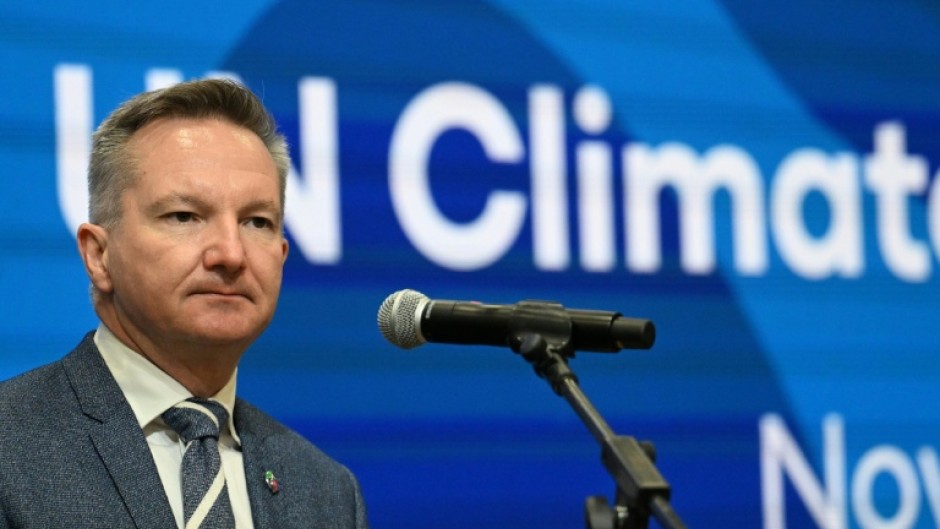
ANTALYA - COP31 co-host Australia unveiled the first draft of a broad political deal Monday, setting out sharply divergent positions on climate policy while calling for a faster phase-out of fossil fuels.
The sweeping, 18-page proposal underscores the gulf that nearly 200 nations must bridge to reach consensus before global climate talks in Turkey wrap up Friday.
The draft tackles the future of fossil fuels, the role of climate science, and the impending breach of the 1.5C climate target -- all major fault lines in the negotiations.
"It won't be the final draft," Australia's Climate Minister Chris Bowen, who is overseeing the marathon negotiations in Antalya, told reporters.
"There are elements in this draft that not all parties will agree on. That is a given."
Negotiators immediately retreated to closed-door meetings to digest the proposals.
"There's a lot in it... it's a process that will take time," a negotiator from a European Union country told AFP after leaving one such meeting.
The draft "cover decision" is an overarching political statement designed to sum up what countries agreed and set the course for future climate action.
Its call for "accelerated action to phase out fossil fuels" could encounter strong resistance, with language aimed at curbing coal, oil and gas -- the main drivers of global warming -- highly contested at UN climate talks.
Many countries have pressed for strong language on fossil fuels in Antalya after last year's summit in Brazil ended without any explicit mention of them at all in its final agreement.
"We will need to find some kind of balance," Belgian Climate Minister Jean-Luc Crucke told AFP, acknowledging that some oil and gas-producing nations held "reservations" over the proposals about energy.
'See what flies'
The draft also calls for rich nations to provide at least $120 billion for adaptation measures, a key demand of developing countries on the frontlines of climate change.
"We are positive about it but unfortunately there is no agreement yet and we continue to push for it," Raju Pandit, a climate negotiator from Nepal, told AFP.
This goes to the heart of long-running tensions over the responsibility of wealthy countries most responsible for greenhouse gas emissions to assist poorer nations bearing the brunt of global warming.
Countries are also asked to contribute to a global goal to raise electricity's share of final energy demand to 35 percent by 2035 -- a centrepiece initiative of COP31 host Turkey.
Among the draft's more striking positions is a call for wealthy nations to "achieve net zero emissions by 2030" -- a target few could hope to realistically meet.
"They definitely decided to put out a very expansive first text," veteran COP observer and policy analyst at the E3G think tank Alden Meyer told AFP.
"They're sort of going to see what flies and see what the reaction is."
Low expectations
The draft evokes "deep concern" over the impending breach of the Paris accord's 1.5C target and "resolves" to return global warming to below this threshold "as early as possible this century".
Nations have disagreed at COP31 over how to respond to the 1.5C overshoot while a separate row has erupted over the role of science and the IPCC, the global authority on climate change.
Dozens of countries, including many European and low-lying island nations, are pushing for the IPCC's critical next reports to be published before nations review carbon-cutting efforts at COP33 in 2028.
But a smaller number of countries, most notably Saudi Arabia and India, want publication pushed back to 2029.
The draft recognised the "central role of the best-available science" and called for the IPCC reports to be available "in time" for the 2028 stocktake.
The summit unfolds against a difficult backdrop, with a conflict-driven energy crisis and soaring geopolitical tensions tempering expectations of a major outcome.
Wopke Hoekstra, the European Union's climate envoy, said expectations are low for this COP as the situation was "complex and we're encountering pushback internationally on climate action".
Bowen said negotiators would be concentrating on "those issues where people can find common ground".
- AFP