
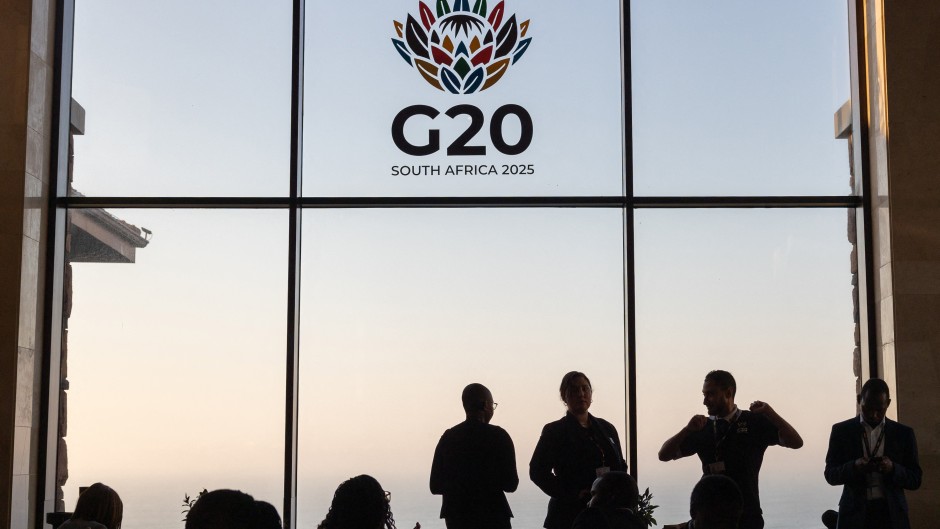
Delegates arrive ahead of the G20 Finance and Central Bank Deputies and Finance Ministers and Central Bank Governors’ Meetings, at the Capital hotel in Zimbali, Durban
In a complex global environment, South Africa’s G20 Presidency represents a beacon of hope in the advancement of partnerships and collaboration in driving solutions to global challenges.
Under the overarching theme of “Solidarity, Equality, and Sustainability”, South Africa’s G20 Presidency has underscored the importance,
of leaving no one behind in building a better world.
The Development Working Group (DWG) has emphasised this during the course of the year, bringing together G20 Development Ministers, invited states, and representatives of multilateral institutions,
the private sector and civil society, to strengthen cooperation on the path to achieve inclusive and sustainable development.
The DWG meetings and the Ministerial Meeting on Development which have taken place during South Africa’s G20 Presidency,
have been a necessary bridge for developed, developing, and low-income countries to address global challenges and mobilise collective action to accelerate development.
The meetings have emphasised the urgent need to build an inclusive world by strengthening domestic resource mobilisation, mobilising finance for development through reducing illicit financial flows,
advancing inclusive social protection systems and aligning development finance with the United Nations Sustainable Development Goals (SDGs).
The G20 DWG Ministerial Meeting was historic not only in its location, having taken place at Skukuza in the Kruger National Park, but also in its outcomes.
This meeting achieved landmark outcomes, adopting by consensus the following:
- The 2025 G20 Skukuza Development Ministerial Declaration
- A Call to Action on Universal Social Protection Systems and Social Protection Floors – which emphasises accelerating universal access to social protection and implementing nationally defined social protection floors,
to enable vulnerable communities access to healthcare, education, income security, food and nutrition. - A Call to Action on Combatting Illicit Financial Flows – which emphasises addressing this scourge which robs governments of critical resources for sustainable development.
South Africa’s G20 Presidency also released a Chair’s Statement which reflects on the optimal provision and financing of Global Public Goods,
including emerging principles for international cooperation and a proposal for the establishment of an Ubuntu Commission to take this work forward.
The work of the DWG during the course of South Africa’s G20 Presidency has been impactful and relevant.
Crucial multilateral platforms such as the Fourth International Conference on Financing for Development (FfD4) have deepened the focus on domestic resource mobilisation,
reducing illicit financial flows (IFFs), and social protection as part of the renewed global financing for development framework.
The voice of the Global South and the African continent, which has echoed through South Africa’s G20 Presidency, is playing a central role in the conversations of global development priorities,
and addressing the inequalities and gaps which hinder the capacity of developing and low-income countries and efforts to build an inclusive society.
Moving forward, the DWG and the Ministerial Meeting on Development have laid an important foundation on collective action which is substantive and responsive to the needs of the people, especially those in developing and low-income countries.
We have ensured that the world’s wealthiest countries, developing and low-income countries and all partners engage together,
to implement measures which address inequalities and lay the foundations for the implementation of much needed reforms to achieve sustainable and inclusive development.
As we continue to advance solidarity, equality and sustainability in building a better world, the DWG has underscored not only the unified commitment to accelerate progress in achieving the SDGs,
but the important role of multilateralism in addressing the world’s complex challenges.
The 2025 G20 Skukuza Ministerial Declaration and Calls to Action are a clear message of the continued commitment to partnership and collective action in accelerating development,
and leaving no one behind in building a better world.
Maropene Ramokgopa is the Minister in the Presidency for Planning, Monitoring and Evaluation.