
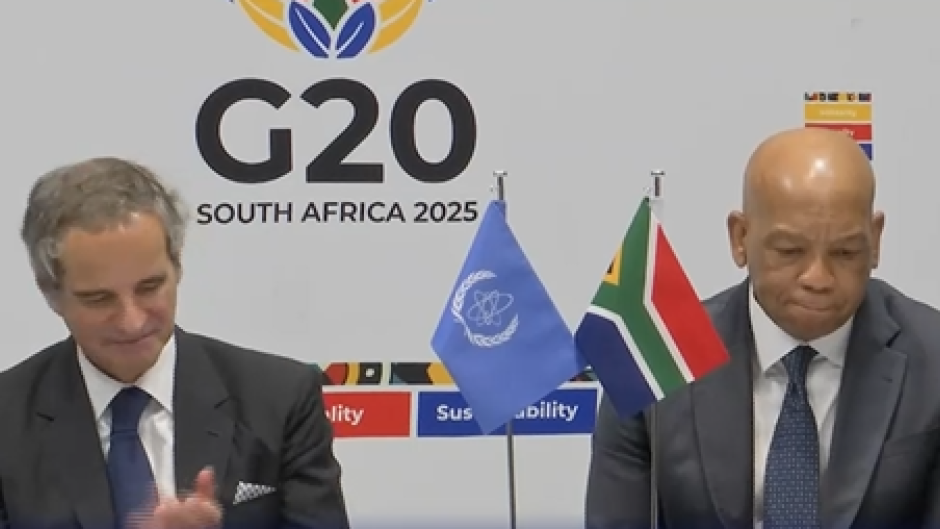

JOHANNESBURG - South Africa says preparations for the historic G20 Leaders’ Summit are firmly on track, with 42 countries confirmed to participate in the high-stakes gathering that begins in Johannesburg this weekend.
Addressing the media at Nasrec, Minister of International Relations and Cooperation Ronald Lamola confirmed that twenty G20 member states (excluding the United States), sixteen guest countries, and six regional blocs from Africa, the Caribbean and East Asia will attend at various levels.
Last week, President Donald Trump announced a US boycott, citing debunked claims that white Afrikaners are being “killed and slaughtered.”
READ | Trump Boycotts SA’s G20 Summit Over ‘Afrikaner Killings’ Claim
The Summit, the first G20 Leaders’ Summit ever hosted in Africa, will take place from 22 to 23 November at the Nasrec precinct.
Lamola said South Africa was ready to welcome world leaders as the country enters the final phase of its G20 Presidency. “Of the 133 official G20 meetings, 130 have already taken place, with the 4th Sherpa Meeting, Social Summit, and Leader’s Summit set to conclude this transformative journey.”
The SA Presidency has centred on four major priorities: improving disaster resilience, securing debt sustainability for low-income countries, mobilising finance for a just energy transition, and using critical minerals to drive inclusive and sustainable growth. Lamola said three dedicated Task Forces were also established to support this agenda.
Outlining the programme, Lamola said the Summit agenda will centre on three major sessions: inclusive and sustainable economic growth, building a resilient world, and a fair and just future for all.
Topics will include financing for development, disaster risk reduction, climate change, food systems, critical minerals, decent work and artificial intelligence.
Leaders are also expected to consider key documents commissioned by South Africa. These include findings from the Africa Expert Panel, the Extraordinary Committee of Independent Experts on Global Wealth Inequality, and the G20@20 Review.
A key recommendation from the Committee is to create a permanent international panel on inequality, modelled on the Intergovernmental Panel on Climate Change (IPCC).
The G20@20 Review is a high-level assessment of the forum’s first two decades aimed at determining whether it remains fit for purpose and how it can better coordinate global crisis responses in future.
Side Events
Lamola said high-level side events will take place across Johannesburg. These include the IBSA Leaders’ Meeting, an annual summit where the leaders of India, Brazil and South Africa convene to address global issues, advance South-South cooperation and deepen trilateral collaboration.
The Global Fund’s Eighth Replenishment (a summit aimed at accelerating the fight to end AIDS, TB and malaria while strengthening resilient and sustainable health systems), a Renewable Energy Pledging event, a Disaster Risk Reduction meeting, an engagement with African Heads of State, and a special SA-EU Summit will also be held.
Preparations were also underway for the G20 Social Summit, running from 18 to 20 November. Lamola said the event will bring together 5 000 delegates at the Birchwood Hotel in Ekurhuleni.
Of these, 4 050 participants will come from civil society and engagement groups, he confirmed. Representatives aim to discuss global challenges and ensure ordinary voices are heard at the main G20 Leaders’ Summit.
South Africa’s G20 momentum
Lamola highlighted several milestones achieved during South Africa’s Presidency, including the G20 High-Level Dialogue on Debt Sustainability in Addis Ababa, the work of the Africa Expert Panel chaired by former finance minister Trevor Manuel, and outreach meetings on food security and industrialisation in Cairo and Abuja.
The Minister said the Presidency had also pushed for reforms to global financial architecture, advanced the interests of the Global South, and secured progress on illicit financial flows and Africa-centred energy efficiency initiatives.
As the Summit approaches, Lamola said South Africa remains confident that leaders will reach consensus on the South African Declaration, now in the final stages of negotiation.
“When South Africa assumed the G20 Chairship last year, the world was navigating a precarious geopolitical climate… South Africa’s G20 Presidency has not only elevated African voices it has galvanised global momentum toward a more inclusive, equitable, and sustainable future.
“It is our firm belief that the outcomes of the South African Summit will be ambitious and leave a lasting legacy for the cause of the African continent and the Global South beyond South Africa’s historic G20 Presidency,” said Lamola.