
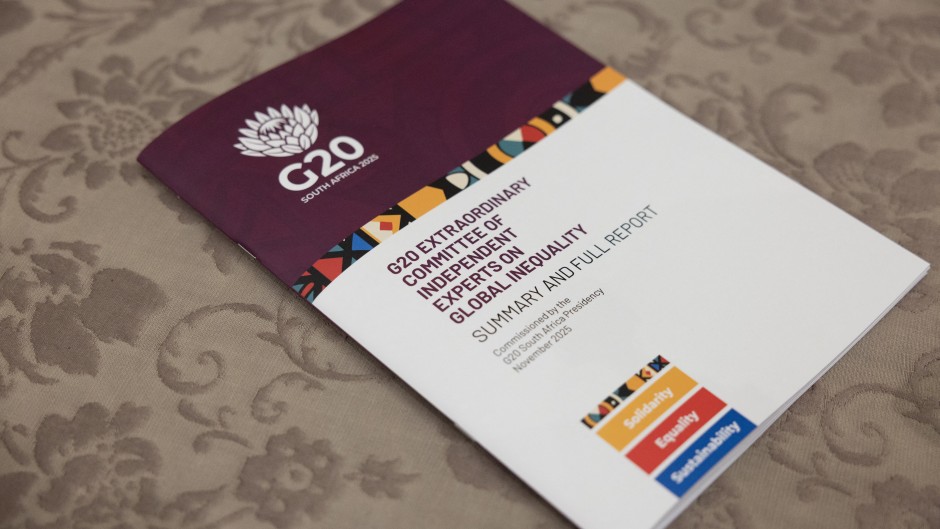
A general view of the G20 Inequality Committee's Report on global inequalities after it was handed over to South Africa's President Cyril Ramaphosa by US economist and recipient of the Nobel Prize in Economic Sciences Joseph Stiglitz, at Tuynhuys in Cape Town on November 4, 2025.
JOHANNESBURG - The rich are getting richer, and the poor are finding it almost impossible to change their circumstances.
That is, in a nutshell, the findings of the first G20 report on inequality. Released this week, it recognises the trends that are keeping the rich and poor in their vastly disparate camps as an “inequality emergency”.
The Extraordinary Committee of Independent Experts on Global Wealth Inequality, which produced the report, was commissioned by current G20 president, South Africa. Ironically, the country is one of the most unequal in the world.
The committee is led by Nobel laureate Joseph Stiglitz. Its headline finding is that, between 2020 and 2024,
the top 1% in terms of wealth held 41% of all new wealth while the bottom 50% of humanity held only 1%.
Unless you believe that half the world is lazy or incapable, this means the idea that capitalism is creating “equal opportunity” is a myth. The rich simply have more opportunities and more ways to add to their wealth.
The information is not especially new, and there’s been a lot of research in the last decade which Stiglitz says allowed them to put the report together in record time.
The fact that this is the first report of its kind, however, and the fact that the committee has been invited to the G20 Leaders’ Summit at the end of the month in Johannesburg, puts the issue high on the G20 agenda.
Stiglitz encourages one to wonder: What if people don’t have to be obscenely rich or dirt poor?
He suggests that the disparities between the rich and the poor aren’t inevitable or natural, but the outcome of human choices.
His team of experts advocates for more restraint on capitalism to ensure some upward mobility.
These include minimum wages and unions to fight for workers; measures to ensure that the rich can’t avoid taxation that goes toward social services; and measures to ensure that sectors don’t become so concentrated that no new players can get in.
Stiglitz says the committee felt strongly that some of the worst effects of inequality are on democracy. When people realise that they have a vote but it’s doing nothing to change their life circumstances, they lose faith in the system. It partly explains the rise of “strong men” that have emerged in democratic countries in recent years.
Stiglitz agrees with South Africa that the inequality highlighted during the Covid-19 pandemic was a form of health apartheid.
Essentially, people in Africa and other poorer parts of the world were denied access to vaccines so that rich countries could stockpile for their own populations, or pharmaceutical companies could maximise their profits.
Of course, there are deeper debates about intellectual property and incentives but most of the world seems to agree there’s something wrong with the system. Health inequality, justice inequality and gender imbalances all fall under the banner of the inequality the committee is looking at.
The burning question is what might the report change in South Africa, one of the most unequal countries in the world? The stubborn inequality here is linked to apartheid but, despite many of the ideas that Stiglitz advocates for already being in place, it’s something the democratic government has been unable to address.
South African labour laws are strong (too strong, some would argue) and the rights of unions to strike are fiercely protected. South Africa has a progressive taxation system and high tax rates at the top, as well as a substantial safety net in terms of one of the biggest social grant programmes in the world.
It also has a Competition Commission which has, at times, been accused of doing its job too rigorously. South Africa’s government has put conditions in place for foreign investment to uplift previously disadvantaged South Africans and local suppliers. There is a fact a stack of measures in place to supress inequality, but very few are working.
The main problem – as highlighted by the Madlanga Commission and the parliamentary ad-hoc committee investigation police corruption – is leakages along the way. The tax money that comes in is not always used as intended, and South Africans have become used to the eyewatering figures lost to state capture and other corruption.
The money that’s meant to even the score often lands up in the pockets of politicians. At the same time, the economy is not growing enough to offer enough people careers and a way to grow their wealth and, in fact, many of the measures South Africa has taken have proven to be disincentives to invest.
The extraordinary committee has recommended that a global panel be introduced to look at the situation regarding inequality, its drivers and solutions, on an ongoing basis. If this happens, it will be something of a coup for South Africa’s G20 presidency. But instead of trying to implement the policy choices that South Africa’s own report recommends, the country needs to do the harder work of making the state effective and ethical.
It has to find politicians who don’t want to become rich, but care about the poor.
- Francis Herd is an eNCA business reporter.