
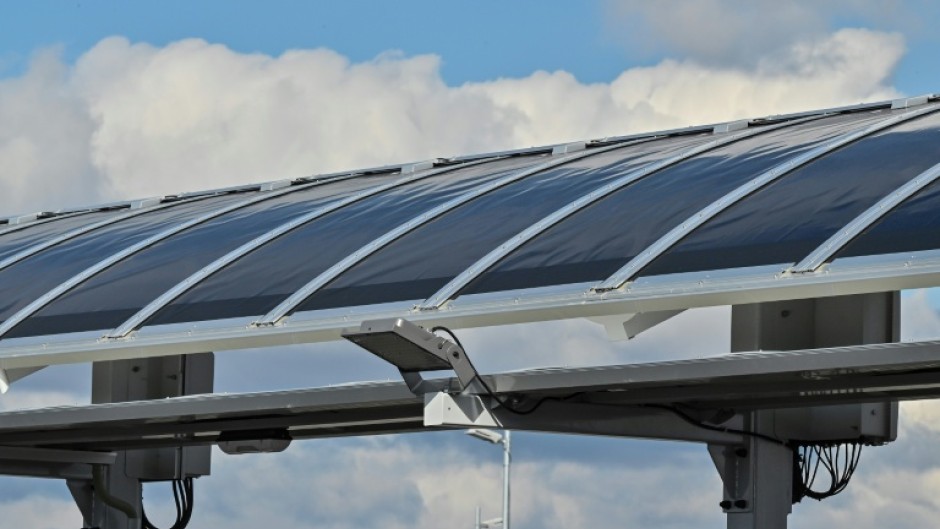
TOKYO - Japan is heavily investing in a new kind of ultra-thin, flexible solar panel that it hopes will help it meet renewable energy goals while challenging China's dominance of the sector.
Pliable perovskite panels are perfect for mountainous Japan, with its shortage of flat plots for traditional solar farms. And a key component of the panels is iodine, something Japan produces more of than any country but Chile.
The push faces some obstacles: perovskite panels contain toxic lead, and, for now, produce less power and have shorter lifespans than their silicon counterparts.
Still, with a goal of net-zero by 2050 and a desire to break China's solar supremacy, perovskite cells are "our best card to achieve both decarbonisation and industrial competitiveness," minister of industry Yoji Muto said in November.
"We need to succeed in their implementation in society at all costs," he said.
The government is offering generous incentives to get industry on board, including a 157-billion-yen ($1-billion) subsidy to plastic maker Sekisui Chemical for a factory to produce enough perovskite solar panels to generate 100 megawatts by 2027, enough to power 30,000 households.
By 2040, Japan wants to install enough perovskite panels to generate 20 gigawatts of electricity, equivalent to adding about 20 nuclear reactors.
That should help Japan's target to have renewable energy cover up to 50 percent of electricity demand by 2040.
The nation is looking to solar power, including perovskite and silicon-based solar cells, to cover up to 29 percent of all electricity demand by that time, a sharp rise from 9.8 percent in 2023.
"To increase the amount of renewable energy and achieve carbon neutrality, I think we will have to mobilise all the technologies available," said Hiroshi Segawa, a specialist in next-generation solar technology at the University of Tokyo.