
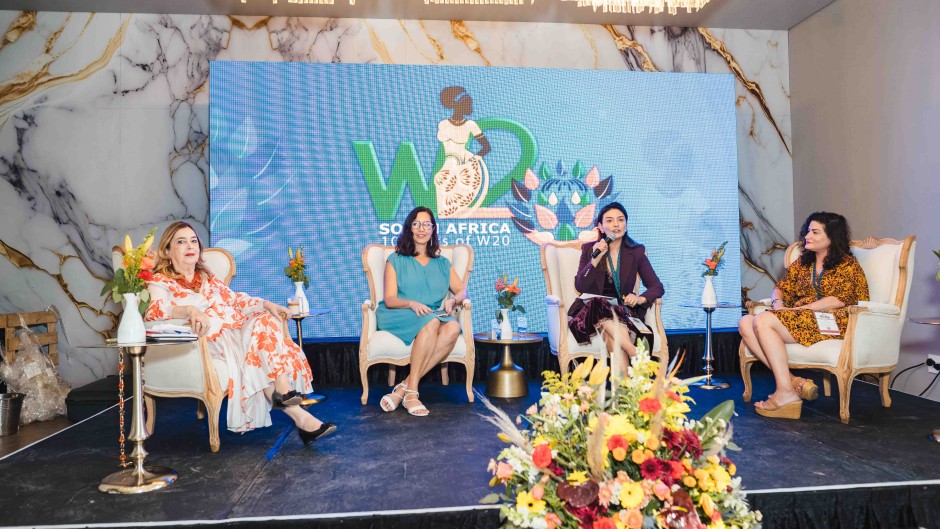
JOHANNESBURG - This year marks ten years since the inception of the G20's Women20 (W20) in Istanbul, Turkey in 2015.
The W20 is one of the official engagement groups of the G20 led by members of civil society from all 20 countries advocating for gender equity. Each year since 2015, the group has gathered on the sidelines of the G20 meetings to work together and draft policy recommendations for global leaders to hopefully adopt into their final declarations, with the ultimate goal of transforming these into actual policies on the ground.
In the last decade 220 recommendations were submitted to the G20 leaders for their consideration. Following an in-depth analysis commissioned by South Africa's W20 leadership, and using World Bank data, the Harvard Kennedy School Women's Alumni Network (HKSWAN), a US-based nonprofit working to amplify, connect and support women from HKS and a knowledge partner of the W20 this year, determined that 74 of those or 33.6% were adopted into their leaders' commitments document.
This is the first time the W20 has evaluated its impact since it began, and it matters: it demonstrates that civil society advocacy is driving reform within the G20 countries, with spillover effects on other global economies, while allowing delegates to identify areas of progress and persistent gaps.
We face a paradox today: evidence documenting gender inequality’s costs has never been more comprehensive, yet progress remains alarmingly slow. The W20 was created precisely to bridge this gap—transforming advocacy into concrete policies that drive change.
HKSWAN analysis captures the W20's journey during a complex decade. The organisation began with a focus on fundamental economic issues, but global crises demanded evolution. When COVID-19 exposed care workers’ invisibility, the W20 responded. When digital transformation threatened to leave women behind, it adapted. This isn’t just policy evolution—its survival strategy, demonstrating the W20's capacity for strategic adaptation while maintaining its core economic empowerment focus.
Over the decade, the W20 aligned with the broader international community on global challenges, bringing them to G20 leaders’ attention—from supporting the 25x25 initiative to reduce the gender employment gap by 25%, to Saudi Arabia in 2020 prioritising healthcare access during the pandemic, to India’s 2023 presidency linking gender equality with climate action.
The good news: the number of gender-related commitments by G20 leaders has increased tenfold, from just five in 2016 to substantially higher levels in recent years. Gender equality is being taken more seriously as a core policy issue.
The concerning news: not all commitments are created equal. HKSWAN’s analysis identified specific action-oriented language—“we commit to,” “we will,” “we endorse”—to distinguish substantive pledges from vague references. Commitments with this strong language are classified as “A-Level,” representing the highest quality institutional pledge.
The data reveals a critical temporal pattern. Until 2020, the W20 experienced a “golden era”: not only did commitment numbers rise, but the proportion of high-quality A-Level commitments also increased, peaking at 80%. Post-2020, however, that quality declined sharply. While gender remains on the G20 agenda, the ambition and concrete nature of promises have waned—likely reflecting the pandemic’s impact and growing political backlash. This assumption aligns with an analysis done by UN Women documenting similar global trends.
Where has the W20 succeeded? Parenthood policies stand out: ten countries implemented 15 reforms, including paid parental leave. This shows a clear translation from commitment to action.
Where has it failed? Assets. Zero reforms. This category—encompassing gender equality in property and asset ownership, fundamental to women’s economic independence—represents the largest implementation gap. The takeaway is stark: we are failing to address complex structural barriers related to women’s ownership and control of capital. Incremental reforms like parental leave prove politically feasible; fundamental economic restructuring for asset equality does not.
HKSWAN’s evaluation concludes with ten concrete recommendations, but three priorities stand out.
First, accountability over aspirations. Policy recommendations must incorporate binding implementation metrics for all G20 gender commitments. What gets measured gets done. Without robust monitoring, even high-quality commitments remain aspirational.
Second, integration over isolation. Gender equality cannot be siloed as a side issue. It must be integrated into every G20 workstream—climate, finance, trade, energy. Women are half the population; gender equity intersects with all major policy domains.
Third, implementation partnership over advocacy voice. The W20 has proven it can influence policymaking. The data supports repositioning from advocate to implementation partner for the G20. Building powerful South-South coalitions offers particular promise—countries like South Africa, with influential female leadership across public and private sectors, are already demonstrating how this works.
The W20’s first decade shows remarkable influence amid persistent challenges. But a 33.6% adoption rate, while meaningful, is insufficient. And adoption alone isn’t victory—implementation is where equality becomes real.
The divergence between commitment growth and quality decline demands strategic refocusing on enforceability over proliferation. The implementation gap in asset ownership reveals where advocacy must intensify. The parenthood policy successes prove reform is achievable when political will aligns with civil society pressure.
Without acceleration, achieving full gender equality could take close to 300 years, according to UN Women’s analysis of progress toward Sustainable Development Goal 5. The W20’s first decade proves that collective action, strategic adaptation, and accountability mechanisms can compress this timeline dramatically. The challenge for the next decade is transforming demonstrated influence into sustained implementation across all dimensions of gender equity.
- Tatiana Der Avedissian is a communications and sustainability expert. She is head of business development for the World Ocean Initiative at The Economist Group and leads her own consultancy. She is co-president of the Harvard Kennedy School Women's Alumni Network.
- Farah Arabe is the Founder of itotheN | Intergenerational Impact, a international development consulting firm focused on early relationships as engine for global change. She also serves as UN Representative for Make Mothers Matter and sits on the board of several non-profits. She is Co-President of the Harvard Kennedy School Women’s Alumni Network.
- Meriem Boudjadja is a gender equity expert advancing women’s economic empowerment and leadership worldwide. She advises the World Bank, the United Nations, and other multilateral institutions on gender mainstreaming and inclusion, contributing to the World Bank’s 2024–2030 Gender Strategy. Meriem recently published a new book ’Humble Dreams’ and is a key contributor to ADWIN. Meriem is a member of the Harvard Kennedy School Women's Alumni Network.