
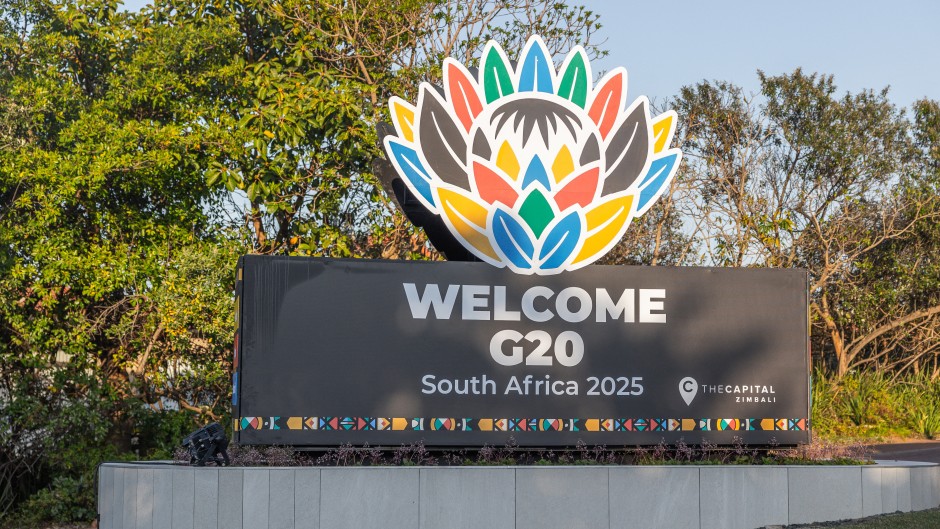
A general view of a sign welcoming delegates at the entrance of the G20 Finance and Central Bank Deputies and Finance Ministers and Central Bank Governors’ Meetings, at the Capital hotel in Zimbali, Durban
JOHANNESBURG - Women20 (W20), established in 2015 as an official G20 engagement group, serves as a strategic platform to advance women’s economic empowerment.
Comprising 19 nations, the EU and the African Union, W20 convenes women’s rights organisations, entrepreneurs and experts to craft consensus-driven policy recommendations for G20 leaders.
Over the past decade, W20 has evolved from an advisory body into a transformative force, embedding gender equality into the heart of global economic governance.
Under South Africa’s 2025 G20 presidency, W20 operates with Ubuntu as its guiding value with the theme “Women in Solidarity towards Sustainable Socio-Economic Development”.
Its objectives include securing inclusion in the G20 Leaders’ Declaration, consolidating a decade of impact, amplifying Global South voices, and launching legacy projects for long-term change.
W20’s origins trace back to the 2014 Brisbane G20 summit, where leaders pledged to reduce the gender employment gap by 25% by 2025.
The inaugural W20 summit in Istanbul formalised its mandate to monitor gender commitments, challenge economic orthodoxy, and advocate for women’s representation.
Since then, W20 has influenced G20 declarations by promoting gender-responsive budgeting, board diversity, pay transparency, STEM education, and care economy investment.
In 2025, W20 urges decisive action across six strategic domains:
1. Entrepreneurship and financial inclusion: Achieving gender parity to yield a $5 trillion return on investment (WEF 2025). Key actions proposed by the W20 include legal reforms enabling access to finance for female entrepreneurs, and procurement targets for women-led businesses.
2. Care economy: Every $1 invested in paid and unpaid care economy returns $3.76 (ILO 2023). W20 recommends allocating 10% of national income to care systems, reducing unpaid care by 35%, and enforcing fair labour standards.
3. Education, STEM and digital inclusion: Closing the digital gender gap could boost global GDP by $5 trillion (GSMA 2025). Actions include funding digital literacy, mandating STEM scholarships, and launching a Global Index on AI & Gender Equality.
4. Climate justice, the environment and food security: Women’s leadership is vital for Net-Zero and Zero Hunger goals. W20 calls for 50% female participation in energy sectors, recalibrated climate finance, and securing land rights for carbon markets.
5. Health equity for women and girls: Investing in women’s health could yield up to $1 trillion annually. Priorities include gender-responsive health systems, sexual and reproductive health and rights access, and mental health integration.
6. Ending violence against women and girls: W20 advocates for survivor support, criminalising tech-facilitated GBV, crisis leadership, and ending modern slavery.
Under South Africa’s leadership, W20 has shifted from consultation to implementation, launching sector-specific task teams and evidence-based projects, particularly in climate resilience and tech access for rural women in South Africa, Argentina and Indonesia.
W20SA has amplified African perspectives, strengthened cross-sector partnerships, and served as a resource for the Women’s Economic Empowerment Working Group. It continues to integrate gender across all G20 tracks and proposes the W20 Johannesburg Goals: Reducing labour participation, wage and unpaid care gaps by 35% by 2035.
As W20 enters its second decade, it remains a blueprint for solidarity, equality and sustainable prosperity – transforming gender equity from a moral imperative into an economic one.
Prof Narnia Bohler-Muller is the Divisional Executive, Human Sciences Research Council. She is also the Head of Delegation, W20 South Africa.