
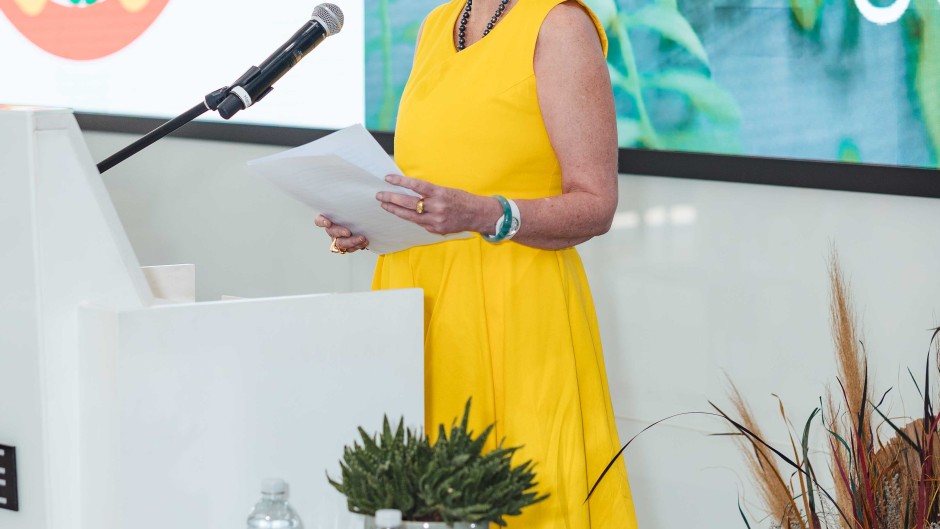

JOHANNESBURG - The W20 recently handed over their recommendations to Human Settlements Minister, Thembi Simelane at their W20 summit, and Prof. Narnia-Bohler delivered the following remarks.
This is not just another convening. It is a reckoning.
A decade of advocacy has brought us here, and the road ahead demands more than words—it demands will.
W20 South Africa rises at the intersection of history and hope, carrying the mandate of gender equality into the heart of global recovery.
Rooted in Ubuntu, we do not speak for women—we speak with them. We speak from the soil of shared struggle and the sky of shared possibility.
Our theme—Women in Solidarity towards Sustainable Socio-Economic Development—is not a slogan. It is a summons. A call to center dignity, mutuality, and collective responsibility in every policy, every partnership, and every promise.
The Journey of W20 South Africa
Today, we trace the journey of W20 South Africa—from its origins to this moment of purpose and promise. It is a story of collective insistence: that women’s economic empowerment must anchor global recovery and shape the moral architecture of our shared future.
Born as a G20 engagement group dedicated to gender equality, W20 was established to make the economic case for women’s inclusion and translate it into consensus-driven policy for G20 leaders.
Its long-term goal is to close the gender employment gap and embed women’s economic participation into the core of G20 priorities.
Over the past decade, W20 has evolved into a global convenor—bringing together entrepreneurs, civil society, academics, and policymakers to craft joint recommendations for the Leaders’ Declaration.
Theme and Defining Value
Under South Africa’s G20 Presidency, W20SA adopted the theme Women in Solidarity towards Sustainable Socio-Economic Development, aligned with the G20 pillars of Solidarity, Equality, and Sustainability.
Ubuntu is our compass—an ethical and political framework that centers dignity, mutuality, and shared responsibility.
W20SA grounds global policy in the lived realities of women across the Global South, amplifying southern and African voices while building bridges to partners in the North.
Milestones and Priorities
Marking a decade of W20 engagement, W20SA honours this milestone with a consolidated archive of recommendations. Our thematic priorities respond to both urgent and structural drivers of inequality:
- Entrepreneurship and financial inclusion
- The care economy
- Violence against women and girls
- Climate justice, environmental resilience, and food security
- Education, STEM, and the digital divide
- Health equity for women and girls
These are not just challenges—they are strategic levers for scaled, coordinated G20 action.
Achievements and Contributions
W20SA advances evidence-based, implementation-ready proposals shaped by the voices of women leaders and experts from the Global South.
Over ten years, W20 has helped mainstream gender in economic policy, proving that women’s participation is both a rights imperative and an economic multiplier.
W20SA builds on this legacy with three-year, recommendation-based projects designed for long-term impact across Africa and the Global South.
Challenges and the Road Ahead
The triple planetary crisis—climate change, pollution, and nature loss—deepens gendered vulnerabilities and demands integrated responses.
Violence against women remains a global emergency, undermining progress across every sector.
The care economy, though essential, remains undervalued and under-protected.
W20SA insists that care, climate resilience, digital inclusion, health equity, and access to land and finance be treated as interdependent pillars of a just recovery.
Deliverables and Legacy
W20SA seeks not only policy language but implementation.
Our priorities include embedding W20 recommendations in the Leaders’ Declaration and launching multi-year, partnership-driven projects that operationalize those commitments.
By documenting a decade of evidence-based proposals, we offer both an archive of progress and a roadmap for future presidencies.
Call to Solidarity
Solidarity is not symbolic. It demands investment, reform, and alignment—from governments, multilateral institutions, the private sector, and civil society.
Ubuntu reminds us: resilience and prosperity are collective goods. When women thrive, societies flourish. When women are excluded, communities falter.
Conclusion
Let this summit not be remembered for its declarations, but for its decisions. Let it not be measured by applause, but by alignment.
W20 South Africa does not seek symbolic solidarity—we seek structural change.
We call on governments, institutions, and partners to move from endorsement to action, from statements to systems. Because when women rise, the world does not tilt—it steadies.
When care is valued, economies grow. When violence is addressed, futures are protected. When inclusion is real, prosperity is shared.
This is our invitation: to turn policy into practice, to ritualize dignity in procedure, and to steward a future where economic justice for women is non-negotiable.
- This is a shortened version of a speech delivered by Professor Narnia Bohler-Muller at the W20. She is the Chair of the Women20 group.
She is also the divisional executive in the HSRC's Developmental, Capable and Ethical State research division and acting Group Executive: Shared Services (since April 2021).