
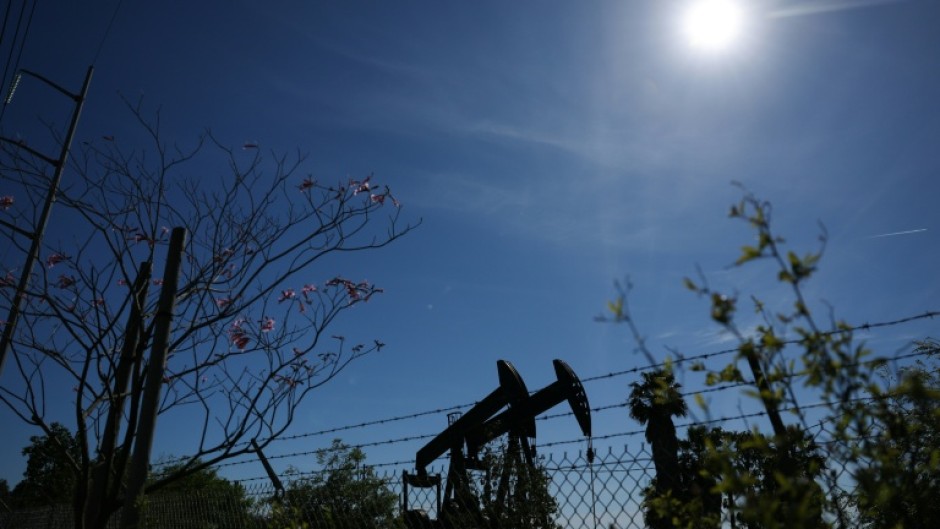
DOHA - Energy prices soared and stocks sank Thursday as Iran stepped up attacks on Gulf energy infrastructure, reigniting fears over global supplies and inflation as well as the likely damage to economic growth.
International benchmark Brent crude rose more than five percent to top $115 per barrel and US contract WTI rose 1.3 percent as Tehran targeted regional installations in retaliation for an Israeli strike on a site serving its massive South Pars field, which it shares with Qatar.
European gas prices also soared by more than a third on fears of the impact on energy supplies.
Repeated attacks on energy infrastructure in recent days have only deepened fears that the US and Israeli war on Iran launched on February 28 could morph into an energy war that will have painful and lasting consequences for the global economy.
Iranian missiles struck Qatar's Ras Laffan, the world's largest liquefied natural gas (LNG) hub, causing "extensive damage".
Drones struck a Saudi oil refinery on the Red Sea and caused fires at two others in Kuwait in the latest attacks.
"The prospect of a longer, more drawn-out conflict is in sharp focus, as both sides ratchet up attacks on energy infrastructure," said Susannah Streeter, chief investment strategist at Wealth Club.
"Downbeat sentiment is spreading fast... as investors assess the repercussions for the global economy," she added.
Kathleen Brooks, research director at XTB noted central banks, in prioritizing inflation risks had hitherto "not priced in the risks to growth. What happens to demand? The BOE does not seem to be prioritizing the risks to growth, which could be very damaging down the line."
Wall Street opened in gloomy mode albeit the Dow limited early losses to 0.6 percent standing at 45,965.66 points minutes into the session with the broader S&P 500 and tech-heavy Nasdaq suffering similar early falls.
Frankfurt, Paris and London all shed in the order of two-and-a-half percent in afternoon trading.
In Asia, Tokyo tanked more than three percent, while Hong Kong and Shanghai were also down.
Markets have been hammered since the start of the war, with Tehran hitting sites across the Gulf and effectively closing the Strait of Hormuz, through which a fifth of global oil and gas flows.
The surge in energy costs has fanned fears of a spike in inflation and the spectre of higher interest rates.
The Bank of England and the European Central Bank held interest rates on Thursday, after the US Federal Reserve also kept its borrowing costs unchanged.
Concerns were compounded Wednesday with data showing US wholesale inflation rose more than expected in February, before the war started and oil prices soared by more than 40 percent.
Federal Reserve Chair Jerome Powell said he expected higher energy costs to boost price rises in the near term but added that little was clear at this point.
The Bank of Japan held rates on Thursday and also warned it saw inflation spiking on the back of the crude surge. Sweden and Switzerland also kept their rates steady on Thursday.
That came after the Reserve Bank of Australia hiked its key rate Tuesday, pointing to "sharply higher fuel prices".
- Key figures at around 1350 GMT -
Brent North Sea Crude: UP 5.0 percent at $112.70 per barrel
West Texas Intermediate: UP 1.3 percent at $96.84 per barrel
New York - Dow: DOWN 0.6 percent at 45,965.66 points
New York - S&P 500: DOWN 0.6 percent at 6,583.12
New York - Nasdaq Composite: DOWN 0.8 percent at 21,970.43
London - FTSE 100: DOWN 2.6 percent at 10,038.49
Paris - CAC 40: DOWN 2.3 percent at 7,786.31
Frankfurt - DAX: DOWN 2.7 percent at 22,862.94
Tokyo - Nikkei 225: DOWN 3.4 percent at 53,372.53 (close)
Hong Kong - Hang Seng Index: DOWN 2.0 percent at 25,500.58 (close)
Shanghai - Composite: DOWN 1.4 percent at 4,006.55 (close)
Euro/dollar: UP at $1.1476 from $1.1451 on Wednesday
Pound/dollar: UP at $1.3302 from $1.3256
Dollar/yen: DOWN at 159.22 yen from 159.87 yen
Euro/pound: UP at 86.86 pence from 86.38 pence