
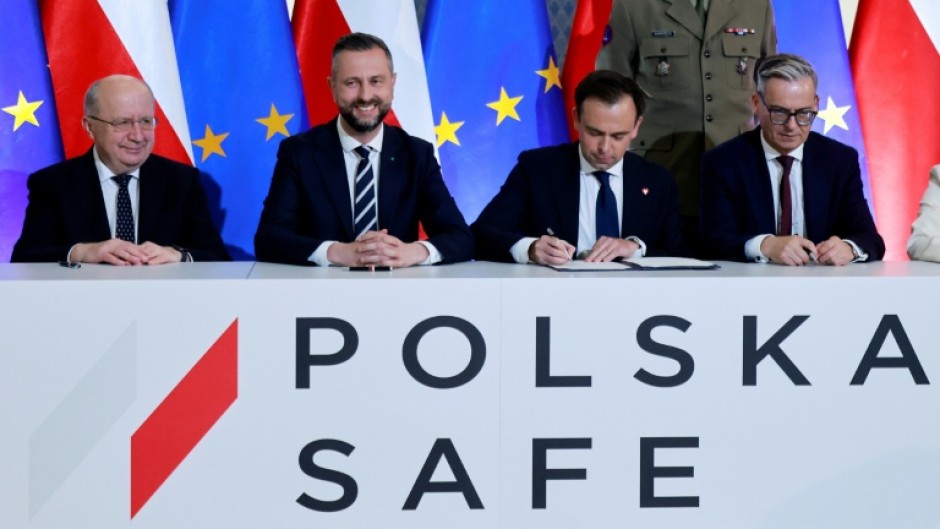
WARSAW - Poland on Friday became the first country to sign a loan agreement with the European Commission to fund the modernisation of its military and arms industry, under which it will receive nearly 44 billion euros ($52 billion).
"This is a watershed moment in the history of both Poland and the European Union," Prime Minister Donald Tusk said at a ceremony for the signing of the agreement.
"Poland will be safer in these difficult and highly risky times," he added.
The billions in funding will go to the most populated country on NATO's eastern flank, and the alliance's largest spender in relative terms, allocating 4.8 percent of its GDP to defence.
The Security Action For Europe (SAFE) scheme makes some 150 billion euros available in the form of preferential loans to finance joint projects in defence, the purchase of weapons or ammunition, and the development of critical infrastructure.
Poland, which is receiving 43.7 billion euros, is by far the greatest beneficiary of the programme, which was developed for European countries seeking to reinvigorate their defence industry to face the threat from Russia and risk of US disengagement.
"This is also the day when Europe ... is showing that it has learned a lesson from history and that it is ready ... to shoulder a much greater responsibility for our security," Tusk added.
The agreement was signed by the Polish finance and defence ministers, as well as EU budget commissioner Piotr Serafin and defence commissioner Andrius Kubilius.
As Poland borders Russia, Belarus, and Ukraine, it has been building part of the EU's and NATO's "eastern shield".
- Overcame opposition -
Friday's signing put an end to months of political debates in Warsaw pitting the pro-European government against the right-wing nationalist opposition and President Karol Nawrocki.
In March, Nawrocki vetoed a government measure allocating SAFE funds, leading Tusk's government to ensure SAFE funding made its way to Poland under more complex arrangements.
Hostile to Brussels, Nawrocki and the opposition argued that SAFE would alienate a key Polish ally in Washington by prioritising European arms purchases at the expense of US suppliers, and make Poland dependent on Germany and the EU.
Rather than back the SAFE proposal, Nawrocki insisted on his own alternative, "SAFE 0%", drawn up with right-wing ally central bank governor Adam Glapinski.
Described as a "sovereign" alternative to the European loans, the programme would instead use central bank funds. Tusk's government labelled the initiative "unrealistic" as the central bank faces financial losses.
- Article by AFP