
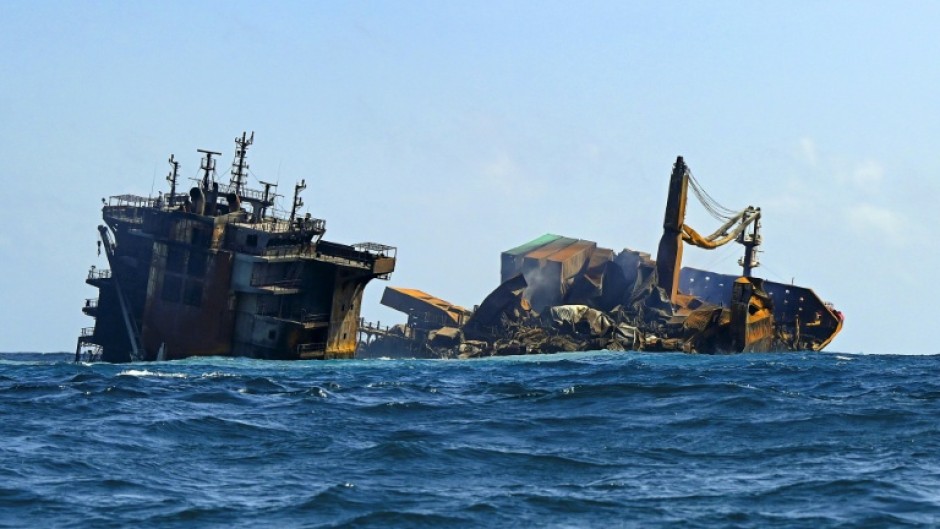
SINGAPORE - A Singapore shipping company told AFP on Tuesday it will refuse to pay Sri Lankan court-ordered damages of US$1-billion for causing that country's worst case of environmental pollution.
In an exclusive interview, X-Press Feeders chief executive Shmuel Yoskovitz said he believed paying would have wide-ranging implications on global shipping and "set a dangerous precedent".
The company operated the MV X-Press Pearl that sank off Colombo Port in June 2021 after a fire -- believed caused by a nitric acid leak -- that raged for nearly two weeks.
Its cargo included 81 containers of hazardous goods, including acids and lead ingots, and hundreds of tonnes of plastic pellets.
The ship was refused permission by ports in Qatar and India to offload the leaking nitric acid before it arrived in Sri Lankan waters.
Tonnes of microplastic granules from the ship inundated an 80-kilometre (50-mile) stretch of beach along Sri Lanka's western coast. Fishing was prohibited for months.
Sri Lanka's Supreme Court in July ordered the company to pay Colombo an "initial" US$1 billion in damages within a year, with the first tranche of US$250 million to be paid by Tuesday.
It also ordered the company "to make such other and further payments" in the future as the court may direct.
Yoskovitz rejected the open-ended nature of the penalty.
"We are not paying because the whole base of maritime trade is based on the limitation of liability. This judgment undermines this limitation of liability," he told AFP.
"Any payment towards the judgment could set a dangerous precedent for how maritime incidents will be resolved in the future," he said.
Yoskovitz said the absence of limitations could lead to higher insurance premiums, which would be ultimately passed on to consumers.
The chief executive again apologised for the incident, saying the company recognised the disaster and was trying to make amends.
He said X-Press Feeders had already spent $170 million to remove the wreck, clean up the seabed and beaches, and compensate affected fishermen.
"We are not trying to hide... We are willing to pay more, but it has to be under certain marine conventions and an amount that is full and final and then it can be settled, and we can move on," he said.
"But to live under this hanging guillotine -- it is simply impossible to operate like this."