
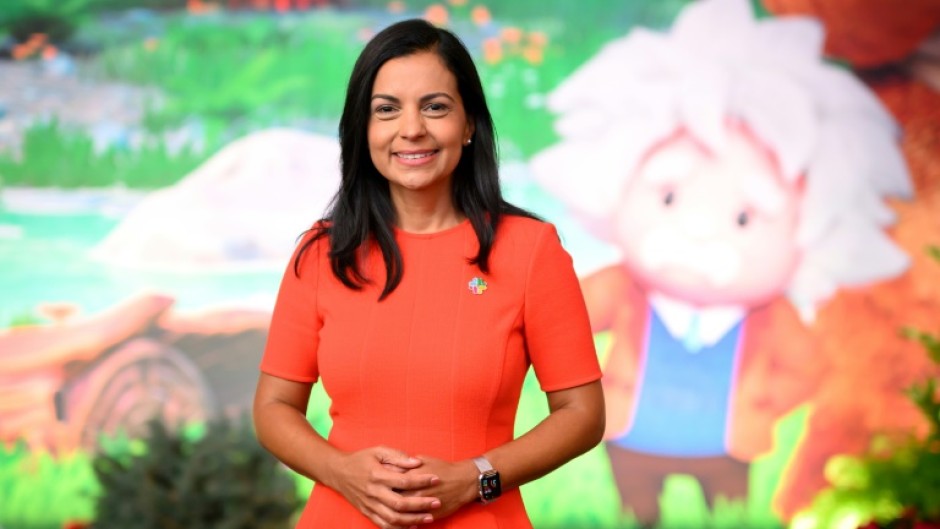
SAN FRANCISCO - Artificial Intelligence is transforming Slack, the widely used workplace messaging platform, its CEO told AFP just nine months after taking on one of the most high profile jobs in Silicon Valley.
Lidiane Jones was handed the reins to Slack after the departure of its co-founder and CEO Stewart Butterfield who exited two years after his company's acquisition by Salesforce, the San Francisco-based enterprise software giant.
Life at Slack after the blockbuster $27.7-billion transaction was not always smooth sailing and Jones, a former Microsoft executive who shot up the ranks in just a few years at Salesforce, was made chief executive to bring stability.
Jones took the job in January, only a few weeks after the launch of ChatGPT made the world aware of the superpowers of AI, and Slack has moved quickly to not fall behind, especially against its archrival Microsoft.
"It's amazing what has happened to the world," Jones said of this AI moment that has captured the imagination of Silicon Valley and the world.
"We've launched more features in the last nine months than in the several years before."
Brazilian-born and living in the Boston area, Jones was in San Francisco for "Dreamforce", Salesforce's big annual event to plug its new products and AI was on everyone's mind.
Many believe that tools such as Slack are first in line to be profoundly transformed by generative AI, which can produce texts, images and sounds on request in everyday language.
Originally designed to facilitate teamwork and internal communication, Slack, along with its equivalents such as Teams from Microsoft, have rushed out new versions supercharged by AI to act as something close to an online assistant.
"When I got back from my two-week vacation this summer, I had mountains of messages from customers and colleagues to catch up on," Jones said.
"I asked 'Slack AI' to summarize everything and in two hours I was up to date, instead of spending a whole day, or even the week."
She said this recourse to new AI tools works for summarizing all types of content or for fully automating complicated administrative tasks, like approving expenses or connecting users to in-house expertise.
- Won’t 'reinvent the wheel' -
For the time being, Slack has no plans to develop its own language model, the systems at the heart of generative AI that have made OpenAI a household name.
"We don't feel we need to reinvent the wheel," Jones joked, while reserving the possibility of one day designing a more specialized model.
On an even more distant horizon, Slack may one day develop highly personalized AI agents, sort of digital secretaries that know users down to their most personal detail.
"It is definitely a plausible future. And, look, I have a family, I work, it's very busy... Isn't it amazing to think that a system can track all of it in one place?"
"But it's gonna take time" to make people comfortable to do that, she said.
"I think there's a possibility and desire, but the trust boundary is going take a while for us to get there."