
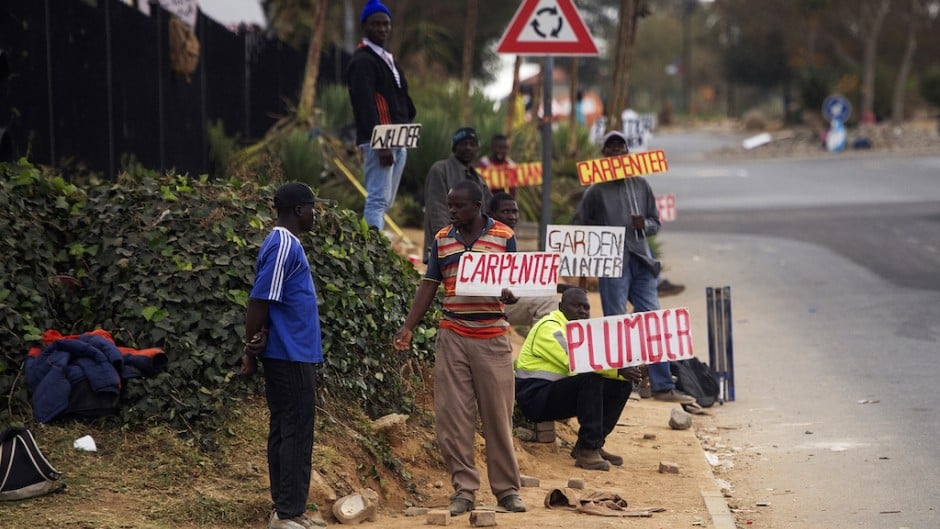
JOHANNESBURG - Economists have dubbed South Africa’s employment rate a crisis.
According to Xhanti Payi, the reality of this crisis can be seen in socio-economic outcomes, from crime to violence on the rise.
“People are really feeling quite starved of opportunity, and they're outside that moment,” he said.
Payi’s remarks come after the recent announcement of the unemployment rate, which has jumped to a four-year high.
It rose to 33.6% in the second quarter of the year, from 32.7% in the first.
READ | SA unemployment rate climbs to 33.6%
South Africa's unemployment rate has been above 30% for five years, and it's among the highest in the world.
Payi said when one tracks the number of people who are coming into the job market and are ready to work, and the number of people who are actually working, those numbers are diverging.
He said this is a major problem because that divergence means not only is the job market failing to accommodate the number of people who are coming in or are available for work, but it is also actively losing jobs.
“That's actually something that's of serious worry. It's even more sad for young people who can't even look forward to a job,” Payi said.
Statistics show that 19,000 jobs were lost on balance, while more than 300,000 people entered the workforce, either from school or because they had re-entered the job market.
This pushed up the unemployment rate by nearly a percentage point.
The jobs crisis looks even worse according to the expanded definition of unemployment, which includes people who have simply given up looking for work.
It soars above 43.5%.
READ | Foreign nationals hold just 3.4% of SA formal jobs, Wits study finds
The data points to an economy that is still struggling to generate enough jobs, especially in the formal sector.
Women are also bearing the brunt, Payi noted.
“Over the last 10 years, I think the statistics office has really highlighted this in quite a stark way. We have actually moved now to 50% more women, and now almost 60% more women are actually unemployed. If we just look back 10 years ago, which is something of a crisis, given that we keep celebrating all of these opportunities.
“We think there are all these programmes around, including women, but clearly something is amiss,” he said.