
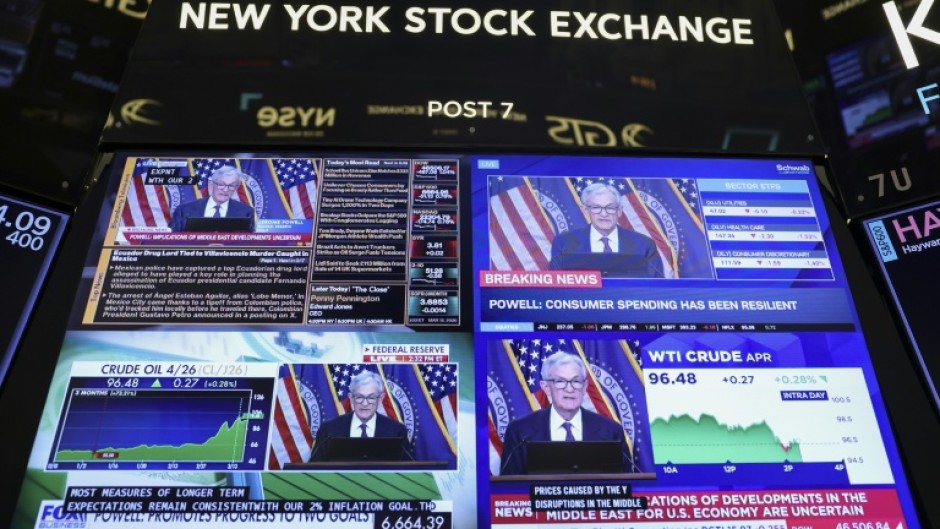
WASHINGTON - The US Federal Reserve raised its inflation forecast as it held interest rates steady, citing an "uncertain" economic outlook due to the war in Iran.
The 11-1 vote on the benchmark lending rate was widely expected, but nonetheless defied US President Donald Trump's demands for a reduction as the world's largest economy battles stubborn inflation and weak labor demand.
Rates were kept steady at a range of 3.50 percent to 3.75 percent, with officials flagging one expected cut by the end of the year.
But the Fed raised its inflation outlook, now expecting its preferred personal consumption expenditures (PCE) measure to stand at 2.7 percent by December 2026, up from an earlier estimate of 2.4 percent.
"In the near term, higher energy prices will push up overall inflation," Fed Chair Jerome Powell said, referring to steeper costs from the war in the Middle East.
"But it is too soon to know the scope and duration of the potential effects on the economy," he told a press briefing after the Fed's policy meeting.
Powell refused to be drawn into sharing specifics of his expectations for how the war could affect the US economy.
"We're right at the beginning of this, and we don't know how big -- you just don't know how big this will be and how long it lasts," he said, adding that the Fed would have to "wait and see."
Trump has repeatedly insulted and criticized Powell for not slashing rates more aggressively, and in January, the Fed chair revealed that the US Justice Department had opened an investigation into him related to cost overruns on renovations at the bank's headquarters.
On Wednesday, Powell was also adamant that he would not leave the Fed's board when his term as chair is over in May -- his tenure as governor ends in 2028 -- until the investigation is completed.
"I have no intention of leaving the board until the investigation is well and truly over, with transparency and finality," Powell said.
The central bank had cut rates three consecutive times late last year before holding them steady at its January meeting.