
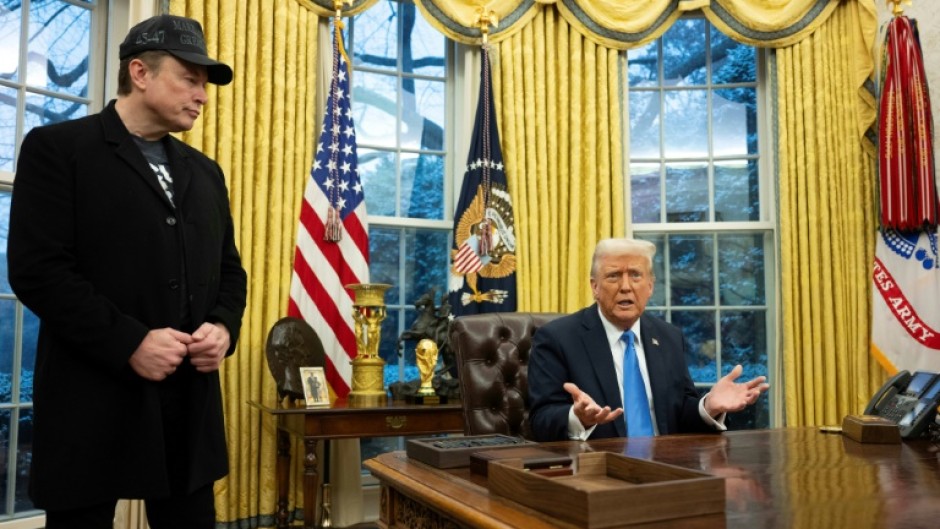
WASHINGTON - A US judge declined a request to temporarily block Elon Musk and his Department of Government Efficiency (DOGE) from firing federal employees and accessing agency data, a victory for President Donald Trump in his bid to shrink the government workforce.
Fourteen Democratic-ruled states had filed suit last week contesting Musk's legal authority but District Judge Tanya Chutkan denied their emergency request to pause his actions.
"Plaintiffs have not carried their burden of showing that they will suffer imminent, irreparable harm absent a temporary restraining order," Chutkan said.
DOGE is a free-ranging entity run by Musk, the world's richest person and Trump's biggest donor. The billionaire has taken an assertive role in the new administration, with his agency aiming to cut hundreds of billions of dollars in government spending.
His plans have effectively shuttered some federal agencies, sent thousands of staff members home and sparked legal battles across the country.
In their suit, the 14 states claimed that Musk and DOGE lacked statutory authority for their actions because he had not been formally nominated by the president and confirmed by the Senate.
"(Musk) exercises virtually unchecked power across the Executive Branch, making decisions about expenditures, contracts, government property, regulations, and the very existence of federal agencies," they said.
In addition, Musk and DOGE have gained access to "sensitive data, information, systems, and technological and financial infrastructure across the federal government," they added.
The 14 states had sought to block DOGE from accessing the data systems of the Office of Personnel Management and the Departments of Education, Labor, Health and Human Services, Energy, Transportation and Commerce, and from terminating any of their employees.
Chutkan, in her ruling, said "the court is aware that DOGE's unpredictable actions have resulted in considerable uncertainty and confusion for Plaintiffs and many of their agencies and residents.
"But the 'possibility' that Defendants may take actions that irreparably harm Plaintiffs 'is not enough,'" she said.