

TEHRAN - US Vice President JD Vance said Sunday that 21 hours of talks with Iran failed to reach an agreement, saying he was leaving after putting forward a "final and best offer".
"The simple fact is that we need to see an affirmative commitment that they will not seek a nuclear weapon and will not seek the tools that would enable them to quickly achieve a nuclear weapon," he told reporters in Islamabad, on the main sticking point for talks moving ahead.
- Iran says talks hinged on avoiding 'excessive demands' -
The success of peace talks between the United States and Iran depended on Washington avoiding "excessive" and "unlawful" demands, the Iranian foreign ministry's spokesman said early on Sunday after marathon talks in Islamabad.
"The success of this diplomatic process depends on the seriousness and good faith of the opposing side, refraining from excessive demands and unlawful requests, and the acceptance of Iran's legitimate rights and interests," Esmaeil Baqaei wrote on X.
- Iran and US spar over strait -
Iran denied Washington's claims that two US Navy warships crossed the Strait of Hormuz to clear the strategic waterway of mines, with Tehran warning that military ships attempting the passage "will be dealt with severely".
US Central Command's claim that mine detection operations were already underway was echoed by President Donald Trump, who told reporters Saturday "we have mine sweepers out there. We're sweeping the strait".
A fifth of the world's crude oil passes through the Strait of Hormuz.
- Trump says Iran deal 'makes no difference' -
Trump told reporters Saturday it "makes no difference" if a peace deal comes out of the trilateral US-Iran talks in Pakistan, insisting the United States has already won the war.
The 79-year-old Republican's comments came as Vice President JD Vance was leading the US delegation in Islamabad, with discussions heading into a second day.
Earlier, Iranian media said the United States was making "excessive demands" on the Strait of Hormuz during the talks.
- Iran nuclear programme crushed: Netanyahu -
Israeli Prime Minister Benjamin Netanyahu said the joint US-Israeli campaign against Iran had succeeded in "crushing" the Islamic republic's nuclear and ballistic missile programmes.
"They wanted to strangle us, and (now) we are strangling them. They threatened us with annihilation, and now they are fighting for survival," he said, adding that the war against Tehran had also weakened Iran's leadership and its regional allies.
He agreed to Lebanese requests for peace talks on two conditions, he added: "We want the dismantling of Hezbollah's weapons, and we want a real peace agreement that will last for generations."
- Lebanon death toll past 2,000 -
Lebanon's health ministry said the death toll since the start of the war between Israel and Iran-backed Hezbollah is now 2,020.
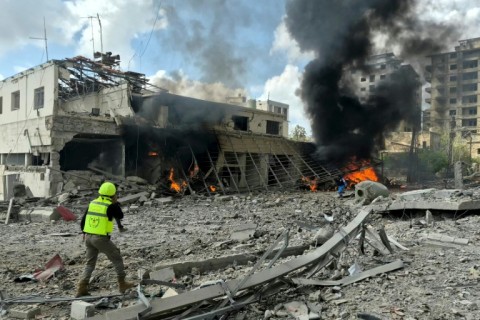
The new toll from the Lebanese health ministry includes 248 women, 165 children and 85 medical and emergency personnel killed, along with 6,436 people wounded since Lebanon was drawn into the Middle East war on March 2.
Earlier Saturday, Lebanon said Israeli strikes on a village near Sidon in the south killed eight people, after earlier strikes killed 10 people including three emergency workers.
Israel's military said it had struck more than 200 Hezbollah targets in Lebanon in the last 24 hours.
- Pope denounces warmongers -
Pope Leo lashed out against warmongers while calling on billions of people around the globe to embrace peace and "believe once again in love, moderation and good politics".
In one of his most passionate entreaties yet to end the raging conflict in the Middle East, the American pope said faith was needed "in order to face this dramatic hour in history together".
- Macron appeal -
French President Emmanuel Macron said he had urged his Iranian counterpart Masoud Pezeshkian to use the talks to achieve "a lasting de-escalation."
"I urged him to seize the opportunity presented by the talks launched in Islamabad to pave the way for a lasting de-escalation and a robust agreement that provides solid guarantees for security in the region," Macron said on X.
- Iran says lacks 'trust' with US -
Iran's parliamentary speaker Mohammad Bagher Ghalibaf said shortly after arriving in Pakistan's capital that previous experiences negotiating with the United States had led to a lack of trust.
"Our experience in negotiating with the Americans has always been met with failure and broken promises," Iranian state media quoted him as saying.
- Israel won't discuss ceasefire -
Israel's US ambassador Yechiel Leiter told his Lebanese counterpart in Washington that he "refused to discuss a ceasefire with the Hezbollah terrorist organisation", according to a statement after a meeting.

Lebanon's presidency said a meeting would be held at the US State Department on Tuesday "to discuss declaring a ceasefire and the start date for negotiations between Lebanon and Israel under US auspices."