
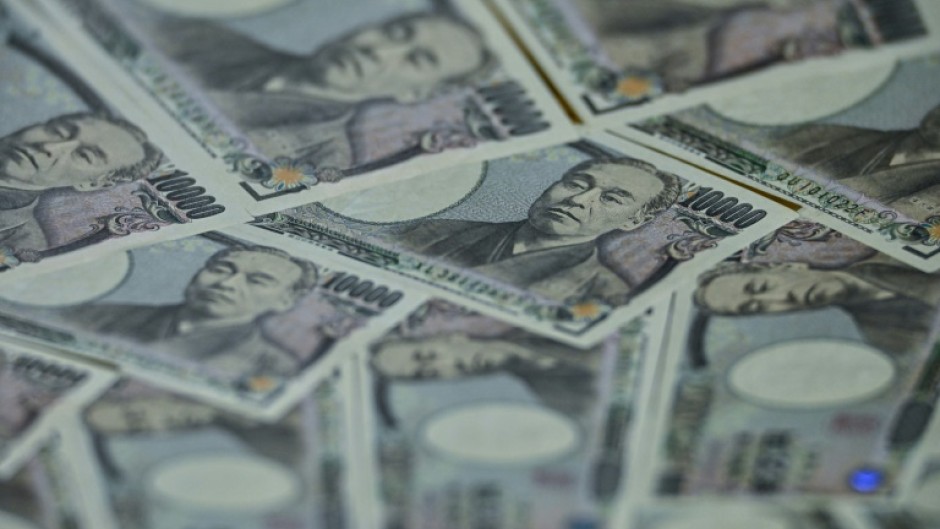
File: Japanese yen. AFP/Richard A. Brooks
TOKYO - Japanese economic growth showed a surprise slowdown in the second quarter, official data showed on Monday, as capital expenditure dropped along with consumption.
The reading will complicate the central bank's attempts to lift interest rates as it battles a weaker yen, which has come under pressure from elevated oil import costs and concerns about Prime Minister Sanae Takaichi's spending plans.
Gross domestic product (GDP) grew 0.3 percent on-month in April-June, the cabinet office said, down from 0.5 percent in the previous three months. Another 0.5 percent increase was forecast in a survey by Bloomberg.
On an annualised basis, the economy expanded 1.1 percent, against expectations of 2.0 percent and 1.9 percent in January-March.
Higher oil prices have swollen the country's import bill and led to higher prices for consumers -- a situation worsened by the weak yen -- and eroding Takaichi's popularity.
Marcel Thieliant at Capital Economics called the expansion "decent... and with the government still limiting the pass-through from higher energy prices that should remain the case across the second half of the year."
A 5.4-percent annual rise in nominal government consumption "was the largest since 2021 and suggests that Takaichi's expansionary fiscal policies are starting to have an impact", Thieliant said.
The Bank of Japan had been expected to hike interest rates soon as inflation accelerates in the world's number four economy.
But Taro Kimura at Bloomberg Economics said Monday's figures "weaken the case" for a September increase, "a move markets had increasingly priced in".
A BoJ rate hike could lift the yen.
The currency has given up around half of its gains that followed a historic joint market intervention by the United States and Japan last month.
A weak yen is a boon to big Japanese exporters, and on August 4 Toyota cited that as it raised its profit forecasts.
But since many imports are priced in dollars, particularly oil, Japan needs to shell out more yen for every barrel.
The weaker-than-expected GDP came after capital expenditure fell and missed market expectations, and flat private consumption against forecasts that it would grow.
Takaichi, whose two predecessors were undone by anger over inflation, has widened government support for voters.
Following a massive stimulus package adopted in late 2025 and extensive energy tax rebates, her government approved further aid earlier this year.
The government last month also said it would slash consumption tax on food products from eight percent to one percent, starting in April.
Media reports said this will cost the government 10 trillion yen ($63 billion) in lost tax revenues over two years.
This has exacerbated concerns about Japanese public finances, with the country's debts more than double annual economic output, one of the highest ratios in the world.
These worries, as well as expectations of a BoJ rate hike, pushed yields on 10-year Japanese government bonds to their highest since 1996 on Monday.
- AFP