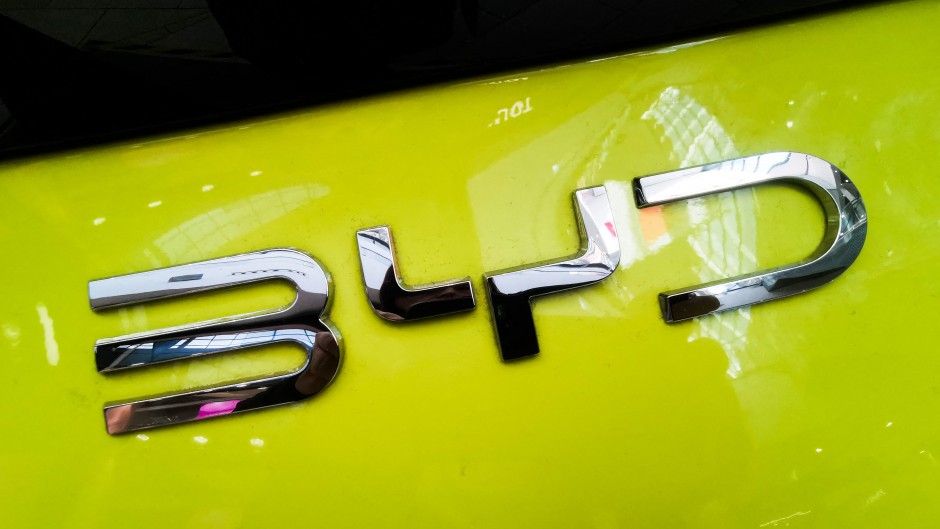
JOHANNESBURG - The biggest manufacturer of electric vehicles (EVs) in the world, BYD, has announced it will start covering South Africa with EV charging stations next year that are both clean and super-fast.
They won’t rely on Eskom power because they will use BYD solar panels and batteries. And the ‘Flash’ stations will ultimately be able to provide as much as 400km of range to an electric car in just five minutes.
When we spoke to BYD executive vice president, Stella Li, in Johannesburg, she said the investment had not been quantified yet but represented ‘big money.’
The investment is significant because it highlights the extent to which South Africa has become an important market for Chinese car makers in general. Even the visit by Li, who has been voted 2025 World Car Person of the Year, is significant.
Li says BYD will unveil between 200 and 300 charging stations across the country next year which it also plans to triple its dealership network. BYD is still a relatively new player in South Africa, having arrived after many other Chinese brands, but it’s clear that it sees potential for growth.
BYD has been outperforming its American rival, Tesla, in terms of sales since late last year. While it’s top of the EV world, it faces significant competition in its home market which adds to the push to expand globally.
Additionally, since growth in EV sales has slowed generally, partly due to concerns around resale values, which makes a relatively new and ripe market like South Africa even more attractive.
If BYD bets and many other predictions are right, Chinese cars will increasingly make inroads in South Africa.
Years ago, Chinese cars were a pretty rare sight. By 2023, China made up 7% of the market and in 2024 about 10% with Cherry being the most popular Chinese brand, coming in fifth behind Toyota, Suzuki, Volkwagen and Hyundai. (BYD did not release its sales data to the Automotive Business Council, NAAMSA, but it’s believed to have sold only a few hundred vehicles since its arrival in South Africa in 2023.)
The rise of Chinese cars is generally a price story, since most models are cheaper than similar vehicles from other manufacturers. They usually offer much more for much less, in terms of advanced features.
For years, Chinese car manufacturers have been copying ideas quite shamelessly from Western brands and have even cloned famous models. Some of them, however, are now coming into their own.
What’s happening in South Africa is in line with a global market trend, whereby China is increasing its market share year by year.
When German models were all the rage, the Chinese government put up protections and offered subsidies to car makers to build up their capacity and supply the massive home market. The manufacturers are now disrupting the world market in a very noisy way, accounting for more than 30% of car exports.
China still invests heavily in electric vehicles, not least to reduce its dependence as a nation on imported oil, which means that BYD has an inherent advantage.
Car makers, mostly German, who operate in South Africa have been raising the alarm bells, saying there’s an uneven playing field because Chinese car makers receive substantial support from their government.
They’ve even warned that the rising popularity of Chinese cars in South Africa could add to deindustrialisation.
- by Francis Herd
For price-sensitive buyers, however, Chinese cars are best. It remains to be seen if buyers will be satisfied in the long run since most Chinese brands do not have a track record in terms of providing after-sale customer support. Li says that’s why BYD is building up slowly, establishing a strong base, to ensure that the company can give customers the support they need.