
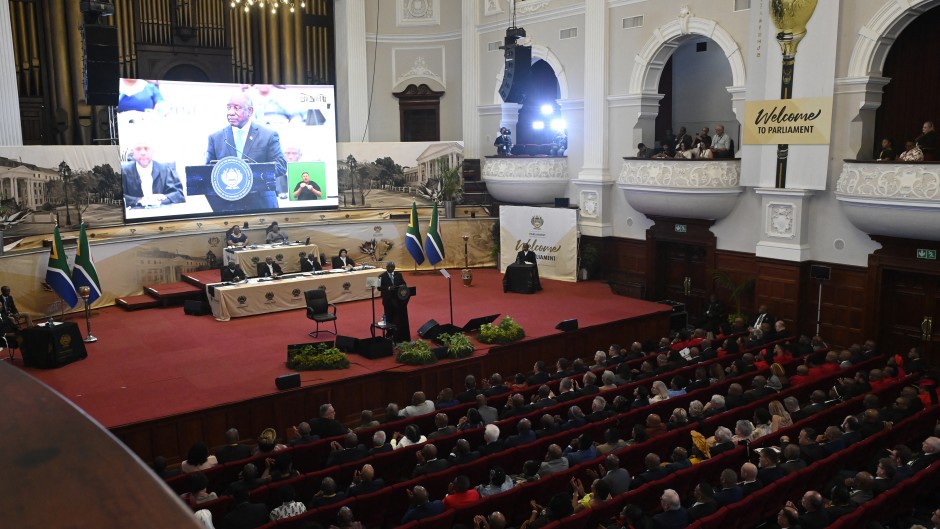
A general view of the audience and of President Cyril Ramaphosa as he delivers the State of the Nation (SONA) address in Cape Town on February 12, 2026.
CAPE TOWN - On Monday, Parliament's Impeachment Committee will hold its first meeting.
In the meeting, the party will elect a chairperson. Build One South Africa (BOSA) leader Mmusi Maimane has come out saying that should the Committee appoint an ANC chairperson, the Committee would be biased.
This is something that ANC Secretary-General Fikile Mbalula has rubbished.
READ: Mbalula: ANC will go into impeachment process guided by Constitution
Last week, National Assembly Speaker Thoko Didiza released the names of the 31 Members of Parliament (MPs) who will be serving in the Committee.
The Committee will look into President Cyril Ramaphosa's Phala Phala farm theft and the section 89 Independent Report.
In May, the Constitutional Court ordered Parliament to set up a committee after it ruled that the National Assembly acted unlawfully when voting against the adoption of the panel report in 2022.
The sub- committee on the Review of the Assembly Rules is expected to finalise technical processes before the Impeachment Committee can begin its work.
What is an impeachment?
Section 89 (1) of the Constitution deals with the removal of the President from his position. Two-thirds of the National Assembly must adopt a resolution to remove the president from office.
The grounds on which the President can be removed from office include:
- A serious violation of the Constitution or the law;
- A serious misconduct; or
- Inability to perform the functions of office
According to new procedures adopted by the Rules Committee on 28 August 2018, a motion to remove the President must be brought to the Speaker of Parliament.
When the motion has been submitted, the Speaker must refer it, with any supporting evidence, to a panel of three independent legal experts.
The panel must then assess whether there is enough evidence for Parliament to proceed with the inquiry.
The panel has 30 days to deliberate and report to the National Assembly. It is up to the House to decide whether to proceed with the impeachment inquiry.
Should Parliament decide to proceed with the inquiry, the matter must be referred to a specially constituted Impeachment Committee.
The panel must conclude its deliberations within 30 days and report to the National Assembly. The House must then decide whether to proceed with an inquiry. If it decides to proceed with an inquiry, the matter must be referred to a specially constituted Impeachment Committee.
READ: EXPLAINER | High Court review can halt Ramaphosa impeachment
Once the Impeachment Committee has done its investigation, the House must schedule the report for debate.
Should the report recommend that the President be impeached, the matter is then put to a vote.
The President can be removed if two-thirds of Parliament supports the recommendation.
Section 89 (2) of the Constitution says once a President is removed, they may not receive any benefits from the office and may not serve in any public office.