
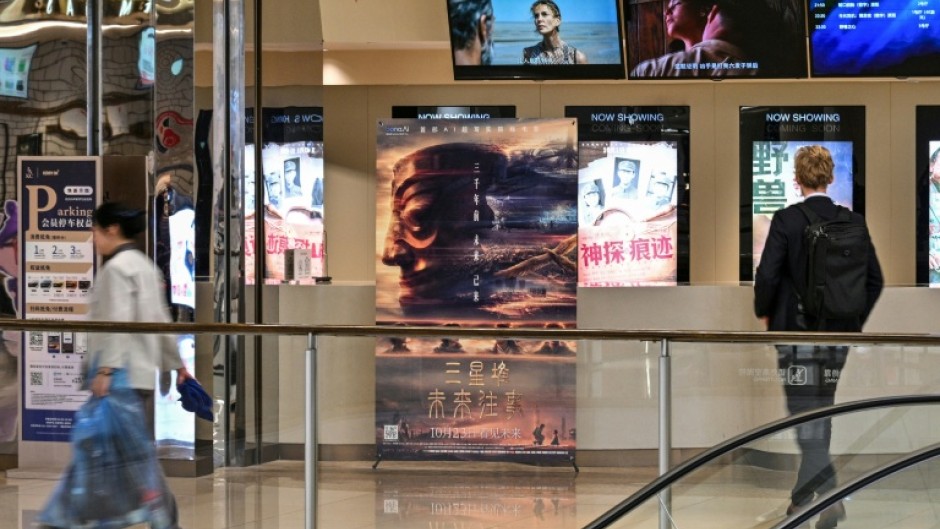
BEIJING - China's first fully AI-generated feature film opens in cinemas on Friday in what promises to be a tough box-office test for the country's booming tech industry as advance ticket sales lag.
More than 10,000 screenings of the sci-fi thriller "Sanxingdui: Future Past" are scheduled for Friday, according to ticketing platform Maoyan.
Public reception, however, has been less than enthusiastic.
Film revenue was approaching 290,000 yuan ($43,425) by Friday evening, and total box-office takings were forecast to reach about 390,000 yuan, much less than the reported production cost, according to Maoyan.
Ticket prices range from 20 to 90 yuan, bringing the number sold to a few thousand at most.
Jiang Defu, CEO of the production company Bona Film Group, acknowledged the lukewarm reception in a recent interview but said the film was pushing boundaries.
"We are the first to try it, the first to get a theatrical release permit and the first to be tested by the audience," he told Chinese film industry outlet Yuli.
"I think that is not easy at all."
Nearly 100 people took more than two years to make the film, which cost more than 10 million yuan ($1.5 million), Bona said, although all the actors, their voices and the backdrops are AI-generated.
The film touches on the theme of humanity in a future shaped by AI.
But that was not enough to convince Iris Yang, who attended a free preview screening of the film on Thursday for acquaintances of the production team and industry workers.
Yang said she would not have paid for a ticket, given the movie's quality.
"If AI generation can match the theatrical experience of 'Avatar', I think I would be willing to pay for it," she said, referring to the US franchise known for the quality of its animation.
On Friday evening, moviegoer Lilian Gong, 35, sat through one of the first screenings in central Beijing. Curiosity drew her to see how well AI generation would work on the big screen, she said.
AI generation can only play a supporting role in filmmaking at the moment, she said: "In terms of quality, compared with human production, it still falls short."
"In the future, just like films, maybe decades later, it would get to a level when people are all willing to pay to watch," she told AFP.
"But for the moment, I think there would be very few who would."
Only four audience members were present at the screening attended on Friday by AFP.
AI-generated video has gained popularity in the world's second-largest economy. On Douyin, the Chinese equivalent of TikTok, AI-generated short dramas garnered more than 200 billion views in September alone.
But "the audience won't automatically pay for the tickets just because it's an AI-generated film", independent AI director Zhang Jun told AFP.
Online, Chinese social media users also seemed unconvinced by the launch of AI movies in cinemas.
"If it's free to watch on streaming platforms, it could become legendary. But paying to watch? People are not going to accept it at this stage," one user on Weibo commented.
In Hollywood, the rise of AI has sparked concern among film workers about the prospect of job losses.
An AI-generated sci-fi feature called "Gods Don't Give Gifts" is scheduled for US release on December 4.
And a virtual Hollywood actor called Tilly Norwood, whose interviews have gone viral while fuelling job fears, is also set to star in an upcoming movie called "Misaligned".
-AFP