
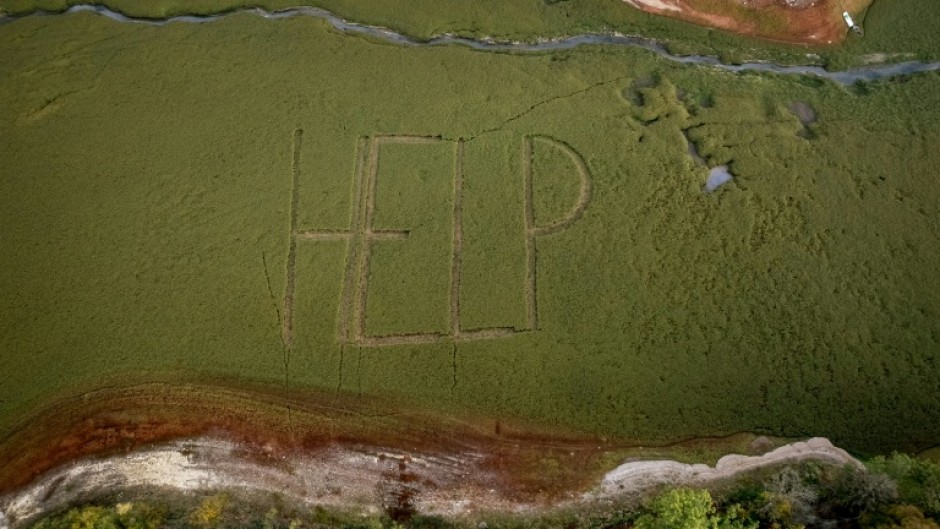
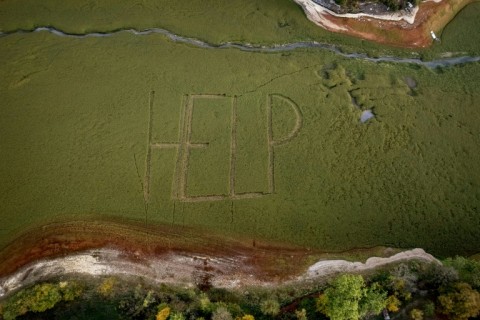
BERN - The picturesque Lac des Brenets between France and Switzerland has dried up after a record-breaking hot summer, leaving locals crying out for help to save the lake.
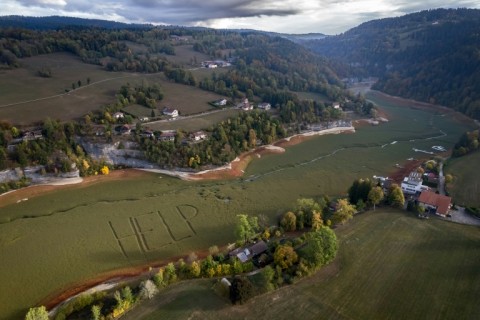
Indeed, the words "HELP" and "SOS" have been scratched out in the weeds now flourishing on the exposed lake bed.
The drought has ruined pleasure boat tourism, while some question whether the lake will ever return to enduring full health.
"It's absolutely heartbreaking. It really is emotionally devastating, because it's utter despair: no more lake," said amateur local historian David Favre, who lives in the Swiss village of Les Brenets.
"As children, we used to spend all our summers swimming at the beach, having fun by the water, diving, jumping in and sometimes even fishing," the 76-year-old told AFP.
But "since the last drought in 2018, it's been a disaster. Unfortunately, the lake empties out every couple of years, or soon, perhaps every year," he added, saying he felt the authorities have "completely abandoned" the lake.
The Doubs river rises in the French Jura mountains and normally forms a lake at Les Brenets, where it begins to mark the border between France's Franche-Comte region and Switzerland's Neuchatel canton.
The lake ends at 27-metre-high waterfall, which has now stopped flowing.
The lake has dried up due to a combination of factors, including geological fissures that drain water underground, below-average rainfall and repeated heatwaves.
The months of June, July and August were each the hottest ever recorded in Switzerland since measurements began in 1864.
- 'It's unbearable' -
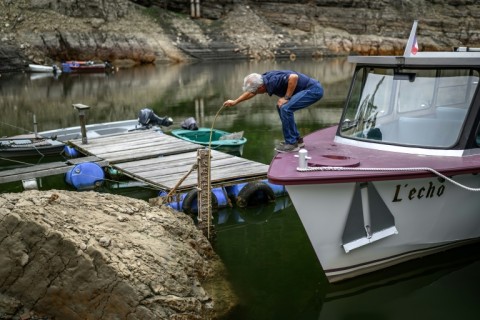
Every day Yvan Durig, owner and captain of the Lac des Brenets navigation company, measures the level of the remaining basin of water which is shrinking away at the very deepest bit of the lake.

"Normally, we have 25 or 30 metres of depth here," but now there are only nine metres of water left, and within it "the fish are really chock-a-block", he said.
While locals are used to periods of low water, this particular spell is alarming, with the record low of 1906 set to be surpassed imminently.
A task force was set up by French and Swiss authorities in 2022, notably to explore ways of limiting the water draining into the fissures, but has not resulted in decisive action.
"We had to halt boat operations on July 20," said Durig.
"Just imagine: having to stop right in the middle of the season like that. It's unbearable for a company like ours," he said.
"Normally, these are times when we transport 200 to 300 people a day," said Durig.
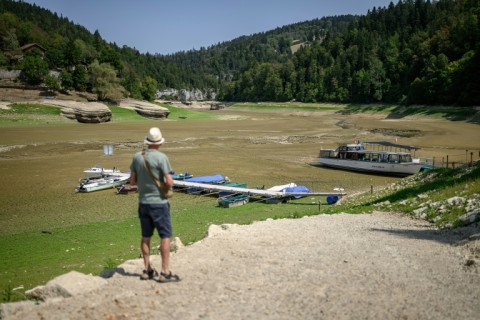
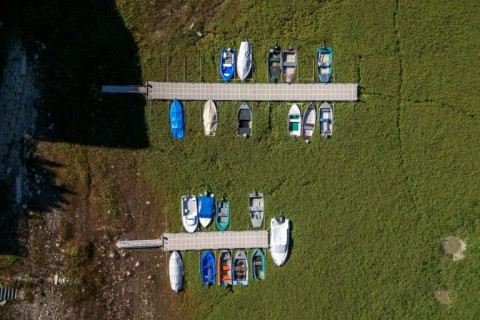
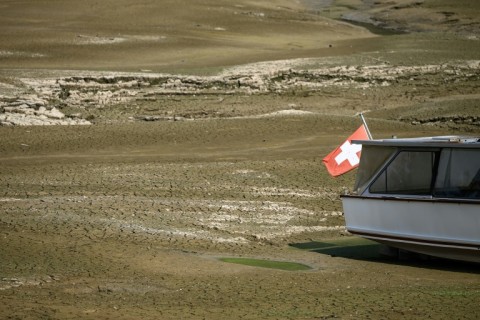
Pontoons and dozens of boats lie stranded on the dry lake bed.
- Losing soul of Les Brenets -
The water level monitoring station for the lake is now so far out of the remaining basin that Durig does the measurements manually.
The water line is dropping around 20 to 22 centimetres a day.
On October 1, it fell to an elevation of 735.34 metres above sea level fully 14.66 metres below where it should be.
Within days, it is expected to surpass the 1906 record drop of 15.35 metres.
A tiny stream now trickles through the weeds on the lake bed.
Maxime Fallet, who works at a Doubs riverboat excursion company, fears the lake is "destined to disappear", for lack of a plan to save it.
"The atmosphere in Les Brenets these days, when talk turns to the Doubs, is often tinged with a certain sadness, a melancholy at the thought that we could lose this lake -- a lake that has been part of the soul of Les Brenets for generations," he told AFP.
Durig feels time is running out.
"We must take action indeed, be proactive and seal the lakebed," he said.
"But this can no longer take years. That is simply not an option anymore."
By Elodie Le Maou
- Article by AFP