
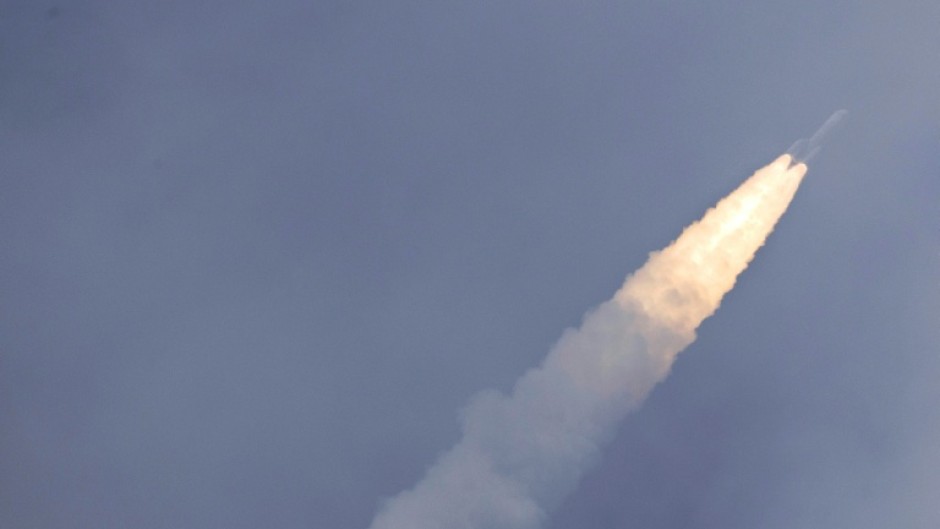
KOUROU - The most powerful version of Europe's Ariane 6 rocket carried 32 satellites into space for the Amazon Leo network, which aims to rival Elon Musk's Starlink.
The launch from Europe's spaceport in Kourou, French Guiana, on the northeastern coast of South America, is a first for Amazon Leo.
The largest number of satellites ever carried by an Ariane rocket successfully separated and set off toward their final orbit to applause from those following the event live at the control centre.
"What a day, what a launch!" exclaimed Arianespace CEO David Cavailloles, who said the operation proved the launcher's ability to "carry out the most complex missions".
"Amazon, your package has been delivered," French President Emmanuel Macron wrote on X, speaking of a "European success".
US firm Amazon, founded by billionaire Jeff Bezos, is the main commercial partner for the Ariane 6 despite the latter being touted as a symbol of European sovereignty in the sector.
To take on the 32 satellites, the Ariane 6 was upgraded with four strap-on boosters, instead of the two used on the first five flights.
The increased number marks "our largest payload that we have launched to date," Martijn Van Delden, head of commercial development for Europe at Amazon Leo, told AFP.
With 175 satellites already in orbit, Amazon Leo aims to expand its constellation to 3,200.
Rival Starlink, meanwhile, has nearly 9,400 satellites.
"We're looking to then increase the payload every time we have a new mission, especially as more powerful boosters come online on Ariane 6," Van Delden said.
"Ariane 6 is a perfect launcher for constellations" of satellites, said Arianespace CEO Cavailloles during a press briefing.
He said the Amazon launches would help in training for a flagship multi-orbital constellation project of the European Union aimed at ensuring secure and sovereign connectivity, with deployment slated to begin in 2029.