
SAPPORO - Dressed in an orange puffer jacket, Japanese scientist Yoshinori Iizuka stepped into a storage freezer to retrieve an ice core he hopes will help experts protect the world's disappearing glaciers.
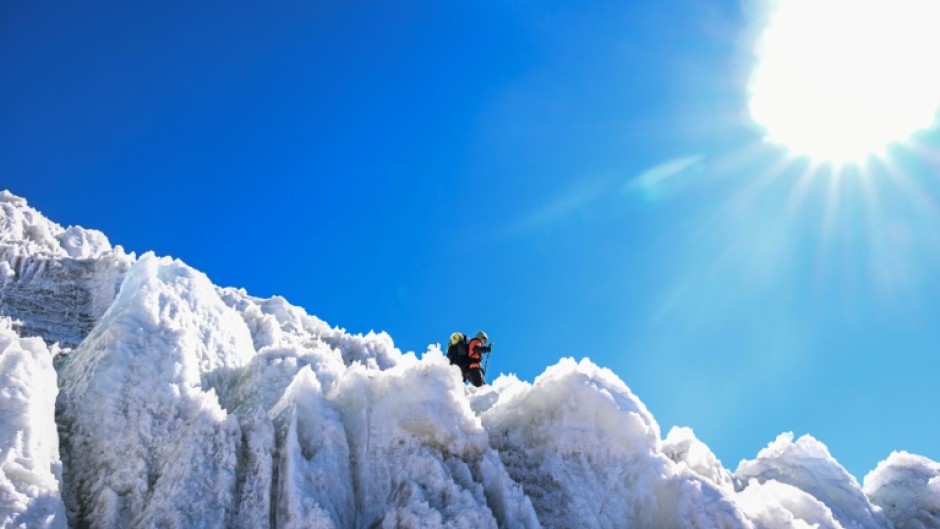
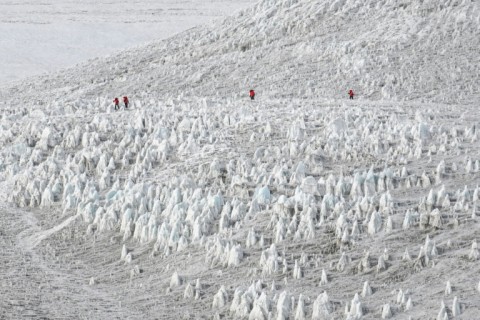
The fist-sized sample drilled from a mountaintop is part of an ambitious international effort to understand why glaciers in Tajikistan have resisted the rapid melting seen almost everywhere else.
"If we could learn the mechanism behind the increased volume of ice there, then we may be able to apply that to all the other glaciers around the world," potentially even helping revive them, said Iizuka, a professor at Hokkaido University.
"That may be too ambitious a statement. But I hope our study will ultimately help people," he said.
Thousands of glaciers will vanish each year in the coming decades, leaving only a fraction standing by the end of the century unless global warming is curbed, a study published in the journal Nature Climate Change showed Monday.
"Information from the past is crucial," said Iizuka.
"By understanding the causes behind the continuous build-up of snow from the past to the present, we can clarify what will happen going forward and why the ice has grown."
Since the samples arrived in November, his team has worked in freezing storage facilities to log the density, alignment of snow grains, and the structure of ice layers.
In December, when AFP visited, the scientists were kitted out like polar explorers to cut and shave ice samples in the comparatively balmy minus 20C of their lab.
The samples can tell stories about weather conditions going back decades, or even centuries.
A layer of clear ice indicates a warm period when the glacier melted and then refroze, while a low-density layer suggests packed snow, rather than ice, which can help estimate precipitation.
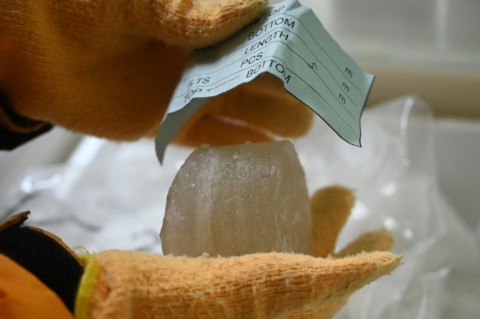
Brittle samples with cracks, meanwhile, indicate snowfall on half-melted layers that then refroze.
And other clues can reveal more information -- volcanic materials like sulfate ions can serve as time markers, while water isotopes can reveal temperatures.
The scientists hope that the samples contain material dating back 10,000 years or more, though much of the glacier melted during a warm spell around 6,000 years ago.
Ancient ice would help scientists answer questions such as "what kind of snow was falling in this region 10,000 years ago? What was in it?" Iizuka said.
"We can study how many and what kinds of fine particles were suspended in the atmosphere during that ice age," he added.
"I really hope there is ancient ice."