
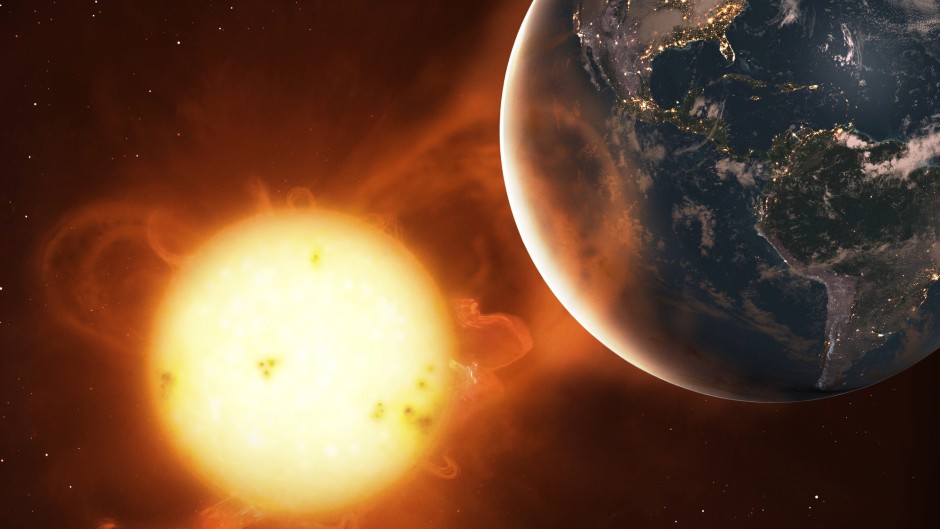
JOHANNESBURG - Earth is currently experiencing a moderate geomagnetic storm.
The South African National Space Agency (SANSA) said on Tuesday morning that solar winds remain strong, reaching 900km/s.
These conditions may continue to affect satellite navigation, communication systems, and power grids, although the storm is largely invisible to the naked eye.
What is a solar flare?
A solar flare is a sudden burst of light and energy from the Sun. It can disrupt high-frequency radio communications on the day side of the Earth. Flares are ranked by intensity: A, B, C, M, and X, with X-class flares being the most powerful.
According to SANSA, the recent flare, classified as X1.9, occurred on Sunday night.
While the flare caused radio disruptions over the Pacific region, SANSA said Africa was largely unaffected since it was nighttime locally.
How the flare causes a geomagnetic storm
The solar flare released a Coronal Mass Ejection (CME) directed toward Earth.
As this cloud of plasma interacts with the Earth’s magnetic field, it generates a geomagnetic storm, which can affect technological systems like electricity grids, satellite navigation, and communication networks.
Unlike weather storms, geomagnetic storms are largely invisible to the naked eye.
Their main impact is on technology:
- GPS accuracy may be affected, impacting aviation and drone operations.
- High-frequency radio transmissions may experience disruption.
- Electrical systems may experience fluctuations or temporary outages.
The K-Index is a standard measure of geomagnetic activity, ranging from 0 (quiet) to 9 (extreme disturbance).
Tracking the Storm
SANSA uses a network of ground-based instruments over the African continent, the Southern Ocean and Antarctica.
It works with space weather centres across the globe to monitor these storms and is accredited by the International Civil Aviation Authority (ICAO) as a regional centre.
SANSA operates a local K-Index in Hermanus, which can be monitored at spaceweather.sansa.org.za