
LONDON - The London Museum, a free museum telling the story of the British capital, reopens this week in former meat market buildings transformed into an exhibition space.
The museum has relocated from a dated 1970s-era site to a 19th-century brick building formerly part of the Smithfield Market in central London, in a project costing £437 million ($570 million).
The atmospheric new space, which incorporates objects from the last 2,000 years, opens to the public Saturday.
"It's thrilling to see people in the museum," Sharon Ament, the museum's director, told AFP at a press preview Tuesday.
She called the completed building "miraculous and I think, much needed: we've got this great new museum for London."
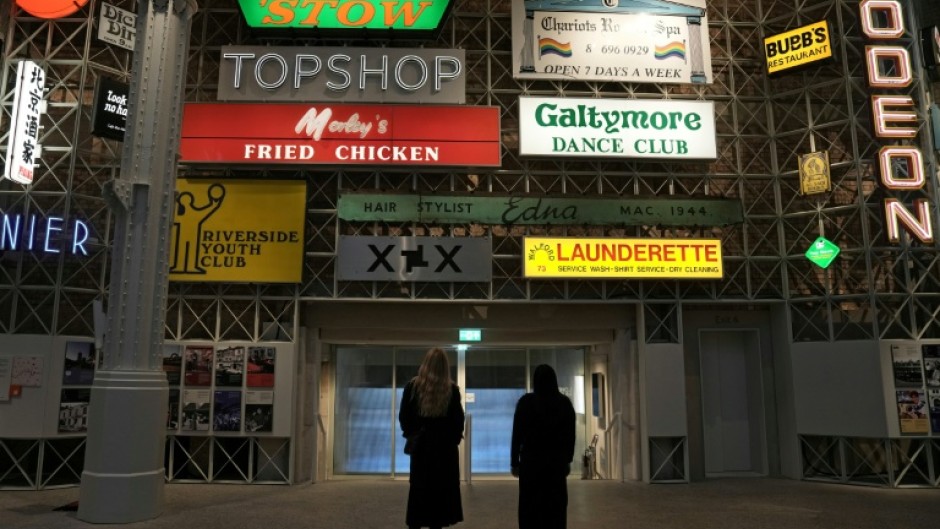
On the ground floor a huge open space with brick walls and iron columns has seating and places to eat and shop.
This is intended to be "a great big indoor public square," Ament told AFP.
"I think this is a new model for a museum and it's all come about because of the market buildings themselves. I couldn't imagine that we would have ever designed a museum like this from scratch."
The displays reflect recent history: a bike courier's outfit, Indian ready meals and a horse-drawn coffee stall donated by the family who ran it for 100 years.
One display commemorates Grenfell Tower, a block of flats in west London where 72 people were killed in a fire in 2017, with a sign saying the community there "have yet to see the change that they are owed".
Shop signs on the walls come from businesses including Top Shop fashion retailer whose store on Oxford Street closed in 2021.
Most spectacular is the Lord Mayor's gilded coach, used for an annual parade.
"When we were offered these buildings in 2015, we thought it would be the perfect home," said Alec Shaw, the museum manager who oversaw the move.
- 'Same fears, same hopes' -
"It's this incredible set of buildings with amazing architecture but also located right in the middle of the city."
But the site had been disused since the 1990s and was "dripping everywhere", Shaw told AFP. Just restoring the glass roof took about three years.
Smithfield Market, the last major food market in central London, is gradually closing down and the last traders are due to move out in the next few years.
The museum gives a nod to the building's history with archival photographs of hanging carcasses.
A sign calls the market closure a "massive change", while suggesting the "business of food may be too messy for a sanitised city".
Downstairs the main museum houses 5,000 objects in a former railway depot.
A viewing window allows museum-goers to watch commuter trains running past on tracks nearby. The vibration is so strong that mugs in the gift shop upstairs clink against each other.
The diverse displays are roughly chronological, running up to the 2012 Olympics.
One focuses on goldsmiths in the City of London in the 16th and 17th centuries, accompanied by sound effects of hammering and chinking and a treasure trove of more than 500 pieces of jewellery from the era.
Queen Victoria's black silk mourning dress is shown on a mannequin, emphasising her short stature.
A section on City workers includes a bowler hat and an early "brick" Nokia mobile phone as well as a banker's Armani suit and Hermes scarf from the 2000s.
Pictures of pop stars Boy George and David Bowie feature, along with Russian ballerina Anna Pavlova's feathered Dying Swan costume.
The idea is to show that "when you look across history, you see that all humans are kind of the same: even if they lived 2,000 years ago in Londinium," the city's Roman name, said Ament.
"They had the same fears, the same hopes, the same dreams, the same concerns as us today and that gives us a huge common bond."
By Anna Malpas
- AFP