

JOHANNESBURG - A newspaper advertisement by a 58-year-old Free State man seeking a bride aged between 16 and 25 has sparked widespread backlash, with child protection advocates warning that it could expose vulnerable young women and girls to exploitation.
The man, whose name is known to eNCA, describes himself in the advertisement as a wealthy farmer seeking what he calls “a pure, marriageable lady” with “biblical values”.
The advert, published in Die Burger on 24 July 2026, promises a R100,000 bride price for the woman’s parents and a R5 million inheritance for the successful applicant.
The inclusion of 16- and 17-year-olds has drawn particular concern.
While the age of consent in South Africa is 16, anyone under the age of 18 is legally regarded as a child, and child-protection organisations say the advert raises serious safeguarding concerns.
Shaheda Omar, director of the Teddy Bear Foundation, said the advert could place vulnerable young people at risk, regardless of whether it was intended as a genuine proposal, satire or a publicity stunt.
"Whether it's genuine, a publicity stunt or intended satire, the potential consequences are serious because vulnerable individuals may perceive it as a legitimate opportunity," she said.
"The promise of a R100,000 bride price and a R5-million estate provision could be particularly appealing to young women and girls experiencing poverty, unemployment or family hardship."
Omar said financial desperation can impair judgement, making people more susceptible to exploitation and coercion.
She also criticised the inclusion of 16-year-olds, saying the advert shared characteristics commonly associated with grooming.
"The inclusion of 16-year-olds in such an advert is deeply concerning because it targets an age group that requires protection rather than recruitment into intimate relationships with unknown adults."
The advert states that the prospective bride should be a non-smoker with “deep core beliefs”, and that the husband would be the head of the household in accordance with what it describes as “original Biblical principles”.
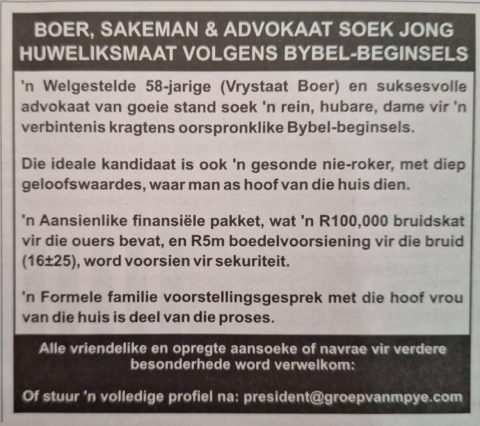
It also says a formal introduction to the “head wife of the house” would form part of the selection process.
Speaking to eNCA, the man said he was surprised by the public reaction and maintained that placing a newspaper advertisement was a more effective way of finding a wife than using dating apps.
Asked why he had included 16-year-olds in the advertised age range, he said people had focused too heavily on the lower end of the range.
"What if the successful candidate is 25?" he asked.
"What everyone forgets is that you don't meet a person and get married the next day. Families need to meet each other. Over time, that person will probably be 18. There is a rare chance of a 16-year-old coming forward."
However, Omar said the concern was not whether a 16-year-old ultimately married the man, but that the advert explicitly invited interest from minors.
She said advertisements targeting minors with promises of financial security risk normalising relationships between adults and children and could create opportunities for grooming and coercion.
Gender-based violence activist Corné Davis-Buitendag said the advert reflected the commodification of women and raised serious concerns about exploitation.
"There are so many risks for women and girls who buy into the idea of a 'soft life'. Sexual exploitation is glamourised while the risks of gender-based violence, HIV and psychological harm are minimised," she said.
"The inclusion of girls as young as 16 is particularly concerning because adolescents are generally more vulnerable to manipulation and financial inducement.
"Even where no criminal offence has been committed, advertising financial rewards in exchange for marriage can create circumstances that increase vulnerability to exploitation," Davis added.
This was echoed by the Commission for Gender Equality.
The Commission’s Javu Baloyi said any public invitation targeting minors for marriage or intimate relationships raises serious child protection, gender equality and human rights concerns.
“In a country grappling with high levels of gender-based violence and the economic vulnerabilities of young women, such messaging undermines the constitutional values, dignity, equality and informed consent.”
“The Commission will continue to monitor the matter and determine whether any further intervention is warranted within its constitutional mandate.”