
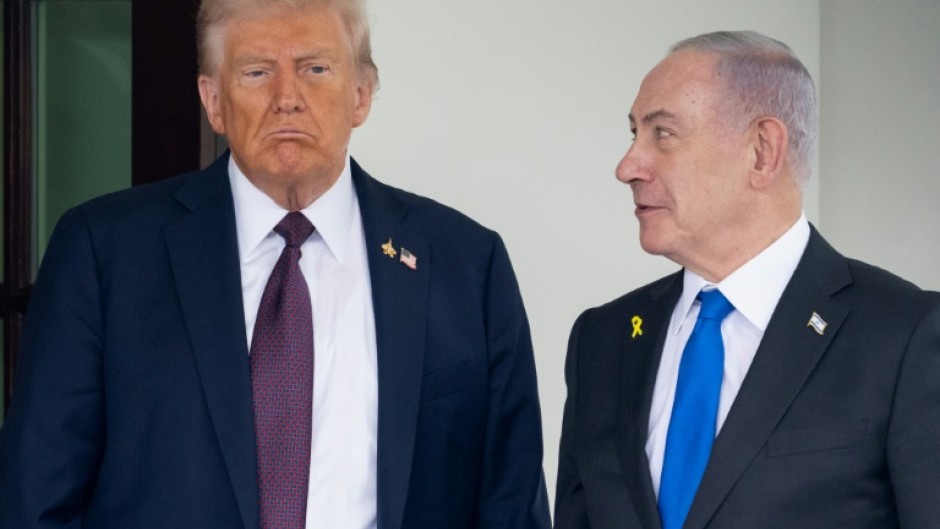
MIAMI - Israeli Prime Minister Benjamin Netanyahu will meet Donald Trump in Florida on Monday, with the US president pushing to move to the next stage of the fragile Gaza truce plan.
The crucial meeting at Trump's lavish Mar-a-Lago resort comes as some White House officials fear both Israel and Hamas are slow-walking the second phase of their ceasefire.
Trump, who said Netanyahu had asked for the talks, is reportedly keen to announce -- as soon as January -- a Palestinian technocratic government for Gaza and the deployment of an international stabilisation force.
The two leaders are to meet at 1 pm (1800 GMT), the White House said.
Israeli government spokeswoman Shosh Bedrosian said Netanyahu would discuss the second phase, which involves making sure that "Hamas is disarmed, Gaza is demilitarised."
But Netanyahu will also try to shift the focus onto Iran during his fifth meeting in the United States with Trump this year, amid reports he will push for more US strikes on Tehran's nuclear program.
Netanyahu would also bring up the "danger Iran poses not only to the region of the Middle East, but the United States as well," Bedrosian said before flying out with the Israeli premier.
Netanyahu's visit caps a frantic few days of international diplomacy in Palm Beach, where Trump hosted Ukrainian counterpart Volodymyr Zelensky on Sunday for talks on ending Russia's invasion.
The Gaza ceasefire in October is one of the major achievements of Trump's first year back in power, but his administration and regional mediators want to keep up the momentum.
Trump's global envoy Steve Witkoff and son-in-law Jared Kushner hosted senior officials from mediators Qatar, Egypt and Turkey in Miami earlier this month.
The timing of the Netanyahu meeting is "very significant," said Gershon Baskin, the co-head of the peacebuilding commission the Alliance for Two States, who has taken part in back-channel negotiations with Hamas.
"Phase two has to begin," he told AFP, adding that "I think the Americans realise that it's late because Hamas has had too much time to re-establish its presence."