
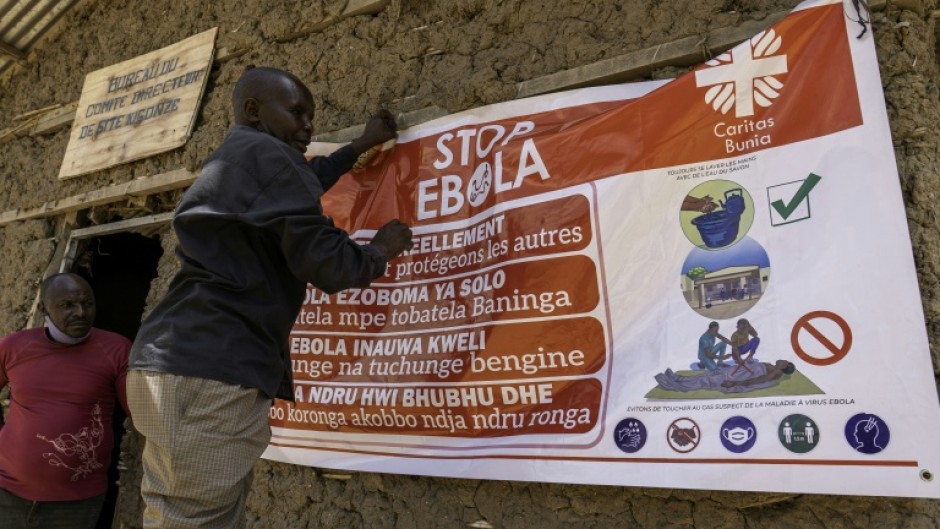
KINSHASA - The UN health chief said the Ebola outbreak in the Democratic Republic of Congo, which has claimed over 200 lives, can be stopped, as he arrived to oversee the fight against the highly infectious disease.
World Health Organization (WHO) head Tedros Adhanom Ghebreyesus's plane landed in the capital Kinsasha on Thursday evening. He is set on Friday to travel to Ituri province in the northeastern DRC, the epidemic's epicentre.
"That thing can be stopped," Tedros said, adding that the WHO did not support travel bans to combat the outbreak because they "don't help much".
"Together, we will overcome this outbreak," he said earlier, vowing to do "everything in my power to help you."
The WHO has recorded 10 confirmed and 223 suspected Ebola deaths in the DRC since the outbreak was declared on May 15, out of more than 1,000 confirmed and suspected cases, according to its latest figures up to May 24.
The true spread of the outbreak, thought to have circulated under the radar for some time, is likely much wider, the WHO has warned.
This is the 17th recorded Ebola outbreak in the vast central African country of more than 100 million people.
Complicating efforts to battle it is the fact that its epicentre lies in the east, a mineral-rich region that has been scarred by violence from various armed groups for more than three decades.
In the latest spasm of violence, the Rwanda-backed M23 has since 2021 seized swathes of territory, with fighting stepping up over the last year and a half.
Tedros has urged warring factions to stop the fighting.
"Conflict and displacement make everything harder," he said.
"I am making a direct appeal to all warring parties in this region: please, declare a ceasefire.
"No cause, no conflict, no grievance is worth condemning innocent people to death from a preventable disease."
- Vaccine in the works -
No vaccine or treatment exists for the Bundibugyo strain of Ebola, which is behind the current outbreak.
But the head of African Union's health agency said on Thursday that one should be ready by the end of the year.
"What we can tell you for sure, by the end of this year, 2026, Africa CDC will make sure that we have a vaccine and medicine against Bundibugyo," Jean Kaseya, head of Africa Centres for Disease Control and Prevention (CDC) told reporters in an online briefing.
"Our leaders are ready to invest. We are investing at technical level, at a strategic level, to make sure that (the vaccine) will happen," he added.
The WHO said it had received 4.6 tonnes of aid at the airport in Bunia, capital of the epicentre Ituri province, while UNICEF, the UN children's agency, said it was sending 100 tonnes of aid to the country.
- AFP