
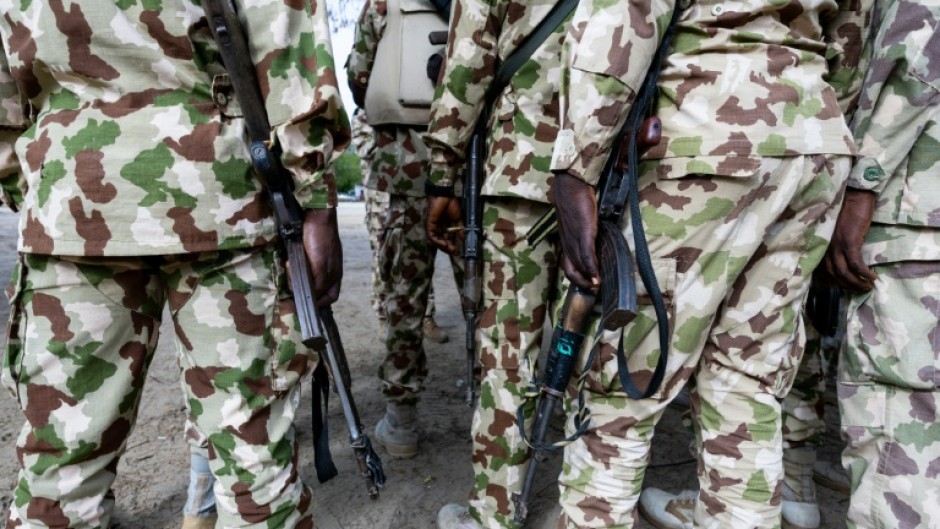
The killing of dozens of people this week in west central Kwara state is the latest grim reminder of the insecurity stalking swathes of Nigeria, driven by multiple and overlapping threats.
Nigeria is grappling with a more than 16-year jihadist insurgency in the northeast, alongside farmer-herder conflict in the north central region.
Violent secessionist agitation rumbles on in the southeast, while rampant kidnappings for ransom plague the northwest.
The unrest is inching closer to the relatively safer southwest.
The resurgence of deadly attacks and mass kidnappings followed US President Donald Trump's unsubstantiated allegation late last year that violence by radical Islamists in Nigeria amounted to the "persecution" and "genocide" of Christians.
Nigeria has rejected that claim.
This week's attacks on a predominantly Muslim district are the latest in a wave of killings targeting both Christians and Muslims.
Although no group has claimed responsibility, President Bola Tinubu blamed the Boko Haram jihadist group for the mass slaughter. Analysts say a faction of Boko Haram is responsible.
Here is a look at the groups responsible for the violence in Africa's most populous country:
- Islamist jihadists -
Nigeria has faced a jihadist insurgency in its northeast since 2009, led by Boko Haram and its rival offshoot, the Islamic State West Africa Province.
The insurgency has killed more than 40,000 people and displaced over two million, according to the United Nations.
Several other armed groups, some linked to northeastern jihadists, have also established themselves in the northwest.
Some researchers have recently linked an armed group known as Lakurawa, the main jihadist group operating in Sokoto state, to the Islamic State Sahel Province, which is largely active in neighbouring Niger and Mali, though others remain doubtful.
Research into Lakurawa has been complicated by the term having been used to describe various armed fighters in the northwest.
Lakurawa "have intensified victimisation of civilians" in the days after US strikes on Christmas Day, according to Taiwo Adebayo, a researcher with the Pretoria-headquartered Institute for Security Studies (ISS).
Authorities have not said how many fighters may have been killed and from which groups. But Adebayo said "we learned that more than 100" militants were killed, with many missing and dispersed.
There are also growing fears that the Al-Qaeda-affiliated Group for the Support of Islam and Muslims (JNIM) may become established in Nigeria after it claimed its first attack in the country in Kwara state in October.
The JNIM, which is active in Mali, Burkina Faso, Niger and Benin, is the deadliest jihadist group in west Africa.
- Kidnapping gangs -
Gangs known in Nigeria as "bandits" frequently carry out mass kidnappings for ransom and loot villages, particularly in the northwest.
The kidnappings are predominantly ransom-driven and the crisis has "consolidated into a structured, profit-seeking industry" that raised about $1.7 million between July 2024 and June 2025, according to a report by Lagos-based consultancy SBM Intelligence.
"While jihadists are motivated by certain ideologies, bandits are driven by money," Confidence McHarry, a security analyst at SBM Intelligence, told AFP.
- Herders and ethnic militias -
In parts of Nigeria's central region, clashes between mostly Christian farmers and Muslim Fulani herders have claimed thousands of lives over the past decade.
Researchers say the violence is driven more by competition over dwindling resources than religion.
Climate change impacts and rapid population growth have worsened social tensions and fuelled violence.
Ethnic militias have emerged in recent years to defend local Christian communities against nomadic herders, further entrenching cycles of violence.
"Their activities have contributed to the persistence" of insecurity in the north central region, said ISS's Adebayo.
He said local communities have also armed youths to fight one another over arable land, describing it as a "big, overlooked conflict".
- Secessionist groups -
Despite limited international media attention, secessionist groups have been blamed for hundreds of deaths in Nigeria's southeast.
Authorities have routinely accused the Indigenous People of Biafra (IPOB) and its affiliated paramilitary group, the Eastern Security Network, of carrying out deadly attacks.
Across the region, more than 1,800 people were killed by state and non-state actors between January 2021 and June 2023, according to Amnesty International. SBM Intelligence puts the figure lower, estimating about 700 deaths between 2021 and 2025.
By Tonye Bakare With Samad Uthman In Abuja