

President Donald Trump has warned that Iran would be wiped "off the face of this earth" if Tehran ever succeeded in assassinating the US leader.
Arch foes Iran and the United States in recent days have threatened broadscale wars if the leaders of either country are killed.
It came as both nations traded barbs over a protest wave Tehran blames on Washington, after Trump threatened military action if more protesters were killed in a deadly crackdown by Iranian authorities.
Here are the latest developments:
- 'Set their world on fire' -
Trump reiterated his warning that Iran would be destroyed in an interview aired Tuesday in response to a question on the Islamic republic's threats on the 79-year-old's life.
Earlier Tuesday, Iranian General Abolfazl Shekarchi was quoted as saying Trump already knew Tehran would not hold back if the tables were turned.
"Trump knows that if a hand of aggression is extended toward our leader, we will not only sever that hand," Shekarchi was quoted as telling Iranian state media.
"But we will set their world on fire and leave them no safe haven in the region."
Foreign Minister Abbas Araghchi in an opinion piece published on Tuesday in the Wall Street Journal said Iran would not hold back if attacked, but called for diplomacy and "respect" for his country.
"Unlike the restraint Iran showed in June 2025", during a 12-day war with Israel backed and joined by Trump, "our powerful armed forces have no qualms about firing back with everything we have if we come under renewed attack," he said.
- 'Decisive' action -
Triggered on December 28 by smaller protests over economic hardship, nationwide rallies surged in Iran on January 8, challenging the Islamic republic in power for over four decades.
Rights groups have said several thousand people were killed in the ensuing crackdown, but authorities -- who deem the demonstrations "riots" instigated by "terrorists", have not issued an overall official toll.
The judiciary chief Gholamhossein Mohseni Ejei on Wednesday said the figures circulating were "far from reality".
The national police chief said "decisive" action against those authorities hold responsible for the violence continued, as accessing information from inside Iran remains challenging due to an ongoing internet clampdown.
The Norway-based Iran Human Rights NGO says it has verified the deaths of 3,428 protesters killed by security forces, confirming cases through sources within the Islamic Republic's health and medical system, witnesses and independent sources.
- Kurd opposition party attacked -
An Iranian Kurdish opposition party headquartered in Iraq accused Iran on Wednesday of conducting a rocket and drone attack on its premises, killing one of its members and wounding two others.
"We believe the reason we were targeted is because of our activities, particularly our calls for people in Iran to protest against the regime, and especially because we also have an organised and trained military force," a party official told AFP.
The Kurdistan Freedom Party, founded in 1991 in Iran, includes fighters who took part in battles in Iraq against the Islamic State group.
Since the 1980s, when Iraq was under the rule of Saddam Hussein, several Iranian Kurdish opposition parties have built up a presence in Iraq.
Iran classifies the groups as "terrorists" and separatist groups, and regularly accuses them of carrying out attacks against Iranian forces.
In 2022, during another wave of protests sparked by the death in custody of an Iranian Kurdish woman named Mahsa Amini, Iran also struck the headquarters of Iranian opposition groups in Iraqi Kurdistan.
- 'Completely charred' -
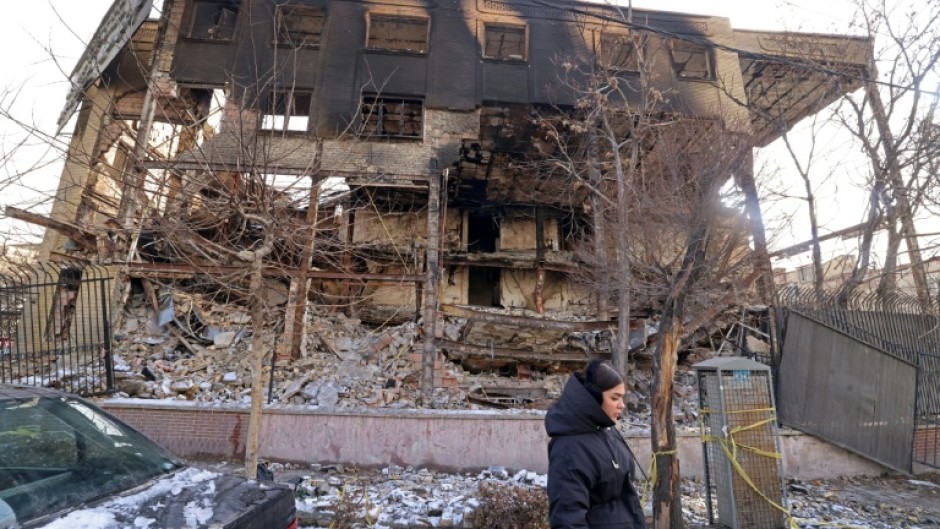
Tasnim news agency reported on Wednesday that "rioters" attacked and burned hundreds of private and public buildings, including attacking 314 governmental buildings and burning 155 more, as well as damaging hundreds of banks, shops and mosques.
The Tehran municipality on Wednesday showed journalists roughly a dozen charred buses lined up in the parking lot of a bus depot in the capital.
Iraj Lotfizadeh, head of the bus operations in district 3 of Tehran, said "22 buses were completely charred across all of Tehran" on January 8, when demonstrations exploded in size and intensity, with more vehicles damaged the following day.
Nearby, soot covered parts of the blue tiled ceramic entrance of a mosque where walls were also blackened and doors damaged.
Banners that once hung printed with prayers and quranic verses were torn down and strewn about the floor alongside several burnt motorcycles.