
JERUSALEM - Israel said on Wednesday its forces had killed another top Iranian official, Intelligence Minister Esmail Khatib, and said its military was authorised to kill any senior figure of the Islamic republic in its sights.
The announcement, the day after Iranian security chief Ali Larijani was confirmed killed in an Israeli strike, is part of a longstanding strategy by Israel to target its enemy's leaders.
"Last night Iran's Intelligence Minister Khatib was also eliminated," Israeli Defence Minister Katz said in a statement.
"Prime Minister Benjamin Netanyahu and I have authorised the IDF to eliminate any senior Iranian official for whom the intelligence and operational circle has been closed, without the need for additional approval," he added.
"We will continue to thwart and hunt them all down."
There was no immediate comment or confirmation from Iran, which had responded with fury and vows of revenge to the death of Larijani.
The two sides have been at war for more than two weeks since US-Israeli attacks on Iran on February 28 killed supreme leader Ayatollah Ali Khamenei and ignited a regional conflict.
Israel said this week it had also targeted Akram al-Ajouri, head of the military wing of Hamas-ally Palestinian Islamic Jihad, in a strike in Iran.
And it has vowed to hunt down Iran's new supreme leader, Mojtaba Khamenei, who has not appeared in public since he succeeded his father.
David Khalfa, co-founder of the Atlantic Middle East Forum, described Israel's strategy as "a campaign of 'counter-regime warfare'".
It was "aimed at dismantling the regime's politico-security architecture to make it waver on its foundations", he wrote on X before the news on Khatib.
- Funeral crowds -
Large crowds gathered in central Tehran on Wednesday for the funerals of Larijani and Soleimani, according to images broadcast by Iranian state television.
They were held alongside the funerals of more than 80 Iranian sailors killed in a US torpedoing of their frigate off Sri Lanka earlier this month.
Trucks carrying coffins draped in Iranian flags moved through the procession, as mourners walked alongside them, carrying portraits of the slain supreme leader and beating their chests, a traditional sign of mourning in Shia culture.
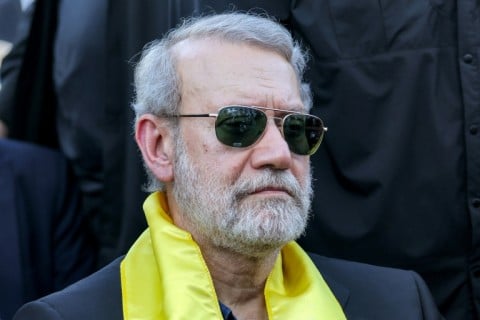
In contrast to Mojtaba Khamenei, Larijani, 68, had walked openly with crowds at a pro-government rally last week in Tehran.
He had "effectively been the figure in charge of the regime's survival, its regional policy and its defence strategy," Khalfa told AFP.
Israel has pursued what analysts have described as a policy of decapitation against Iran and the militant movements it backs in the region.
It killed Hassan Nasrallah, the longtime leader of Hezbollah, in 2024 as well Hamas's top figures since the Palestinian group's October 7, 2023 attack that sparked the Gaza war.
Despite losing its supreme leader of nearly four decades and now Larijani, a key pillar of the Islamic republic, the powerful Revolutionary Guards and the leadership as a whole have remained defiant.
The Guards, the ideological arm of the military, said they had launched missiles at central Israel in retaliation for Larijani's death and warned of more to come.
The "pure blood of this great martyr... will be a source of honour, power and national awakening against the front of global arrogance," they said.
- Deadly strikes -
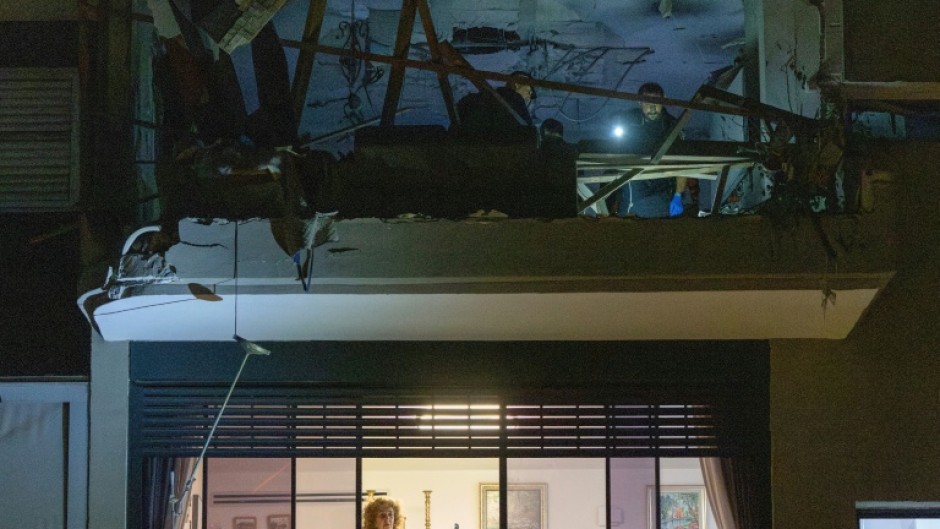
An Iranian missile barrage killed two people near Israel's commercial hub of Tel Aviv, medics said on Wednesday, while authorities said falling munitions hit multiple sites in central Israel overnight.
Police said a cluster bomb hit a residential building in Ramat Gan, a city just outside Tel Aviv, and the roof collapsed on an elderly couple.
Omer, a resident of the area who only gave his first name, said "we heard like a streak of booms... it was not just one, it was a splitting missile".
Iranian media meanwhile said Israel and the United States had launched fresh strikes across several areas of the country, including Tehran.
Tasnim news agency said "seven people were killed and 56 were injured in an American-Zionist attack on residential areas in Dorud town" in Lorestan province.
AFP could not independently verify the figures.
The war has engulfed the region, from Gulf nations to Iraq and nearby Lebanon.
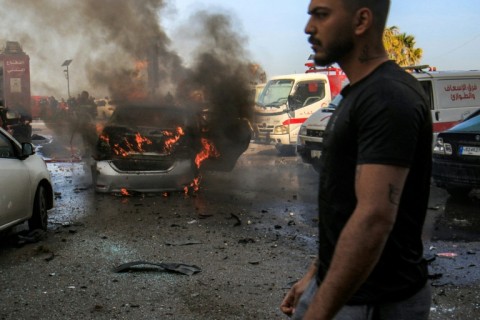
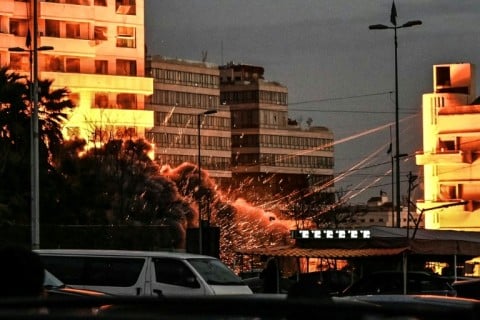
In Lebanon, Israel struck central Beirut multiple times on Wednesday.
The country was drawn into the conflict when the Iran-backed group Hezbollah launched rockets towards Israel over the ayatollah's death.
Lebanese authorities reported at least 12 dead, while AFP journalists said three densely populated neighbourhoods in the heart of Beirut were hit.
- Iranian gas facility hit -
In addition to the human toll of the war, with hundreds killed and millions displaced, the conflict has hit the global economy.
Oil prices shot up to around $100 a barrel after Iran attacked energy infrastructure in the oil-rich Gulf as well as shipping, all but closing the Strait of Hormuz, a waterway through which a fifth of global oil and LNG travels in peacetime.
US-Israeli strikes hit Iranian facilities at a major Gulf gas field on Wednesday causing a fire, Iranian state television reported.
The South Pars/North Dome mega-field is the largest known gas reserve in the world, supplying around 70 percent of Iran's domestic natural gas.
By Afp Teams In Jerusalem, Tehran, Beirut And Washington