
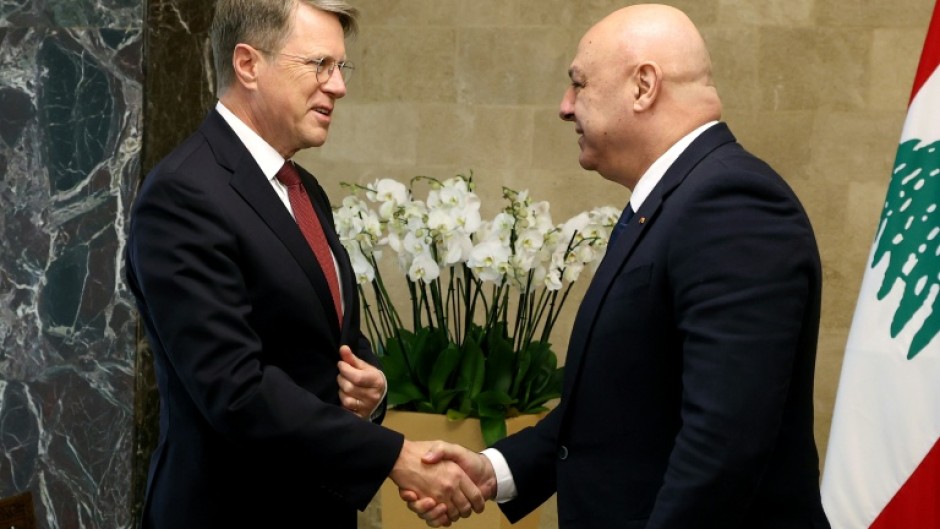
Lebanese President Joseph Aoun on Friday told a United Nations Security Council delegation his country does not want war with Israel, days after civilian representatives from both sides held their first talks in decades.
Hezbollah chief Naim Qassem, whose militant group refuses to disarm, on Friday backed Lebanon's pursuit of diplomacy but called the inclusion of a civilian representative in talks with Israel a "misstep".
During Aoun's meeting with UN Security Council ambassadors, the president said the Lebanese "do not want war again, the Lebanese people have suffered enough and there will be no going back", according to a presidency statement.
Aoun called on the envoys to support the Lebanese army's efforts to disarm non-state groups. The army expects to complete the first phase of its government-approved plan by the end of the year.
"The Lebanese army will play its full role... The international community must support and assist it," Aoun said.
He added there was "no going back" on the decision, "even if it requires some time, because the Lebanese are tired of military confrontations".
Despite a November 2024 ceasefire that was supposed to end more than a year of hostilities between Israel and Iran-backed Hezbollah, Israel has kept up strikes on Lebanon and has also maintained troops in five south Lebanon areas it deems strategic.
- 'Under fire' -
On Wednesday, civilian representatives from Lebanon and Israel joined the meetings of a committee tasked with monitoring the ceasefire, a move Aoun has said was to avoid a second war on Lebanon.
In a televised address, Hezbollah chief Qassem said his group supports the state's decision to choose "diplomacy to end the aggression and implement" the ceasefire, but he strongly criticised the inclusion of a civilian representative.
"We consider this measure an additional misstep on top of the sin" of the government's decision in August to task the army with disarming Hezbollah, he said.
"This concession will not change the enemy's position, nor its aggression or occupation," he added, urging authorities to reconsider.
Aoun emphasised Friday "the need to pressure the Israeli side to implement the ceasefire and withdraw, and expressed his hope for pressure from the delegation".
He said that any outcome from these talks "depends primarily on Israel's position, upon which the negotiations will either reach practical results or fail".
The committee will hold a new round of talks, with the civilian representatives included, starting December 19.
- 'Clear violations' -
The UN delegation visited Syrian capital Damascus on Thursday and met with Lebanese officials on Friday. It is due to inspect the border area in southern Lebanon the following day, accompanied by US envoy Morgan Ortagus.
After meeting with the delegation, Parliament Speaker Nabih Berri, a close ally of Hezbollah, stressed that "negotiating under fire is unacceptable".
"Stability in the south requires Israel's adherence to UN Resolution 1701 and the ceasefire agreement by halting its daily violations and withdrawing behind the international border," he added, referring to a UN resolution that ended the 2006 war between Hezbollah and Israel.
On Thursday, Israel struck four southern Lebanese towns, saying it was targeting Hezbollah infrastructure including weapons depots to stop the group from rearming.
UN peacekeepers called the strikes "clear violations of Security Council resolution 1701".
The peacekeepers also said their vehicles were fired on by six men on three mopeds near Bint Jbeil on Thursday. There were no injuries in the incident.
Hezbollah refuses to disarm but has not been responding to Israeli attacks. It has, however, promised a response to the killing of its military chief in a strike on Beirut's southern suburbs last month.