
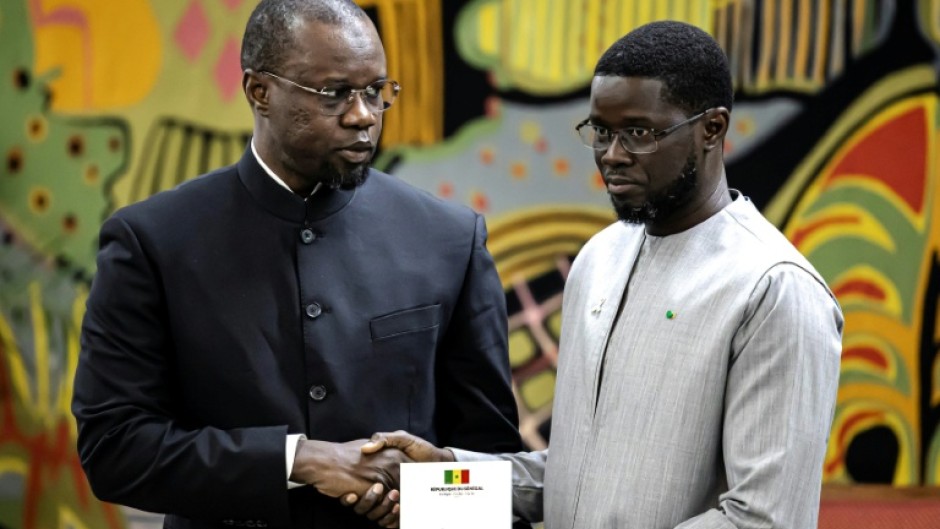
DARKAR - After months of public tensions, Senegal's president last week fired his prime minister and former ally, the charismatic politician Ousmane Sonko, who was elected on Tuesday as speaker of parliament.
Sonko, the fiery leader of the sovereigntist Pastef party, was banned from running in the 2024 presidential election, and allowed his second-in-command and behind-the-scenes strategist, Bassirou Diomaye Faye, to stand instead.
Two years later, their partnership has not withstood the test of time.
Here is a look back at the long-predicted breakup:
Public tensions
Tensions began to surface as early as July 2025 when the outspoken prime minister launched a scathing attack on the president, denouncing a "failure of leadership" in the west African country.
Following the outburst, Pastef activists flooded Faye's social media with hostile messages, in a demonstration of Sonko's popular support.
Since then, the disagreements have multiplied.
Earlier this month Faye took a shot at Sonko, stating in an interview that the party must be "depersonalised from the leader who embodies it".
As long as Sonko "remains prime minister, it is because he retains my confidence", Faye warned at the time.
Legal proceedings
Sonko regularly criticised the slow pace of prosecution against former officials from the administration of Macky Sall, who served as president from 2012 to 2024 and is an arch nemesis of Sonko.
Several former officials, including ministers under Sall, have been indicted by the High Court of Justice, a special court, for embezzlement in separate cases.
The court is responsible for trying former members of the government for offences committed in the course of their duties.
The cases are still pending, which has elicited criticism from supporters of Pastef, which has historically championed the fight against corruption.
Having come to power on a promise of breaking with the old ways, Faye and Sonko had also pledged to deliver justice for the dozens who died and hundreds who were arrested during protests under Sall's presidency.
IMF loans
The breakup between the two leaders has cast doubt on how Senegal's enormous debt, which has reached 132 percent of GDP, will be addressed -- a point of contention between Faye and Sonko.
When the pair came to power in 2024, they accused Sall's government of hiding a part of the debt, leading to the suspension of a $1.8-billion IMF aid programme it had agreed in 2023.
While Faye prefers a more conciliatory approach with the institution regarding a new aid programme, Sonko rejects any debt restructuring.
In the meantime, Senegal has turned to sub-regional financial markets to borrow at very high interest rates.
Political funds
On Friday morning, just hours before his dismissal, the prime minister criticised the president during a speech in parliament regarding the oversight and transparency of political funds whose use is up to the president's discretion.
While the Pastef party had promised to tackle the excessive powers granted to the presidency, Sonko criticised the president for not having initiated a bill to ensure the transparency of these funds.
From allies to rivals
Will these former allies now become political rivals?
Sonko, who enjoys undeniable popular legitimacy, would be the natural candidate to run for his party in the 2029 presidential election.
But Faye has been garnering political support for several months through his "Diomaye president" movement, suggesting a possible candidacy.
Now the head of a loyal parliament, Sonko has become the second most important figure in the state.
Despite Sonko's promise not to use "this responsibility to orchestrate institutional chaos", the question remains as to whether Faye will be able to govern and implement reforms in the country.
- AFP