
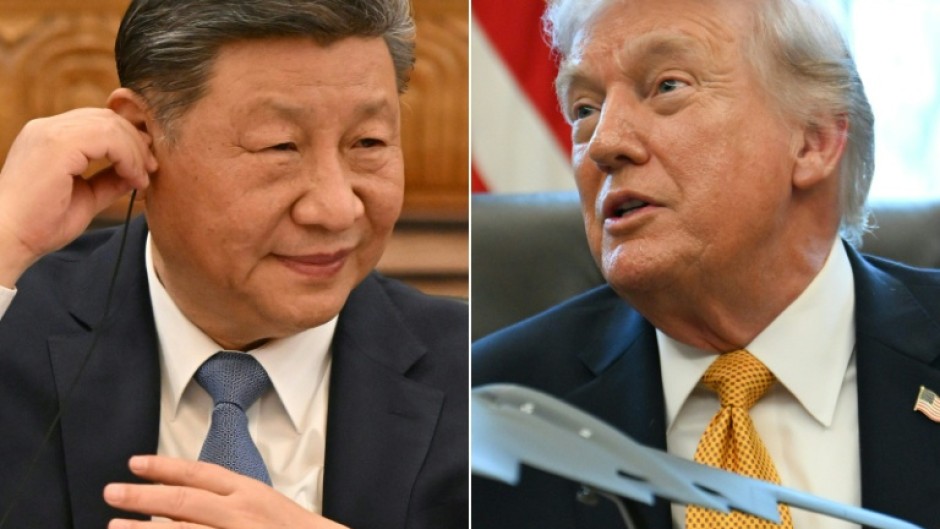
BEIJING - China will be in a stronger position to extract concessions from Donald Trump when the US president finally visits Beijing after becoming entangled in his Middle East war, analysts say.
Trump had been due in the Chinese capital at the end of this month for talks with President Xi Jinping, but has delayed his trip by several weeks to deal with the fallout from the war.
His decision last month to join Israel in strikes on Iran has plunged the Middle East into violence, pushed energy prices to years-long highs and seeded fears of global supply shortages due to Iran's effective closure of the Strait of Hormuz.
With Trump struggling to define how the intervention will end and traditional allies reluctant to back him, the US leader may come to China needing a diplomatic win.
"A show of US force that was meant to intimidate Beijing has instead served to puncture the illusion of US omnipotence," said Ali Wyne, a senior adviser focusing on US-China ties at the International Crisis Group think tank.
Wyne said:
"Unable to reopen the Strait of Hormuz alone, Washington now needs its principal strategic competitor to help it manage a crisis of its own making."
Trump said on Tuesday he expects to travel to China in "five or six weeks".
The prospective summit would aim to formalise a truce on tariffs that Trump and Xi shook hands on at a meeting in South Korea in October.
But Trump's weakened position could help Beijing argue for deeper tariff cuts and limit Washington's ability to push for change on other trade issues like access to critical minerals.
- New leverage -
Top Chinese and American trade officials held what they called "constructive" talks in Paris last weekend that were seen as setting the stage for a Xi-Trump summit.
Any chances of major breakthroughs on trade "seem limited", according to Dan Wang, a director on Eurasia Group's China team, with bilateral trust low after years of disputes over trade, technology and rights.
New US trade investigations into excess industrial capacity in 60 economies including China have also drawn Beijing's ire.
The Chinese leader will benefit from more strategic leverage over Trump as the war drags on, at least in the near term, analysts told AFP.
Beijing has so far ignored Trump's call for help in reopening the Strait of Hormuz, a vital artery for global oil and gas shipments.
Nor has it relaxed its tight control on exports of rare earths, an industry that China dominates and provides certain critical minerals needed in US weaponry.
US military demand for certain "heavy" rare earths far exceed commercial needs, Jason Bedford, visiting senior research scholar at the National University of Singapore's East Asian Institute, told AFP.
They are used for equipment including drones, jet fighters, missile guidance systems and radar, said Bedford.
While the size of US military stockpiles is a "closely guarded secret", he said, "in theory, (China) could certainly disable new weapons production".
The absence of announcements on Hormuz or rare earths suggests "no concrete results were made during the trade talks" in Paris, said Wang of Eurasia Group.
Xi and Trump "have other chances to meet this year", but "the prospects of getting breakthroughs beyond lower tariffs seem limited", she told AFP.
- 'Not reliable' -
China could also calibrate its actions to make Trump's domestic position shakier at a time when a majority of Americans already oppose military action in the Middle East.
Trump and his negotiators "want China to buy US agricultural products, which is important to the midterm elections for the Republicans", said Wu Xinbo, director of the Center for American Studies at Shanghai's Fudan University.
Wu said:
"If you cannot stabilise relations with China, you have to face some big challenges."
Any Xi-Trump summit is unlikely to succeed in changing either side's broader geostrategic aims.
By Peter Catterall