
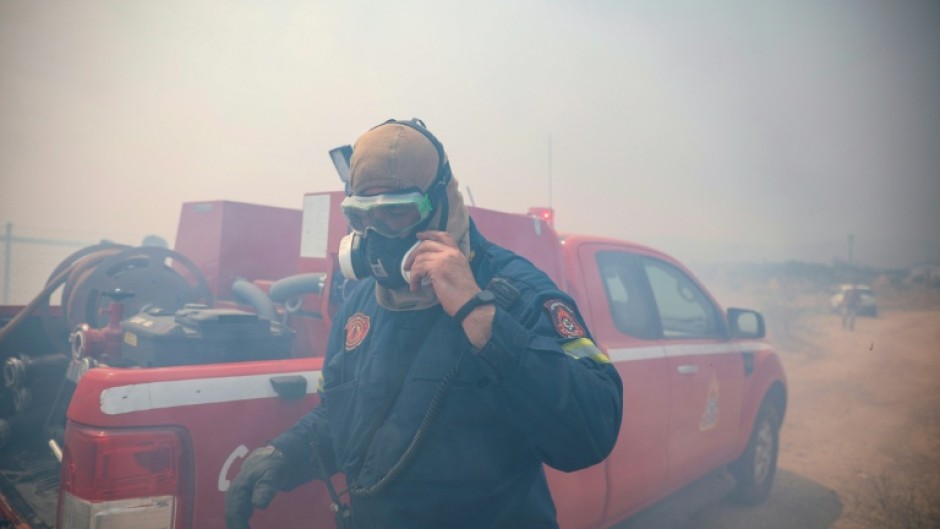
ATHENS - Water-bombing aircraft resumed firefighting operations in Greece on Monday after winds eased, joining hundreds of firefighters battling multiple blazes that have already claimed five lives.
Greece, which had largely avoided major blazes at the start of the summer unlike France and Spain, is now grappling with a second consecutive week of wildfires that have scorched thousands of hectares of forest, scrub and farmland.
The main fires were currently near the villages of Kandyli Megara and Agia Skepi, around 50 kilometres by road west of Athens, Yannis Artopios, a spokesperson for the fire department, told state TV ERT.
"If we had to describe the current situation with the fire, we would say that there has been an improvement, but that there is absolutely no reason to let our guard down," he said.
Vast areas affected by the fire still contained active or smouldering hotspots, which require constant monitoring, since even a strong gust of wind could cause the flames to reignite, Artopios explained.
Other minor fires across the country, such as the one on the island of Cephalonia, Greece's popular holiday destination, in the Ionian Sea "have been contained," he said.
Lighter winds allowed aerial firefighting operations to resume early on Monday, a department spokesperson told AFP.
The fire service said 13 aeroplanes, 12 helicopters and about 450 firefighters were battling the flames in the regions of Boeotia and Attica.
In recent days, wind gusts reaching 80 kilometres per hour had grounded aircraft for safety reasons, hampering firefighting efforts.
Authorities ordered new evacuations on Monday morning in villages near Kandyli, about 45 kilometres west of the capital, Greece's Civil Protection agency said.
"The battle against the fires is uneven," Deputy Minister for Civil Protection and Climate Crisis Kostas Katsafados told public broadcaster ERTNews on Monday.
'Extremely difficult'
The wildfires have claimed five lives since last week.
On Sunday, two Bell helicopters collided while conducting firefighting operations near Psatha.
Local media said a Danish pilot and a Greek co-pilot aboard one of the aircraft were killed, while the British pilot and Greek co-pilot of the other aircraft were injured and taken to hospital.
Pending the outcome of an official investigation, all Bell helicopters deployed to the firefighting operation have been grounded, public broadcaster ERT reported.
The helicopters were leased from Australia's McDermott Aviation as part of a fleet of 15 aircraft. The company said it has supported operations in Greece for the past seven years.
The pilot's deaths followed those of three firefighters who died last week while battling separate wildfires in Crete and the Peloponnese.
Prime Minister Kyriakos Mitsotakis warned that Greece faced "extremely difficult" days ahead, as high temperatures and dry conditions continued to fuel the flames.
More than 12,000 hectares of forest and agricultural land have burned over the past week, according to analyses from the European Union's Copernicus Earth observation programme cited by local media.
Greece, like much of the Mediterranean region, has experienced increasingly frequent and intense wildfires that scientists link to climate change.
Police have arrested two employees of an electricity utility company in connection with one of the fires, which investigators believe may have been sparked on Friday by an electrical cable near the coastal village of Porto Germeno on the Gulf of Corinth, about 60 kilometres by road west of Athens.
At the height of the tourist season, authorities warned that the wildfire threat would remain "very high" on Monday.
Civil Protection placed Attica, which surrounds the capital, and neighbouring Boeotia at level four on a five-point fire danger scale.
- AFP