
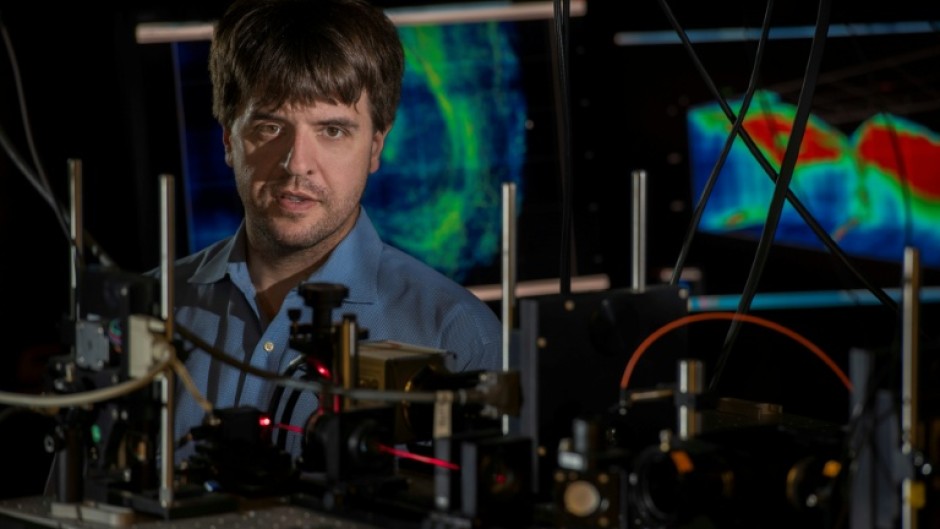
WASHINGTON - Nobel Prize-winning American researcher Karl Deisseroth is a psychiatrist, neuroscientist and bioengineer who has spent more than two decades illuminating the workings of the brain to unlock its mysteries.
The Stanford University scientist spoke to AFP about the Nobel Prize in medicine, which was awarded on Monday, for his work in optogenetics -- a technique combining light and genetics -- alongside German scientists Peter Hegemann and Georg Nagel.
The trio were honored "for their discovery of a molecular switch for nerve cells," the Nobel Assembly said.
- What is the advantage of your approach? -
"This is a long-sought goal in neuroscience because the brain is so complicated with billions of cells that are next to each other and do completely different things," Deisseroth told AFP.
"We needed a way to resolve them, to control one without affecting the other. And the way to do that, as it turns out, is to take something that they normally don't respond to at all, which is light, and give the capability to just some of the cells to respond to light.
"And then, you've got a great way to be specific."
- How does this work change psychiatry? -
Using light, researchers are now able to switch individual neural circuits on or off in a brain.
They have also been able to reveal neural circuits governing specific memories, feelings and behaviors relevant for neurological and psychiatric disorders.
"Unlike most other fields of medicine, in psychiatry we haven't had a good model for what's actually different," Deisseroth said.
"In cardiology, we can model everything about all the diverse symptoms of heart failure by looking at the heart as a failing pump. It's not pumping as well, and we can quantify how badly it's pumping.
"With the brain, we haven't had that. We haven't had a measurable that we can say, 'Oh, this part is not working well enough.'
"In psychiatry it's been a problem, and optogenetics has started to address that because we can say, 'these cells are too active' or 'not active enough,' and that guides us in a very powerful way."
- Is there a potential therapeutic effect? -
"Once you know the cells that are involved, you can study those cells, see which medications or which drugs that cell might respond to, and then you can test those medications in a way that really cuts through a lot of the guesswork in clinical trials," Deisseroth said, adding "that is exciting because it's much more general."
"And there are big clinical trials now that have come out of phase II and entering the final phase, phase III of clinical trials, based on indirect optogenetics for autism and for schizophrenia that are looking promising."
- What could such treatments do for patients? -
"I'll give an example with autism. There are treatments, medications that are currently given for irritability in autism -- that's the syndrome of aggression and irritated discontrol that people with autism can have that causes a lot of trouble.
"So, what do we do with that now? All we have are very, very strong medications that are called antipsychotics. These are medications that cause a lot of weight gain, a lot of sedation. They cause abnormal movements, a lot of side effects, but they're still used because people are so desperate for help.
"Now, what's going into phase III studies is a non-antipsychotic for irritability in autism. It's completely different."
Deisseroth offered another example with Parkinson's disease, a progressive brain disorder that can cause shaking, stiffness and difficulty controlling movement.
"Parkinson's is a very interesting disorder because there's death of a kind of neuron called a dopamine neuron. But dopamine neurons do a lot of different things in the brain. They affect planning. They affect movement. They affect reward or pleasure. They affect vomiting. They affect nursing. All these different things.
"And so our medications for Parkinson's cause a lot of problems because you're driving dopamine action in all these different domains, and it causes trouble.
"Our hope is with optogenetics we'll get more specific treatments, so we just affect, for example, movement, which is a primary problem in Parkinson's."
- What does this mean for neurotech devices? -
"Brain-computer interfaces are largely implemented with electricity. So there, there's electrical recording of activity, and in some cases, if activity is fed back in, there's electrical stimulation as well.
"Optical methods in principle provide another way for communication to happen. You can use, in principle, light instead of electricity. I would say that this as a potential application is a bit more farther out, though. It's an interesting thing, but one that probably will take a little time to build."
- by Charlotte Causit (AFP)