
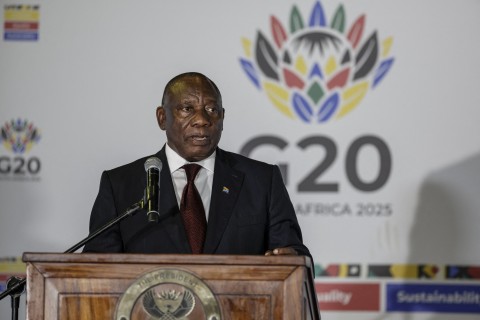
President Cyril Ramaphosa speaks at a press conference during the G20 Foreign Minister Meeting at the Nasrec Expo Centre in Johannesburg on February 20, 2025.
South Africa is current chair of the G20 and in November, will host leaders of the Group in Johannesburg. In the runup to the meeting, this series aims to keep you informed and updated.
JOHANNESBURG - The G20, short for the Group of Twenty, is one of the most influential international forums in the world. It brings together the globe’s largest economies to tackle critical issues affecting global growth, financial stability, and development. South Africa holds the presidency for 2025.
Who’s in the G20?
The G20 is made up of 19 countries plus the European Union, representing a mix of both advanced and emerging economies. Together, they account for:
- Over 80% of global GDP
- Around 75% of international trade
- Nearly two-thirds of the world’s population
Members include:
Argentina, Australia, Brazil, Canada, China, France, Germany, India, Indonesia, Italy, Japan, Mexico, Russia, Saudi Arabia, South Africa, South Korea, Turkey, the United Kingdom, the United States, and the European Union.
Why Was the G20 Formed?
The G20 was established in 1999 in the wake of the Asian financial crisis, initially as a meeting of finance ministers and central bank governors. Its goal: to improve coordination on global financial and economic issues.
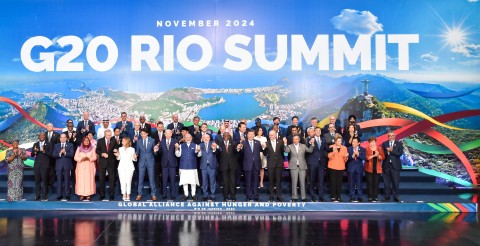
After the 2008 global financial crisis, the G20 was elevated to a leaders’ summit level, giving it greater authority and visibility in shaping global economic policies.
What Does the G20 Do?
The G20 doesn’t create binding laws, but it sets the agenda for many of the world’s most pressing economic and political issues. These include:
- Global economic growth and stability
- Trade and investment
- Financial regulation
- Climate change and energy transitions
- Tax cooperation and digital economy governance
- Development and poverty reduction
- Health crises and pandemic preparedness
It also works closely with major international institutions like the International Monetary Fund, World Bank, World Trade Organisation, and the United Nations.
How Does It Work?
The G20 doesn’t have a permanent headquarters. Instead, a different country holds the presidency each year, setting the agenda and hosting key meetings, including the annual G20 Leaders' Summit.
There are also frequent meetings of finance ministers, central bank governors, business leaders, and civil society representatives throughout the year.
Why Does It Matter?
In a world of growing economic uncertainty and global challenges, the G20 plays a crucial role in fostering international cooperation. When the world faces crises, like financial meltdowns, pandemics, or energy shocks the G20 is often the first platform where leaders come together to coordinate a response.
Its decisions influence global markets, affect international trade, and shape policies that impact millions of people across the world.
While it is not a global government, the G20 is a powerful forum that helps steer the global economy. Its relevance continues to grow as nations grapple with interconnected challenges in an increasingly complex world.
By: Rofhiwa Madzena ( Producer and anchor on eNCA).