
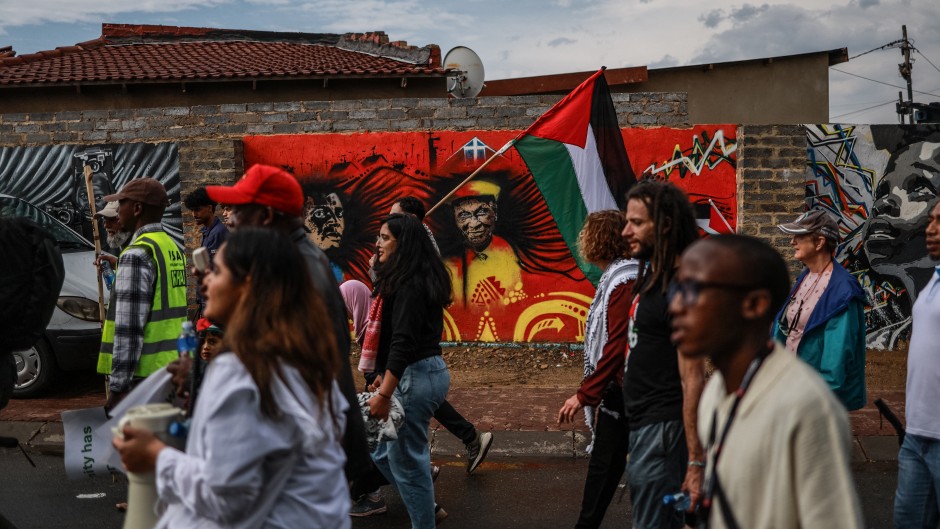
File: Protesters from South African Christians for Palestine and the Muslim community hold pro-Palestinian posters and flags during their march in Soweto
South Africa’s foreign policy has drifted from principled broker to peripheral commentator, forfeiting leverage precisely when leverage was there to be used. The country that once turned moral capital into practical influence now settles for statements, court filings, and applause lines that do not change outcomes in Israel–Palestine, Rwanda–DRC, or the Israel–Iran standoff.
Foreign policy is the posture a state adopts toward other states and non-state actors. It evolves in a messy world and rarely aligns perfectly with tidy doctrine. Yet coherence matters because credibility is the currency of mediation. Over the past two years, Pretoria’s rhetoric has been inconsistent in application — talking non-alignment while telegraphing selective outrage, courting Western markets while baiting Western partners, and leaning on BRICS symbolism without building any bilateral ties that produce concessions.
It wasn’t always this way. In the late 1990s and early 2000s, South Africa paired constitutional values with patient craft: Mandela’s interventions from the Niger Delta to the Great Lakes, Mbeki’s facilitation in Congo and Côte d’Ivoire, and a habit of quiet persuasion that earned trust across divides. That reputation — hard won and globally recognised — has frayed. Today, Pretoria’s moral certainty is undermined by asymmetry: a maximalist posture on Gaza, studied ambivalence on Ukraine, and personalised spats closer to home. Selectivity erodes trust. Mediators need all parties to believe they will be heard; advocates only need their side to be cheered on.
The Palestinian file exposes the decline. The real negotiations on ceasefires and hostages sit with Cairo, Doha, and Washington—actors with border leverage, money, and security guarantees. South Africa is not invited to that table. It chose litigation and condemnation over genuine talks about ceasefires and prisoner exchanges. Most damning, Pretoria failed to leverage an obvious pressure point: Israel’s drive to cement a bona fide place within the African Union architecture. When a state seeks legitimacy in a multilateral club, shrewd diplomacy ties that ambition to verifiable steps — sustained humanitarian access, settlement restraint, accountability mechanisms, and political horizon commitments — while extracting reciprocal discipline from Palestinian factions on hostages, attacks on the Jewish state, and governance. Instead of orchestrating this Pretoria opted for performative theatre at the ICJ. The result was moral satisfaction without material concession.
The same missed calculus haunts the Israel–Iran shadow war. South Africa’s historical channels to Tehran and pragmatic ties across Israeli business and civil society could have enabled deniable backchannels on red lines, de-escalation, and third-party guarantees after cross-border strikes. A country that once prided itself on “talking to those you disagree with” could have convened these dialogues, fed ideas to Gulf and European intermediaries, and offered AU-adjacent monitoring concepts to cool tempers. But rhetorical alignment with Iran and public grandstanding closed doors on this. When confrontation loomed, Pretoria had no trusted access and nothing useful to trade.
Closer to home, Rwanda–DRC was the open goal that was skied. With South African troops exposed in the eastern Congo and Pretoria straddling both SADC and AU platforms, it should have been the indispensable go-between for Kigali and Kinshasa: a guarantor of ceasefire undertakings, a choreographer of deconfliction amid overlapping regional deployments, and a broker of phased demobilisation linked to political inclusion. That requires unglamorous shuttle work, even-handed pressure, and compartmentalising bilateral grievances with Rwanda. Instead, brinkmanship with Kigali hardened positions while others picked up the calls that matter. South Africa’s soldiers in theatre carried the risks of this hard-headedness without any influence to steer the political track.
Defenders will argue that legal activism shifts norms, that someone must speak for principle. Perhaps — but speaking without shaping outcomes is an alibi for irrelevance. Pretoria’s fixation on symbolism has replaced strategy. The death of AGOA, the Lady R saga, and equivocal non-alignment on Ukraine warn partners that South Africa’s positions can be noisy, late, and indifferent to the costs imposed on South African businesses abroad. Diplomatic capacity has thinned while the appetite for long, discreet processes has withered. Abroad, counterparts hear moral certainty but see little of the meticulous coalition-building that delivers reciprocal steps, verification schemes, and off-ramps.
The tragedy is that opportunities were clear and time-bound. When Israel sought deeper engagement with the AU, Pretoria could have led a continental consensus to make that legitimacy contingent on concrete, monitorable steps toward a political solution on Palestine, while demanding parallel discipline from Palestinian factions. When Israel and Iran edged toward direct confrontation, Pretoria could have used unique channels to clarify red lines and stabilise maritime spaces. When the Great Lakes needed a credible guarantor, Pretoria could have been conductor, not passenger. It chose volume over leverage and courtroom victories over negotiated gains.
What remains is a shrinking relevance: celebrated at political rallies, cited in briefs, but excluded from the rooms where the real decisions are made. That may gratify domestic politics, but it will not stop rockets over Gaza, drones over the Gulf, or atrocities in North Kivu. The country that once married moral courage to painstaking diplomacy has squandered that reputation. Unless South Africa relearns the art of quiet leverage and even-handed pressure — and wields the AU not as a podium but as a bargaining instrument — the verdict will hold: from broker to bystander, while the world moves on.
Nkateko Muloiwa
The information contained in the article posted represents the views and opinions of the author and does not necessarily represent the views or opinions of eNCA.com.