

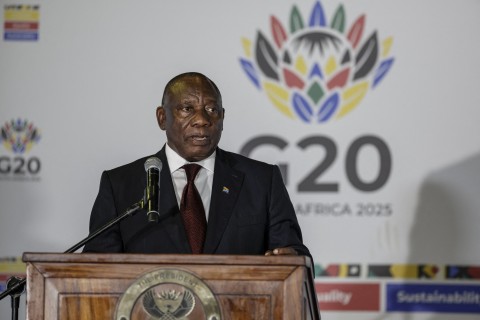
President Cyril Ramaphosa speaks at a press conference during the G20 Foreign Minister Meeting at the Nasrec Expo Centre in Johannesburg on February 20, 2025.
JOHANNESBURG - South Africa has failed to leverage its presidency of the G20 countries to strike beneficial trade deals, commercial partnerships, bring new direct investments to the country and boost economic growth.
South Africa is facing a 30 percent US trade tariff rate, which is likely to further retard economic growth, cause the collapse of many businesses and increase unemployment. The US has also slashed development aid to South Africa. South Africa’s access to the African Growth and Opportunity Act preference program under which many of the country’s manufacturing products get preferential access to the US is also likely to end.
South Africa’s economy, like many others, is also battling the flooding of state-subsidised Chinese products, which are undermining local manufacturing business and jobs.
South Africa’s G20 presidency offered the country close proximity to the largest economies in the world to organise alternative markets, foreign investment, and development funding – which South Africa has failed to take advantage of.
South Africa has a Government of National Unity government, which is a new multiparty coalition, not an ANC majority-based government, as was the case until the 2024 elections. However, in South Africa’s G20 engagements, it appears that ANC leaders are still putting forward ANC strategies on behalf of the country.
The ANC has struggled, since it secured 39.7% of the vote in the 2024 general elections to make a political culture shift from governing as a one-party dominant government, where ANC policies become government policies, to a multiparty GNU government. The ANC’s policies have not ceased to be government policies and no new policies have been constructed to reflect the views of the multiparty GNU.
The SA government’s GNU strategy was put together when the ANC was still the majority, and it was not changed, to include GNU partners positions. This is a weakness, because the diversity of the GNU presents South Africa with a diversity of ideas, energy, and capacity, which would boost the quality of GNU policies, including South Africa’s G20 presidency strategies. The GNU generating new ideas, policies and strategies to underpin SA’s G20 presidency leadership, could have also significantly boosted the cohesion of the GNU itself.
With US President Donald Trump up-ending global trade, economies and markets with his sweeping trade tariffs, most countries are seeking to as quickly as possible diversify their trade from the US to other markets.
With the G20 presidency, with countries scrambling to find alternative markets, South Africa was gifted with an opportunity to use its immediate proximity to the world’s largest economies – and their companies and their capital, to strike commercial partnerships to South Africa’s and Africa’s benefit.
Sadly, South Africa’s G20 presidency strategy mirrored South Africa’s foreign policy: it has been based on slogans, Cold War ideology and old-ANC struggle partnerships, rather than to promote the interests of South Africa, attract foreign investment and capital, and new technology to boost economic growth. This is based on the foreign policy of the ANC when it was the majority party, when its foreign policies standpoint automatically became the country’s foreign policy.
The G20 presidency has a short window of a single host year, so focusing on the right issues are critical. A lot of South Africa’s proposals have been long-term interventions, to try to secure global structural changes. These global structural changes reforms need global partnerships – which is not currently possible because US President Trump has disrupted traditional global partnerships.
In this period of chaos, South Africa’s push for global structural changes during the G20 presidency would seem to be a waste of valuable energy, resources, and opportunities. South Africa should have focused on more short-term changes for itself and for African countries. This means, South Africa should have focused on things that are practically implementable, rather than on issues, which may sound good emotionally or ideologically, but are never going to be implemented.
South Africa prioritised four overarching objects under its G20 presidency. These are strengthening disaster resilience and response, taking action to ensure debt sustainability for low-income countries, mobilising finance for a just energy transition and harnessing critical minerals for inclusive growth and sustainable development.
Rather than focus on global issues which are not going to be resolved overnight as G20 countries prioritise the US trade tariffs and China’s state-subsidised domination of global manufacturing. South Africa has also undermined its own G20 presidency by often getting embroiled in shooting itself-in-the-foot side issues.
For example, South Africa issued a flight permit to a Russian aircraft operator sanctioned by the US. An Abakan Air cargo plane, blacklisted last year by the US for transporting Russian military equipment, landed in Upington last week – this not only raised the ire of the US, but also other industrial countries.
In the context of Africa, South Africa have should cobbled together more practical immediate initiatives to boost investment, lift economic growth and help Africans deal with the negative impact of the Trump administration and other developed countries slashing of development aid in the light of the impact of the US tariffs and other geopolitical crises like Russia’s war against Ukraine and the migrant crisis.
Many developed countries have redirected development aid from Africa to rebuild Eastern Europe, and the conflict zones of Gaza and the Ukraine. It would be more useful if South Africa had used its G20 presidency to lobby for an increase in development aid from non-US developed countries that are members of the G20.
But more importantly, South Africa could have focused on securing critical immediate commercial partnerships for South Africa and Africa. It would be more useful for South Africa to strike critical mineral deals for African countries with G20 countries.
China controls critical minerals, and all industrial countries are trying to desperately diversify from China’s chokehold on the global supply of critical minerals. Many African countries have critical minerals. This offered the opportunity for South Africa to offer critical mineral deals that would involve South African and African minerals in return for guaranteed prices, infrastructure investment, beneficiation and technology and skills transfer.
If South Africa were interested in making Africa an investment destination, it could have also gotten African countries to do more to make the African Continental Free Trade Area (AfCFTA) agreement work. As G20 president, South Africa was closely engaging with African Union leaders.
In 2021, the African countries signed the AfCFTA pact designed to unify all 1.4-billion people under Africa's 54 nations into a single market. 48 African countries may have ratified the free trade deal, but only 24 African countries were actively trading under it. As the G20 president, this was an opportunity to strike commercial, development and trade deals with G20 economies for those 24 African countries that are actually adhering to the agreement.
Business Leadership South Africa CEO Busisiwe Mavuso said success for South Africa’s G20 presidency will hinge on convincing investors that the country is open for business and capable of driving growth across the continent. The sad thing during its G20 presidency, South Africa has actually shown that it is closed to business. President Cyril Ramaphosa and ANC leaders have insisted on continuing failed, outdated ideological policies, rather than adopting more growth-generating policies, and so presenting the country as investment friendly.
For example, the threat of the ANC’s expropriating without compensation policy, undermines property rights, which includes shares, pension funds and businesses from local and international companies and individuals. The ANC’s strategy of cadre deployment which ‘deploy’ individuals to strategic positions in the public sector, state-owned entities and democratic oversight institutions on the basis of their political connections, has caused the failure of these institutions, undermining economic growth.
The ANC’s strategy of Black Economic Empowerment, which has empowered mostly political capitalists, individuals who are connected to politicians ANC, who often set up businesses only to secure a government contract or a shareholding in an existing business, has undermined genuine black entrepreneurs who cannot secure government contracts or BEE partnerships. The ANC has doubled down on these anti-investment policies.
South Africa’s G20 presidency is one of the biggest missed opportunities, at a time when South Africa needs every lucky break to lift economic growth, attract investment, capital, and technology to create jobs, tackle poverty, and secure social peace.
- William Gumede is based at the School of Governance, University of the Witwatersrand, Founder of the Democracy Works Foundation and author of South African in BRICS (Tafelberg).