
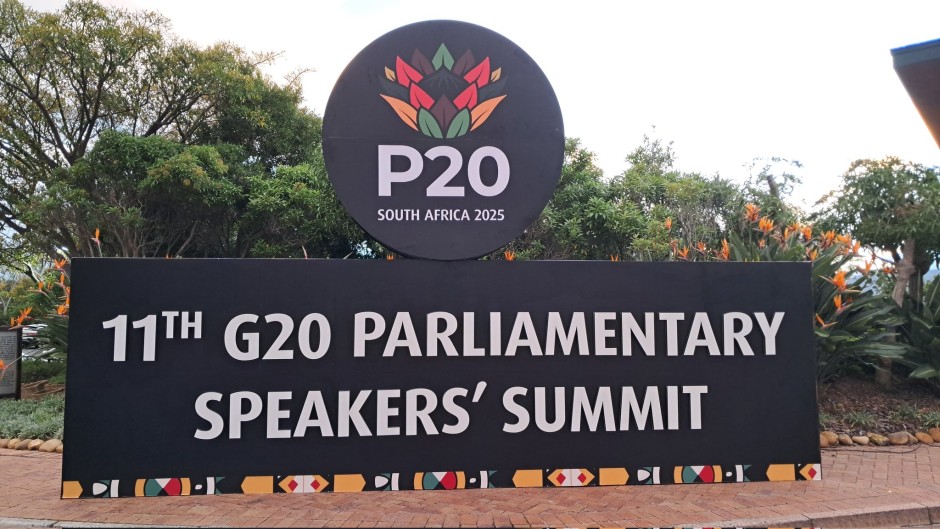
P20 South Africa 11th G20 parliamentary speakers summit logo
KLEINMOND - In a powerful demonstration of solidarity, the 11th G20 Parliamentary Speakers' Summit (P20) concluded on 3 October with the adoption of a joint statement that sets an ambitious legislative agenda for tackling the world's most pressing challenges.
The summit, held under the theme “Harnessing Parliamentary Diplomacy for the Realisation of Global Solidarity, Equality and Sustainability” saw leaders of the world's most powerful legislatures commit to urgent action on climate change, debt relief for developing nations, and a just global energy transition.
The closing ceremony in coastal Kleinmond, in the Western Cape, featured a symbolic handover of the P20 presidency from the Parliament of South Africa to the Congress of the United States, which will host the summit in 2026.
The joint statement will be formally communicated to G20 heads of state, ensuring that the perspectives of national parliaments directly influence the executive decisions at the upcoming G20 Leaders' Summit.
A Parliamentary Blueprint For Global Action
The 58-point joint statement serves as a detailed roadmap, reflecting days of intense deliberation.
The agreements reached are designed to be translated into national law, budgets and oversight mechanisms, moving international diplomacy from commitment to concrete implementation.
1. Unwavering Commitment to Climate Action and Disaster Resilience
Ahead of COP30 in Brazil, legislators pledged to intensify climate action efforts by engaging in global cooperation, participating in climate activities, and promoting the submission of more ambitious nationally determined contributions.
The joint statement "affirms the United Nations Framework Convention on Climate Change and its Paris Agreement as the primary mechanism for the collective, multilateral response to climate change", firmly backing a rules-based international approach.
It emphasises the need for accelerated action to limit global warming to 1.5°C, grounded in equity and the principle of common but differentiated responsibilities.
Crucially, it calls for the "faithful, balanced and comprehensive implementation" of existing climate agreements and welcomes the decisions of COP29, specifically calling for the "full operationalisation of the fund for responding to loss and damage".
It also highlights the disproportionate impact of climate change on vulnerable populations and stresses the importance of "gender-responsive disaster risk reduction strategies".
2. Overhauling Global Finance and Tackling the Debt Crisis
In one of the summit's most substantive sections, legislators sounded the alarm on the global debt crisis, recognising that unsustainable debt remains one of the most pressing structural challenges facing economies across all regions.
The statement calls on the G20 to address debt vulnerabilities "effectively, comprehensively and systematically", and highlights the "urgent need for multilateral development bank reforms".
It urges the swift implementation of reforms advanced during the Indian and Brazilian G20 presidencies to enhance concessional finance and blended capital.
To ensure accountability, parliaments committed to strengthening oversight of public debt through "enhanced transparency and accountability mechanisms and regular debt sustainability assessments."
They further underscored the "need for enhancing the representation and voice of developing countries" in international financial institutions.
3. Driving a Just and Equitable Energy Transition
Acknowledging that Africa is at the centre of the global energy transition agenda, the P20 dedicated significant attention to ensuring this shift is fair.
The statement notes that despite vast renewable potential, Africa receives a "disproportionately low share of energy investment".
It calls on G20 members to "work in partnership with Africa for the mobilisation of Africa's vast renewable energy potential", with a focus on rural and marginalised communities.
The declaration encourages investment in regional power pools, local supply chains, and clean manufacturing.
In an acknowledgment of different national circumstances, the statement resolves that "investing in transitional fuels may facilitate energy transitions, while ensuring energy security", a crucial point for many developing nations.
It also mandates a focus on including women and youth, who are disproportionately affected by energy poverty.
4. Harnessing Critical Minerals for Sustainable Development
Recognising that developing countries hold significant minerals reserves essential for the energy transition, the summit advocated for these nations to reap more significant benefits.
It supported the development of the G20 Critical Minerals Framework to promote sustainable and reliable value chains.
It further advocated for policies that support "expanded local processing, job creation and industrial development" in resource-rich countries, name-checking initiatives like the Africa Green Industrialisation Initiative and Africa's Green Minerals Strategy.
5. Reinforcing Sustainable Development and Human Rights
The joint statement also reaffirmed strong support for the full implementation of the 2030 Agenda for Sustainable Development and the Pact for the Future.
It pledged to align legislation with international human rights commitments and promote "gender-sensitive budgeting and the equitable representation of women, youth and people in vulnerable situations".
Legislators also reaffirmed their commitment from previous summits to "promote and harness artificial intelligence responsibly for the public good", while bridging digital divides.
Handover and a Call for Accountability
In her closing remarks, National Assembly Speaker Thoko Didiza emphasised the critical role parliaments play.
"Through our core responsibilities of representation, lawmaking, budgeting and oversight, we are uniquely positioned to advance the shared objectives outlined in this joint statement," she said.
"We pass the baton to the United States with a clear mandate for continued action."
The US delegation accepted the responsibility with the commitment that the 2026 P20 Summit would build upon the substantial foundation laid by South Africa.
The true test of the Kleinmond summit's success will now unfold in the chambers of parliaments all around the world, as legislators return home to convert ambitious declarations into national laws, budgetary allocations, and rigorous government oversight.