
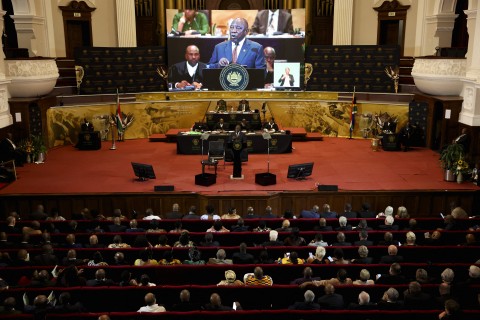
South African President Cyril Ramaphosa (C) delivers his 2023 state-of-the-nation address (SONA) at the Cape Town City Hall in Cape Town on February 9, 2023.
JOHANNESBURG - The upcoming national convention represents a water-shed moment for South Africa’s young democracy. Consequently, the impact of its success or failures will linger with us for generations.
This convention, a precursor to the National Dialogue, presents an opportunity for South Africans to have a say on what they think should be the country’s developmental trajectory. It presents an opportunity for South Africans to outline the details of certain norms and values that must be universally agreed to, by the people of South Africa.
Therefore, it is very important for us to pen down some of the issues that need to be addressed, as the national convention sets the agenda for the National Dialogue:
Firstly, we need a new social contract or compact between the people and our government. The trust deficit between government and citizens has been laid bare for all of us to see. We, therefore, need an agenda on the characteristics of governance that the people want from their leaders.
READ: President confirms date for national dialogue convention
Communities need ward councillors and Parliamentary Constituent Offices to start working with the people to raise issues at the highest echelons of government. We currently have an elite group of councillors who only listen to their constituencies only during times of elections or if they need the people to do something for them – something they call ‘mobilising communities’ for protests etc. We have a self-serving elite that listen only to themselves and ward councillors who have moved out of their wards to better places, at the expense of their constituents.

Furthermore, we need a universally agreed moral regeneration. Our society has lost all sense of what is morally right or wrong, or plainly put they have negated all forms of morality. The burgeoning criminal networks that have more disposable income than your highest performing academics, the rise of open prostitution on social media and other platforms and the ever-diminishing lack of proper role models in our communities, have all contributed to the moral degeneration of our society.
Neighbourhoods where street corners have been turned into drug dens and drug lords and criminals are celebrated more than exemplary police officers, teachers and doctors. We need to question the moral fibre of community members.
The people of South Africa need to define their own set of moral values that will deal decisively with these issues, that remain a scourge of our society. The situation has gotten so out of hand, to the extent that police officers like Lieutenant-General Nhlanhla Mkhwanazi have become whistleblowers themselves, instead of protecting those who blow the whistle on wrongdoing.
These are symptoms of a morally deficient country, which must define its path to morality urgently. And this path will be a painful one, but necessary for our multidimensional moral regeneration.

KZN Police Commissioner Nhlanhla Mkhwanazi
Additionally, we need the people of South Africa to define what they want their foreign policy to look like. Albeit that this is the prerogative – solely – of the president according to our constitution, we need South Africans to define their own foreign policy and interests.
The national convention will serve as a great platform for such crucial matters to be discussed, even if they require a constitutional amendment, that will define what South Africa wants to achieve on the international front. To get an idea of why this needs to happen, one only just needs to look at the Government of National Unity as society in microcosm.
READ: Government of National Unity | A year of the 'unity project'
On the questions of Israel, Saharawi and the United States, members of the GNU hold different positions on each of these states. For example, the ANC’s position on Israel is that we should support the Palestinian struggles and raise awareness. Contrary to the ANC, the DA and PA have all come out in full support of Israel and called for the normalisation of relations between the two countries.
There are of course two sides to every situation, and my aim is not to choose sides. But such a stalemate between the parties surely warrants the need for the national dialogue to discuss – as official policy – the direction the state should take with regards to actions needed to be taken, to bring about peace in that region. These need to be part of the agenda because we have been spending millions of rand on the genocide case without clearly listening to what South Africans need.
South Africans might say that they do not want the demonisation of Israel. In the same vein, they may call for intensification of the demonisation agenda against Israel and even Morocco (In the case of the Saharawi people).
The crux of the matter is that the country’s foreign policy has always been what the ANC thinks is ‘good’ for us. Especially to those who supported the liberation movement during the struggle against apartheid. Therefore, the ANC government must retain the favour.
Although we are all against Human Rights violations, we must do so with the knowledge that the people of South Africa are fully behind the decisions. A decision, in the case of Israel, has been very polarising in nature. You have religious leaders who pledge allegiance to Israel without necessarily conforming to government official policy. This is symptomatic of a society that is not in sync with itself. Therefore, we need that on the agenda for the sake of synchronicity.
Lastly, the national dialogue must be “National” in character and in form. It must not be another elite talk shop which speaks for the people without the people. From the days of CODESA to date, our country has suffered the tyranny of the ‘clever’ elite who decide what the people want without truly listening.
By: Nkateko Muloiwa
*Muloiwa holds a Masters of Arts in Political Studies and is currently enrolled for an MSc in Science Communication at the University of the Witwatersrand, Johannesburg.