
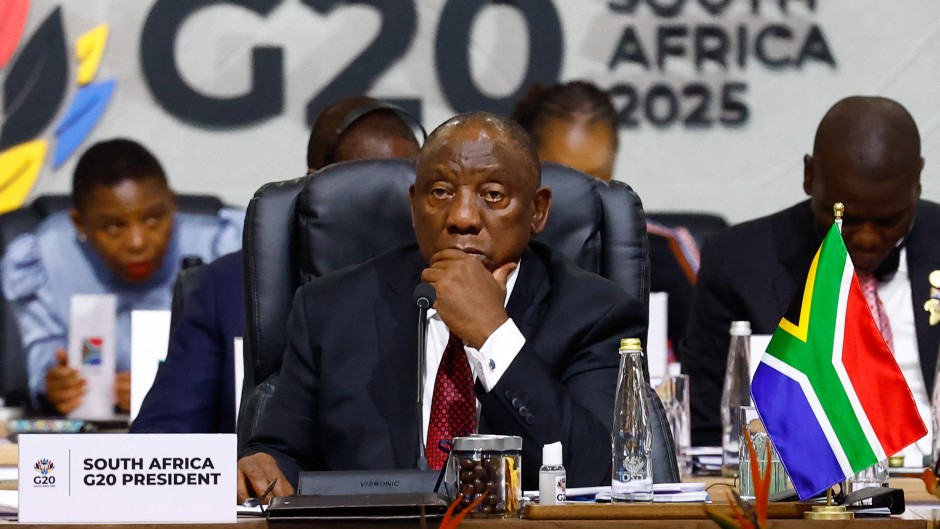
President Cyril Ramaphosa attends a G20 Leaders' Summit plenary session at the Nasrec Expo Centre in Johannesburg on November 22, 2025.
JOHANNESBURG - Two South African presidents, living in different times and different political dispensations, uttering the same message: South Africa’s problems must be solved by South Africans.
The two presidents are PW Botha, the second-last apartheid president and Cyril Ramaphosa, South Africa’s fifth democratic leader.
Botha made the comment in a speech he delivered at the opening of the National Party Natal Congress in Durban on August 15, 1985.
At the time it was a speech that was keenly awaited. Speculation was rife that Botha would announce decisive action to end apartheid. He did nothing of the sort. Instead, he defended white minority rule.
He also rejected foreign involvement in what he saw as South African issues.
“South Africa's problems will be solved by South Africans and not by foreigners,” he said.
It was a defining moment for the country and in the months that followed, South Africa became increasingly isolated.
Botha’s own health subsequently deteriorated, and he was eventually forced to resign.
The man who replaced him five years later, FW de Klerk, implemented the changes Botha was expected to make and went on to win a Nobel Peace Prize.
Botha’s speech was a missed opportunity from which there was no going back. It became known as the “Rubicon” speech.
The phrase “crossing the Rubicon” originated during the times of Julius Caesar.
About 50 years before the date Christians believe Jesus Christ was born, Caesar crossed a shallow river in northeastern Italy called the Rubicon. He did so with soldiers, something which, at the time, was prohibited. It was a point of no return.
However, for Caesar, it turned out well. The crossing kick-started the Roman civil war which led to Caesar becoming a dictator for life.
Fast forward to November 2025, where President Cyril Ramaphosa has now also “crossed the Rubicon”.
Addressing the nation on Sunday night, he made it clear that the relationship between South Africa and the United States of America had passed the point of no return – not with ordinary Americans but with the administration of Donald Trump.
Relations between the two countries became frosty soon after Trump took office earlier this year.
Trump claims there is a genocide against white South Africans – an allegation that is widely accepted as baseless. He has also criticised South Africa’s move to take Israel to the International Court of Justice on the basis that the Jewish state is committing genocide in Gaza.
As relations spiralled, in March this year, Ebrahim Rasool, South Africa’s ambassador to the US, was expelled.
Two months later, Ramaphosa was invited to the White House, where attempts were made to embarrass him.
More recently, Trump decided to boycott the G20 Leaders’ Summit in Johannesburg.
Ramaphosa described the boycott as “regrettable” and said it was founded on allegations that were “baseless and false.”
“Despite the challenges and misunderstandings that have arisen, South Africa remains a firm and unwavering friend of the American people,” said Ramaphosa. “We offer the people of the United States nothing but goodwill and friendship.”
Ramaphosa kept the door open to improving relations with the Trump administration.
“We affirm our commitment to continue to engage in dialogue with the United States government, and to do so with respect and with dignity as equal sovereign countries.”
However, given all that has transpired, it is unlikely Ramaphosa’s comments will be met with anything but disdain among Trump’s inner circle.
Ramaphosa took aim at those groups and individuals within the country who have shaped the mindset of the current US administration.
“These people who are spreading disinformation are endangering and undermining South Africa’s national interests, destroying South African jobs and weakening our country’s relations with one of our most important partners.
“We must remind these people that South Africa is a constitutional democracy, with a Bill of Rights that guarantees equality under the law.
“We have an independent judiciary, able to uphold our Constitution and defend the rights of all South Africans.”
And then came the line that echoed what PW Both had said 40 years ago: “South African problems must be solved by South Africans themselves.”
The similarity between the two statements is striking. Botha opposed foreigners getting involved in the anti-apartheid struggle. And Ramaphosa opposed foreign involvement in, among other issues, the struggle against Black Economic Empowerment.
Ironically, both Botha and Ramaphosa were beneficiaries of the very policies they sought to defend.
There is, however, an important difference.
Botha did not have a plan that would have allowed South Africans of all races to solve the problems of the time. Ramaphosa, on the other hand, has the National Dialogue.
As he pointed out: “… all South Africans – from all walks of life, of all races and creeds – are invited to forge a new future for our country.”
He extended an invitation to those who feel most aggrieved.
“We invite those who are spreading misinformation about our country to bring their concerns – and their solutions – to the National Dialogue.”
An initial convention was held in August this year. Next, public dialogues will be held throughout the country, culminating in a second national convention during next year.
However imperfect the National Dialogue may be, it is an opportunity that must not be missed. It provides a platform for ordinary South Africans to not only list their grievances but also suggest solutions. It is South Africa's best opportunity to cross the Rubicon.
- Aakash Bramdeo is the Economics and Politics Editor at eNCA.