
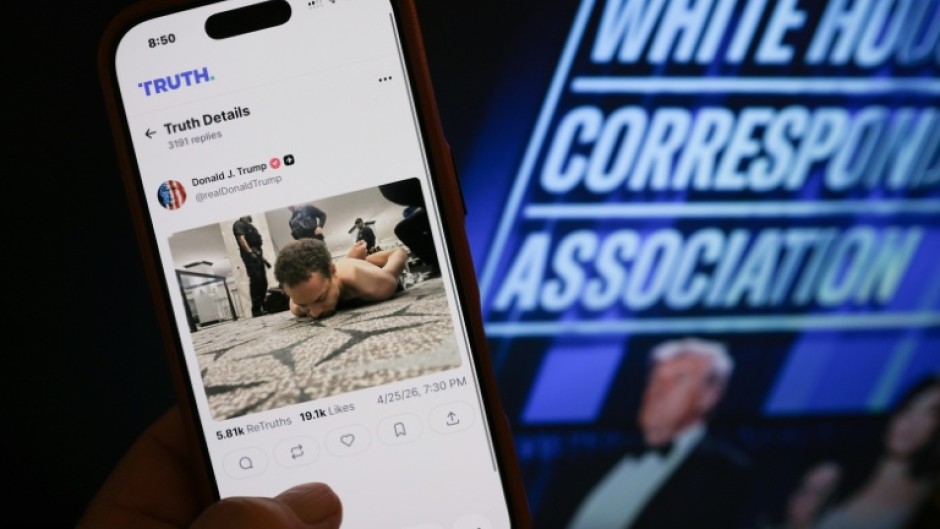
WASHINGTON - A flood of misinformation exploded online after US President Donald Trump escaped a weekend shooting scare, fueling renewed -- and unfounded -- claims that he has staged assassination attempts to boost his political fortunes.
Trump and his top administration officials were evacuated Saturday from a media gala in Washington after gunfire erupted outside the ballroom, marking the third assassination attempt targeting the Republican in two years.
AFP's fact-checkers identified a series of social media posts from anti-Trump accounts circulating an unsubstantiated theory that the White House staged the shooting to distract attention from unfavourable news, including the unpopular US-Israeli war with Iran.
Posts advancing the claim garnered 80 million views on Elon Musk's platform X alone within two days of the shooting, according to the disinformation watchdog NewsGuard.
Many of the same accounts previously claimed that two assassination attempts on Trump in 2024 -- in Pennsylvania and Florida -- were also staged.
The narrative largely emanated from a left-wing conspiracy movement that researchers call "BlueAnon," a play on the right-wing QAnon cult.
"Many of the anti-Trump accounts baselessly claiming that the WHCD (White House Correspondents' Dinner) shooting was staged made identical claims after the 2024 assassination attempts," NewsGuard's Sofia Rubinson told AFP.
"Some viral posts we've seen explicitly cite those earlier incidents as 'evidence' that staging shootings is part of Trump's playbook -- to generate sympathy and distract from unfavourable coverage."
- 'Cult of hatred' -
Fast-developing breaking news events such as shootings often trigger a frantic search for new information on social media, frequently allowing falsehoods to spread and intensifying online confusion.
There is no evidence that the Trump administration orchestrated Saturday's attack.
The White House on Monday blamed what it called a "left-wing cult of hatred" for the shooting and a 31-year-old suspect, Cole Allen, faces a potential life sentence if convicted of attempting to kill Trump.
Following Saturday's shooting, state media in US adversaries -- Russia and Iran -- amplified further conspiracy theories, including claims that the attacker had ties to the Israeli military, according to the London-based Institute for Strategic Dialogue.
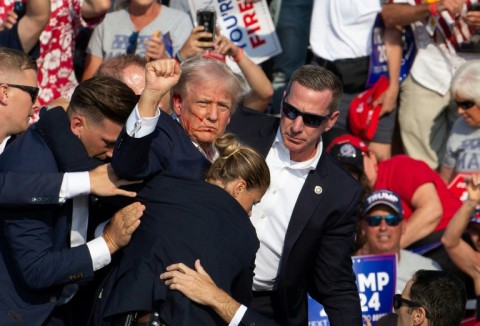
In recent weeks, a growing number of MAGA influencers -- shorthand for Trump's "Make America Great Again" slogan -- have also promoted the conspiracy theory that the Republican had staged the 2024 assassination attempt at a Pennsylvania campaign rally.
The trend underscores how Americans on both sides of the political divide are prone to outlandish conspiracy theories, as many turn to partisan influencers for information amid mistrust of mainstream media, researchers say.
- 'Monetisation' -
"The staged assassination conspiracy theory has advocates on the left, particularly among liberal content creators. It's also starting to take off on the right as they lose faith in Trump," Mike Rothschild, a researcher who studies conspiracy theories, told AFP.
"The theory casts him (Trump) as a master manipulator," he said. "And it uses as 'evidence' either misconceptions, other viral videos, or things that people have just made up."
The theory has gained traction as Trump faces backlash from Americans across the political spectrum -- including segments of his MAGA supporters -- over the war with Iran, which has driven up oil prices and raised concerns about American casualties.
The military campaign has laid bare divisions within Trump's political base, with even longtime conservative supporters -- such as former Fox News host Tucker Carlson -- condemning the Republican's departure from his non-interventionist policy.
The conspiracy theory continues to spread largely unchecked online, as many tech platforms have scaled back content moderation efforts that were once used to curb disinformation.
Influencers are often incentivised to amplify sensational rumours, which can attract followers and increase earnings on revenue-sharing platforms like X.
"The more irresistible the claim the better in terms of the business of political commentary. The actual politics of a party is now secondary to the monetisation of the political brand," Walter Scheirer of the University of Notre Dame told AFP.
"In the long run, this likely does weaken Trump's base."
by Anuj Chopra (AFP)