
PARIS - The UN's annual climate conference is facing mounting calls for reform as it struggles to keep pace with a worsening climate crisis after three decades of hard-fought agreements.
The Conference of the Parties (COP), which brings together nearly 200 countries every year, has delivered some landmark pacts in the recent past.
But it is now facing questions about its future, with France's ecological transition minister Monique Barbut warning of COP "fatigue".
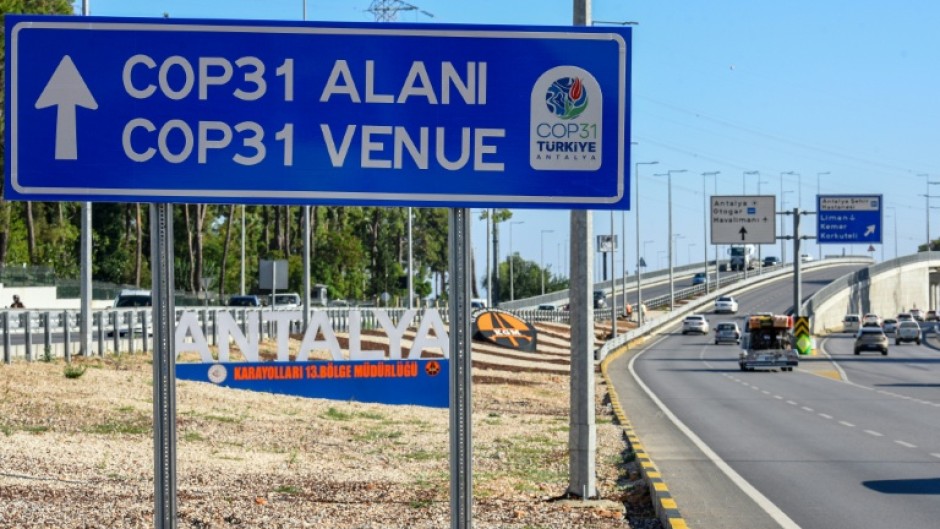
No groundbreaking announcements are expected when Turkey opens the next two-week conference, COP31, on Monday.
That follows a modest outcome at last year's summit in Brazil, where countries failed to include an explicit mention of fossil fuels -- the main cause of global warming -- in the final text.
It is a far cry from some of the major agreements of the recent past.
Nations agreed to limit warming to well below 2C in the Paris Agreement in 2015 while striving for a safer 1.5C.
Just three years ago at COP28 in Dubai, the world pledged for the first time to transition away from fossil fuels.
But the UN warned in September that the 1.5C target would be missed while carbon emissions from burning fossil fuels remained around record highs in 2025.
Since the historic pledge in Dubai, fossil fuel-producing countries have used the COP's agreement-by-consensus system to block further progress on phasing out the polluting commodities.
Climate diplomacy has also lost the United States, the world's biggest economy and second-biggest polluter, which walked away from the process under President Donald Trump, who calls global warming a "hoax".
- 'Designed to fail' -
Now there are calls to overhaul COPs, from holding the formal summit every two years to making it a smaller affair or getting rid of the consensus-based system of decision-making.
Panama's Environment Minister Juan Carlos Navarro said last week that the consensus-based rules allow "one idiot" to block agreement at COP summits and should be replaced by a majority vote.
"COPs have been designed to fail," he told AFP.
In 2023 the Club of Rome, an international think tank of former heads of state, business leaders and scientists, published an open letter calling for an "urgent reform of the COP process".
The manifesto pointed out that the consensus-based COP structure was "predisposed to incremental progress", noting for example that it took seven years for the climate "loss and damage" fund to finally be agreed in 2022.
"This lethargic progress is at odds with climate science and real-world climate damage and risks," the letter said.
The signatories included former UN secretary general Ban Ki-moon, former Irish president and UN special envoy for climate change Mary Robinson and Laurence Tubiana, the architect of the Paris Agreement.
"Part of the reason COPs are running out of steam is that there are too many of them," Barbut said.
"COPs are not simply conferences. They are legal bodies. For them to have meaning, there must be substantive legal issues to discuss," she said.
Barbut suggested that COPs could be held every two years. An annual gathering could still be held, she said, but under a different status.
The UN's other environment-related summits, the biodiversity and desertification COPs, are held every two years.
- Era of 'implementation' -
Others suggested that action can be taken by groups of countries outside the COP system.
While COP30 ended with a watered-down text, Brazil offered to create a voluntary "roadmap" on transitioning away from fossil fuels.
Countries that wanted to advance the issue subsequently gathered in Colombia in April this year for a separate conference, outside the UN framework.
Cosima Cassel, an analyst at climate think E3G, said COP31 should build on the "dual-track" model that emerged at COP30.
The formal consensus-based negotiations would "remain essential to provide direction, establish commitments and create a space for countries to collectively identify and overcome barriers", she said.
Alongside this, there would be an "action agenda" bringing together countries and other groups willing to move ahead on specific issues.
Turkey is heavily promoting such an action agenda for COP31, pushing countries to join an "electrification" pledge.
UN climate chief Simon Stiell said in February that climate diplomacy had entered a new era that he billed as "implementation" -- meaning countries must apply the decisions that have been made at COPs.
"We must continue to evolve our own work for this new era," he said in a speech in Istanbul.
- by Julien Mivielle (AFP)