
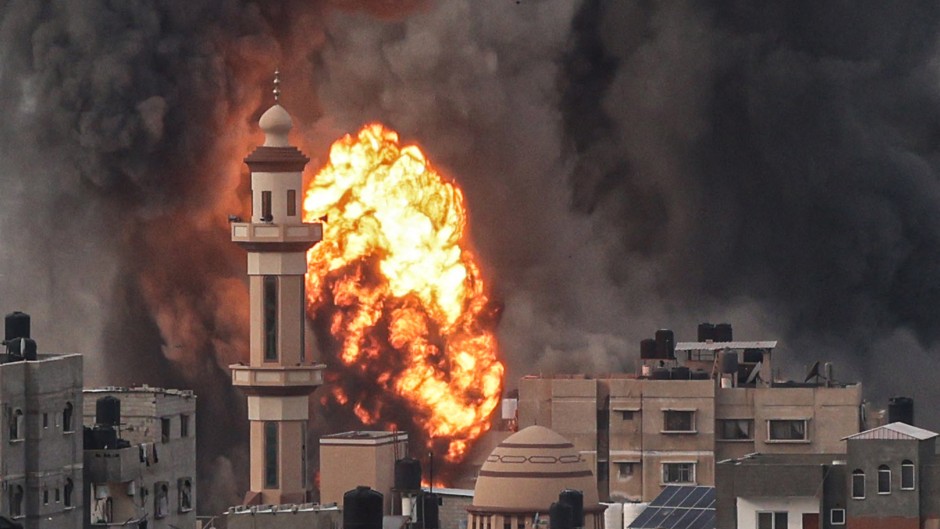
File: A fireball erupts after Israeli strike over Rafah in the southern Gaza Strip on December 20, 2023, amid ongoing battles between Israel and the Palestinian militant group Hamas.
JOHANNESBURG - There is a particular kind of numbness that settles in when you consume enough war coverage.
The alerts, the maps, the missile trajectories as they arrive packaged with the kinetic drama of modern conflict.
Rockets arching through night skies. Iron Dome interceptions lighting up like fireworks over Tel Aviv. Generals issuing communiqués. World leaders issuing condemnations.
And then, silence: a silence that swallows the ones who suffer most and whose stories are rarely told in full: the children, the women, the differently abled, the perpetually displaced. These are the people for whom war is not a geopolitical chess match but an irreversible rupture in the fabric of their lives.
For far too long, the Israel-Palestine conflict, and the wider theatre of violence that now encompasses Iran's proxy networks, the battered north of Israel, and the rubble of Gaza, has been reported and consumed through a binary lens.
The "bad guys versus the good guys." The axis of resistance versus the forces of civilisation, or vice versa, depending on which channel you watch, which algorithm curates your feed, which political tradition shapes your outrage. This framing is not only intellectually dishonest; it is morally catastrophic. It reduces human suffering to a scoreboard and conditions us to see innocent lives as acceptable collateral.
I saw the cruelty of Kibbutz Kfar Aza first-hand, where the bodies of residents were found in their homes, proof, if any was needed, that October 7, 2023, was not a military operation but a massacre. A man called Nirel Zini had been beheaded, his head still unaccounted for. These were not combatants. They were farmers, teachers, parents, people who had built a cooperative community within sight of the Gaza border.
Among the most haunting stories to appear from that day was that of Abigail Mor Edan. A three-year-old girl who saw the murder of her parents and was then taken hostage into Gaza for fifty days, turning four years old in captivity, with no parent to blow out her candles, no one to console her nightmares. She was eventually released in November 2023 as the first American hostage freed by Hamas, but she returned to a world without her mother and father. What the long-term psychological consequences of that trauma will be, her family admits they do not yet know.
Yet even as we grieve Abigail's story, we must stand at Sderot (that battered Israeli border town) and look across toward Beit Hanoun.
What you see on the Gaza side is a ghost of a city. Palestinian municipal authorities declared it a "disaster area" in June 2024, with aerial and ground operations having destroyed an estimated 50,000 housing units across northern Gaza alone, obliterating roads, drainage networks, schools, and water wells. The buildings that once sheltered families, where children slept, where women cooked, where men argued about football, have been reduced to grey rubble, floor upon floor compressed into the earth. A generation of Palestinian children has been displaced, their futures vaporised.
The West Bank tells yet another chapter of this unfolding tragedy. Thousands of children in the West Bank were unable to attend school, facing checkpoints, violence and restricted movement. Since the war intensified, a World Vision report revealed that 74 percent of households in the West Bank now live below the minimum standard of living, a catastrophic leap from 21 percent just two years prior, with 70 percent of children skipping meals regularly, and school dropout rates rising sharply. When visitors pass through certain communities, children chant "Free Palestine", not as a rehearsed slogan, but as the only language available to them to name the conditions in which they are trapped: the ghettos of occupation and poverty that have shaped every waking hour of their young lives.
There is something quietly remarkable, however, about the communities in the West Bank who have openly rejected the violence of Hamas and chosen unarmed, dignified resistance. They deserve far more recognition than they receive. Their courage deserves to be the template, not the footnote.
Even Yasser Arafat, for all the contradictions of his leadership, understood at critical junctures the danger of allowing external theocratic forces to commandeer the Palestinian cause, navigating the fraught relationship between Fatah and Iran with a degree of pragmatism that looked to preserve Palestinian political autonomy. The PLO's struggle, at its most coherent, was always national, not theological. That distinction matters enormously today.
Iran's continued fuelling of armed factions (Hezbollah in the north, Hamas in Gaza) does not liberate Palestinians; it prolongs their suffering while serving Tehran's regional ambitions at the cost of ordinary lives on both sides of the border.
Every rocket fired from southern Lebanon into northern Israel is also a decision that Palestinian children in Rafah will go another week without a functioning hospital. Every escalation engineered in proxy corridors from Tehran to Beirut to Gaza is a deliberate choice to trade civilian lives, Palestinian, Israeli, Lebanese, for ideological leverage. The architects of this violence are never the ones burying their children.
What we need today is not another ceasefire document, not another UN resolution that gathers dust in Geneva. We need a new social contract. A global, moral renegotiation of what it means to be human in the presence of suffering. This contract demands that we stop constructing hierarchies of deserving victims. Abigail Edan's trauma and the nameless child in Beit Hanoun's rubble are not competitors for our sympathy. Their pain speaks the same language, uttered in different accents. A moral framework worthy of the name cannot mourn one and ignore the other. It cannot celebrate rocket interceptions without asking who is left alive in the wreckage the rockets intended to reach.
The two-state solution is not a utopian dream. It is the bare minimum requirement of justice. It will not be achieved through rockets or bombardments, through hostage-taking or collective punishment.
It will be achieved when the international community finds the political will to enforce it, when regional actors stop weaponising Palestinian suffering for their own geopolitical ends, and when we finally decide, collectively and unequivocally, that the children on both sides of every fence matter more than the ideologies that built the fences. Until then, we are failing the most fundamental test of our shared humanity.
The contract has been broken. It is time to write a new one.
- by Nkateko Muloiwa