
JOHANNESBURG - A couple of weeks ago, the complex where I live relocated its communal bins to an enclosed area for all residents, citing non-compliance.
For most people, this might seem like an ordinary inconvenience. For me, as a young woman who lives alone, the walk to that enclosed area has become something else entirely: a calculation of risk.
Yes, it is next to the security house. Yes, there are supposed to be people nearby. I should feel safe.
But being a South African woman has taught me that proximity to security does not necessarily mean safety.
That is the reality we live with.
When you put on your walking shoes in the afternoon to get some exercise, there is a possibility, however much you try not to think about it, that you may never come home.
When you climb into an e-hailing vehicle, you share your live location with family and friends and hope you arrive safely.
When you encounter a man while walking alone, you instinctively assess him. You pray he is not dangerous. You hope he will simply pass you by and leave you unharmed.
Even the most mundane errands carry an invisible threat. You can go to the post office and never return home.
This is what it means to be a woman in South Africa.
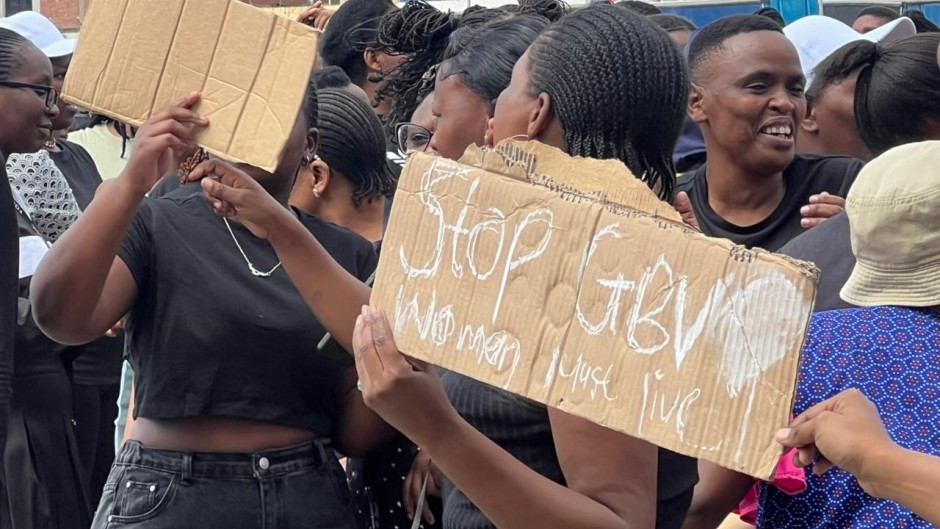
We have begged. We have cried. We have protested. We have dressed in black and mourned our murdered sisters. We have changed our profile pictures to purple. We have spoken until our voices have cracked, demanding that the violence against women and children be treated with the urgency it deserves.
And still, women are raped. Women are murdered. Women disappear.
Sometimes their bodies are found. Sometimes they are not.
The disappearance of Kempton Park runner Elizabeth “Tsontso” Moselakgomo has kicked us in the gut once again. She went for a run and never came home, leaving behind her eight-year-old daughter.
A run.
Something as ordinary as putting on your running shoes, stepping outside and moving your body has become an act that can carry a death sentence.
So where, exactly, is it safe for women in South Africa?
How many more bodies must be buried before government stops being reactive and starts preventing these deaths?
How many more families must be shattered before the safety of women becomes more than a statement, a campaign or a declaration?
How long are we expected to live with our heads on a swivel, watching our backs in a country that is failing to protect its women?
And we have to ask the question we are so often forced to ask: Who must die before this is taken seriously?
Was the blood of Uyinene Mrwetyana not enough?
Was Kirsten Kluyts not enough?
Was Olorato Mongale not enough?
Was Machaka Radebe not enough?
Every name is a woman who should still be here. Every name is a family forced to live with an absence that can never be filled.
It felt like a victory when gender-based violence was declared a national disaster. For a moment, there was hope that the language of crisis would finally be matched by the urgency of action.
But declaring GBV a national disaster cannot become an end in itself.
The language of disaster management has been summoned to confront a scourge that tears through families, communities and the constitutional fabric that binds this country together. Yet a declaration without implementation is only a promise in the wind.
Women do not need another promise.
We need action that is lawful, coordinated, measurable and sustained. We need accountability. We need prevention. We need a state that does not wait for another woman to disappear before asking what went wrong.
Because the question is no longer whether South African women are afraid.
We are.
The question is how much more fear, grief and blood this country expects us to endure before our safety is treated as a national priority.
I should not have to be afraid of walking to the bins.
A woman should not have to be afraid of going for a run.
A child should not have to wait for a mother who will never come home.
We should not have to live like this.
- Nokuthula Khanyile is a Web/App producer for eNCA