
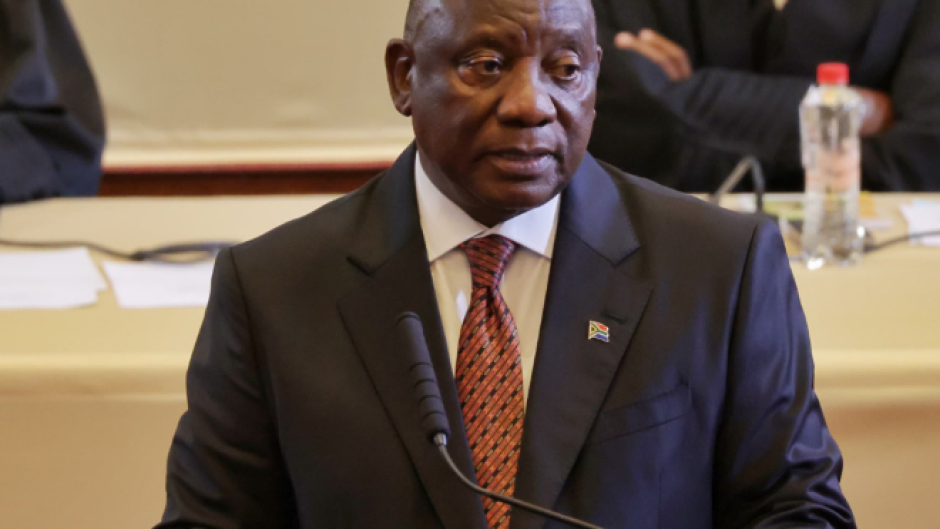
President Cyril Ramaphosa delivers the State of the Nation Address. GCIS
JOHANNESBURG - As has become tradition, President Cyril Ramaphosa’s State of the Nation Address (SONA) follows closely on the ANC National Executive Committee meeting and the cabinet lekgotla.
While these processes shape the broader political environment, the speech itself remains the president’s own -- not a product of Government of National Unity (GNU) negotiations, unlike the more contested Budget process seen last year.
Historically, SONA speeches are broad in scope and light on detail, outlining government priorities rather than unpacking specific policy interventions. This often leaves opposition parties and the media dissatisfied, and this year is unlikely to be different. Detailed policy announcements are typically deferred to the Finance Minister’s Budget Speech.
The parameters of the address are largely defined by the Medium-Term Budget Policy Statement and the Medium-Term Development Plan (2024–2029).
Within this framework, Ramaphosa is expected to reaffirm Operation Vulindlela as the centrepiece of government’s reform agenda.
The programme focuses on infrastructure reform and revitalising network industries such as Eskom, Transnet, PRASA and the water sector.
Public-private partnerships are likely to feature prominently again, with the president expected to highlight perceived gains in renewable energy, urban rail systems and freight logistics as examples of progress through collaboration between the state and the private sector.
Local government is expected to receive particular attention, especially ahead of upcoming elections.
Service delivery failures, infrastructure decay, corruption, skills shortages and the instability of coalition governments are likely to be emphasised.
There is also a strong possibility that Ramaphosa will signal tighter regulation of coalition governance — a reform that has been under discussion for some time.
As in previous years, the economy will form the backbone of the address.
Job creation, inequality and black economic empowerment are expected to dominate the narrative, alongside cautious optimism about early signs of economic improvement.
At the same time, the president is likely to acknowledge global uncertainties, including potential risks linked to South Africa’s trade relationship with the United States.
SONA traditionally touches on all major government portfolios, highlighting key developments and achievements. While occasional announcements may be included, major policy breakthroughs are unlikely.
The speech is also expected to conclude with a reaffirmation of South Africa’s foreign policy stance.
Ramaphosa is likely to reiterate commitments to non-alignment, multilateralism, cooperation within the Global South, African solidarity, free trade and the African Continental Free Trade Area. Continued expressions of solidarity with Palestine, Western Sahara, Cuba and Venezuela are also anticipated.
Ultimately, dramatic surprises are unlikely. Ramaphosa has consistently approached SONA with caution, and he is expected to avoid controversial positions on sensitive issues such as employment equity, black economic empowerment, land expropriation and the National Health Insurance (NHI).
- Professor Dirk Kotze is from the Department of Political Sciences at Unisa